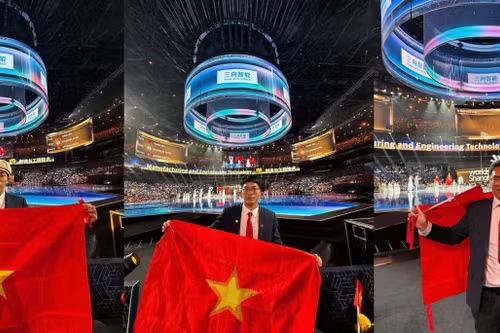

The introduction of artificial intelligence (AI) into schools was piloted during the 2025-2026 academic year, with nationwide implementation planned from the 2026-2027 academic year. Looking back on this journey, the biggest question currently facing the education sector is no longer “should AI be taught?”, but rather how to teach and learn so that learners can truly master the technology.

In the school environment, academic results and examinations remain familiar measures for students. However, behind every transcript are values reflected through creativity, spatial thinking, musical talent, physical agility and the ability to connect with the community.
The 2026 Vietnamese-Chinese Student Exchange Programme, themed “Connecting knowledge, shaping the future,” took place on September 11 and 12 at Lao Cai College in Lao Cai Province.
The presence of international students from different countries provides fresh impetus for educational institutions to innovate, improve quality, and develop their own distinctive strengths, thereby enabling them to engage more deeply with the global education landscape.

Politburo member and Secretary of the Communist Party of Viet Nam (CPV) Central Committee Nguyen Duy Ngoc, who is also Chairman of the Party Central Committee’s Commission for Organisation, held a working session with Russian Deputy Prime Minister Dmitry Chernyshenko on September 9 to discuss new directions for bilateral cooperation in science and education.
From the 2026-2027 academic year, the country’s public education system will have an additional network of People’s Public Security Cultural Schools, managed by provincial-level police forces and operating as specialised boarding schools.
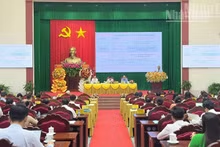
On the morning of September 9, the Vinh Long Provincial Party Committee, People’s Council, People’s Committee and Viet Nam Fatherland Front Committee organised a workshop to solicit feedback on the draft Resolution of the Provincial Party Committee on the development of high-quality human resources in Vinh Long province for the 2025-2030 period, with a vision to 2045.
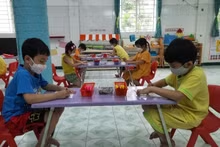
The Ho Chi Minh City People’s Committee has issued a document to pilot an integrated English education programme for preschool children across the city from the 2026–2027 academic year.
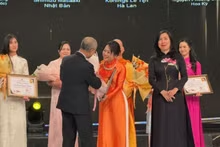
Nguyen Thi Lien Huong, a lecturer at National Taiwan University (NTU) in Taiwan (China), has been honoured as one of eight Vietnamese Language Ambassadors Abroad 2026 on the occasion of the Day honouring Vietnamese language among overseas Vietnamese communities (September 8).
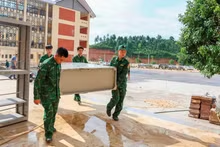
Thanks to the determined efforts of authorities and sectors at all levels, many multi-level boarding schools in mainland border communes have been completed ahead of the 2026-2027 academic year.
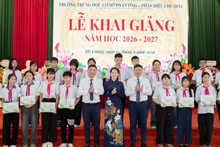
On the occasion of the opening of the 2026-2027 academic year, the National Fund for Vietnamese Children (NFVC) under the Ministry of Health, in coordination with the Joint Stock Commercial Bank for Foreign Trade of Viet Nam (Vietcombank), organised a programme to present the “Green Library: Sharing Knowledge - Building a Strong Future” and “Moving Forward Together” scholarships to students facing difficult circumstances in Hy Cuong Commune, Phu Tho Province.
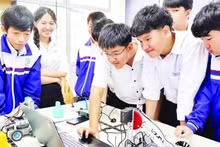
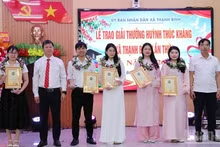
Over the past period, the quality of education and training nationwide has undergone many positive changes and achieved impressive results. Contributing to these achievements, the noble role and mission of generations of teachers cannot be overlooked.
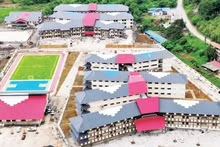
The opening of the 2026–2027 school year was particularly special as localities across the country simultaneously launched well-equipped and modern multi-level boarding schools for primary and lower-secondary education in border communes.
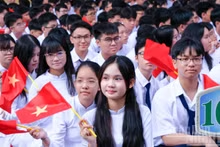
Students at all levels, from preschool to university, gathered at schools across Viet Nam on the morning of September 5 to attend the opening ceremonies for the 2026–2027 academic year.

The 2026–2027 academic year must generate substantive reform from within every school and classroom, involving every teacher, student and the entire education sector, Prime Minister Le Minh Hung said on September 5 at the opening ceremony for the new school year at the Muong Khuong Inter-level Boarding School in Muong Khuong commune, the northern mountainous province of Lao Cai.
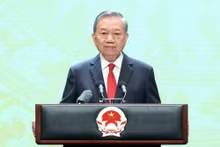
General Secretary of the Communist Party of Viet Nam Central Committee and President To Lam has sent a letter to teachers, education administrators and workers, parents, pupils and students nationwide as the 2026–2027 school year begins.
The 2026–2027 school year is of particular importance to the education sector nationwide, as a single, standardised set of textbooks is officially being introduced across the country in line with the Government's direction and Decision No. 3588/QD-BGDDT issued by the Minister of Education and Training. The sector is also stepping up efforts to streamline its organisational structure and reorganise the network of educational institutions.
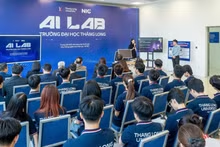
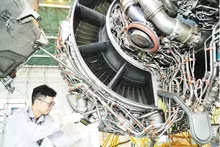
The rapid development of artificial intelligence (AI) is placing higher education before new requirements for restructuring training programmes, renewing teaching and learning methods, scientific research and university governance. In this context, higher education institutions, while proactively improving capacity for both lecturers and learners, need to renew the way technology is applied in an effective, safe and responsible manner.
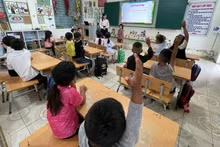
As the new school year approaches, the education sector in Lai Chau has basically completed its preparations. From the border areas of Thu Lum and Hua Bum to Ban Chit School Site, which was affected by flash floods, schools have not only rearranged classes and staff but have also completed preparations for facilities, mobilised students to attend school and ensured conditions for teaching and learning.
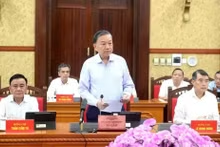
In his concluding remarks at the meeting of the Central Steering Committee for the implementation of Resolution No. 57-NQ/TW on July 30, General Secretary and President To Lam emphasised the need for a fundamental shift from a development model based on low-skilled labour to one driven by creative labour, with a high-quality workforce serving as a key engine of growth.