
Language is the soul of a nation. The Vietnamese language carries within it the very spirit of Viet Nam. Through Vietnamese, all people—wherever they may live and whoever they may be—can understand the history, culture and identity of Viet Nam.
-----------------------------
Against the backdrop of the deep international integration, and in line with the core principles set out in the Politburo’s Resolution No. 80-NQ/TW on the development of Vietnamese culture, Viet Nam is well positioned to revitalise and expand the training of cultural professionals both at home and abroad. This, however, requires nurturing individuals with resilience, adaptability and a firm grounding in Vietnamese values and identity. As preserving and promoting the nation's cultural heritage becomes an increasingly important responsibility, teaching and disseminating the Vietnamese language serves not only to preserve and promote Vietnamese culture among overseas Vietnamese communities and local populations alike, but also to safeguard the nation's traditional values while reinforcing Viet Nam's identity and voice on the global cultural map.
Malaysia is a multilingual and multicultural country where English is widely used as the principal language. Children there typically study English, Mandarin and Malay simultaneously. In addition, children from Muslim families generally learn Arabic, while those of Chinese descent often study Cantonese, Hokkien or other heritage languages spoken by their parents and grandparents.
Therefore, Nguyen Thi Lien, one of five overseas Vietnamese honoured as Vietnamese Language Ambassadors in the 2023 competition organised by the State Committee for Overseas Vietnamese under the Ministry of Foreign Affairs, recalled that until only a few years ago Vietnamese had little chance of finding a place in children's already crowded school timetables. In addition, many Vietnamese women married to local husbands lacked sufficient influence within their families to decide whether their children could learn Vietnamese. Even among other Vietnamese families, many parents did not consider Vietnamese language proficiency essential for their children, while bringing them to Vietnamese classes was often far from straightforward.
As part of the Xuan Que Huong 2026 programme, Nguyen Thi Lien (second from left), a Vietnamese Language Ambassador and Deputy Secretary-General of the Global Network for Vietnamese Language and Culture Education, attends the launch of the textbook series titled “Learning Vietnamese with Joy”.
As part of the Xuan Que Huong 2026 programme, Nguyen Thi Lien (second from left), a Vietnamese Language Ambassador and Deputy Secretary-General of the Global Network for Vietnamese Language and Culture Education, attends the launch of the textbook series titled “Learning Vietnamese with Joy”.
For Ms Lien, the greatest source of satisfaction is the remarkable transformation that has taken place within the Vietnamese community in Malaysia over the past decade. By 2026, Vietnamese language classes had been established in many locations, with both face-to-face and online formats available. Overseas Vietnamese parents have also become far more committed to ensuring that their children learn Vietnamese, viewing their ability to speak the language as a source of pride and the result of years of dedication and perseverance.
A particularly significant milestone came in 2022, when the Prime Minister approved the Project on the Day for honouring the Vietnamese language in overseas Vietnamese communities under Decision No. 930/QD-TTg, officially designating September 9 each year as the Day for honouring the Vietnamese language. The initiative has brought about a profound change in Vietnamese language education across overseas Vietnamese communities.
Similarly, Lanny Phetnion (a Lao Vietnamese language teacher) — one of five individuals honoured as Ambassadors of the Vietnamese Language at the 2024 Vietnamese Language Recognition Day and the “Beloved Vietnamese Language Gala” hosted by the State Committee for Overseas Vietnamese Affairs, the Ministry of Foreign Affairs, and other agencies — also launched Vietnamese language teaching channels on social media and authored Vietnamese language textbooks for not only Lao people but also foreigners in Laos who share a love for the language.
On social media, Lanny Phetnion actively showcases the beauty of Vietnamese life, customs, and traditions to her students and followers.
“This is also a way to contribute to fostering the special friendship between Laos and Viet Nam,” Lanny Phetnion stated.

Like Nguyen Thi Lien and Lanny Phetnion, Dr. Nguyen The Duong (a Vietnamese expatriate in Australia) — the “Ambassador of the Vietnamese Language” in the 2024 search for Ambassadors of the Vietnamese Language in the Vietnamese community abroad — also shares a desire to help Vietnamese children in Australia preserve their mother tongue, thereby maintaining their connection to their roots.
Dr. Nguyen The Duong is honoured at the Beloved Vietnamese Language Gala Programme.
Dr. Nguyen The Duong is honoured at the Beloved Vietnamese Language Gala Programme.
Initially, Dr. Duong and his wife, Hoang Thi Thu Thuy, only hosted free Vietnamese language classes for Vietnamese children near their home. Gradually realising that the love of the Vietnamese language among many Vietnamese children abroad was hindered by geographical distance and time constraints, and hoping to overcome this barrier, in 2016, Dr. Duong decided to launch an online “school” called “Love Vietnamese”, specialising in teaching Vietnamese to overseas Vietnamese children through online classes. The name stems from Dr. Duong’s strong love for the Vietnamese language and his burning desire to instil it in the students. “That’s the most important thing; the reason we named the school “Love Vietnamese”. When you love something, you’ll find ways to understand it, and you’ll find the most appropriate and effective methods and ways to teach it. From there, the children will love Vietnamese more and feel more connected to their Vietnamese roots,” Dr. Duong shared.
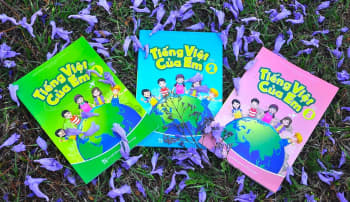
Love Vietnamese is the first online Vietnamese language school in Australia and has now become a preferred platform for children and adults around the world to learn Vietnamese. To date, this online “school” has enrolled thousands of students from over 30 countries and territories; from countries like the US, Australia, the UK, France, Germany, and Japan, to places with very few Vietnamese expatriates, such as French Guiana, Cameroon, and Saudi Arabia. Among them, many foreigners share a passion for and desire to learn Vietnamese. Dr. Nguyen The Duong, co-founder and director of “Love Vietnamese”, is also the co-author of the three-volume “My Vietnamese Language” textbook series, which aims to improve Vietnamese language instruction for children living far from their homeland.
Beyond simply teaching Vietnamese abroad, overseas Vietnamese and foreigners who love the Vietnamese language and culture also systematically promote and elevate the status of the Vietnamese language in their home countries.
In the US, thanks to sustained efforts by the Vietnamese community and support from the State Committee for Overseas Vietnamese under the Ministry of Foreign Affairs, the City and County of San Francisco Board of Supervisors officially recognised Vietnamese as one of the city's official languages in mid-2024. As a result, Vietnamese is now used in a range of public services, including interpretation, official notices and government websites. Beyond San Francisco, Vietnamese is widely available in public services such as healthcare, education and social services in many areas with large Vietnamese communities, including California, Houston, Orange County, Texas and Washington.
In recent years, Vietnamese has also been introduced into university curricula in the US. The language is currently taught at six of the eight Ivy League universities: Brown, Columbia, Cornell, Harvard, the University of Pennsylvania and Yale. At Harvard University, the Vietnamese language programme was established in 2024 under the Department of East Asian Languages and Civilizations.
Similarly, Italy has introduced Vietnamese studies at the Department of Asian and North African Studies of Ca' Foscari University of Venice. In the Republic of Korea, since 2013, the Ministry of Education has designated English as the first foreign language, while Vietnamese is one of nine recognised second foreign languages.
Organisers of the seminar titled “Current situation and solutions for promoting Vietnamese language and culture education within the Vietnamese community in the Republic of Korea” present copies of the book “Vui hoc tieng Viet” (Fun learning Vietnamese) to Vietnamese children living in Gwangju, the Republic of Korea.
Organisers of the seminar titled “Current situation and solutions for promoting Vietnamese language and culture education within the Vietnamese community in the Republic of Korea” present copies of the book “Vui hoc tieng Viet” (Fun learning Vietnamese) to Vietnamese children living in Gwangju, the Republic of Korea.
According to Professor Dr Ahn Kyong-Hwan, former Vice President for External Affairs at Nguyen Trai University, Vietnamese language education in the Republic of Korea began officially in 1967. Since 2012, Vietnamese has been included among the foreign-language subjects accepted in the country's university entrance examination, while Vietnamese language departments have also been established at specialised foreign language high schools.
An online class organised by “Truong Yeu Tieng Viet” (Love Vietnamese School) attracts students from around the world.
An online class organised by “Truong Yeu Tieng Viet” (Love Vietnamese School) attracts students from around the world.
In Australia, Vietnamese is now the country's third most widely spoken language after English. It is taught in a number of mainstream schools, while many community schools also offer Vietnamese language classes for children.
This reflects the growing international status of Vietnamese and the strong support it receives from the Australian Government, local communities and the public. Tran Hong Van, Vietnamese Language Ambassador 2023, said that for Vietnamese communities overseas, particularly in Australia, preserving the Vietnamese language and culture brings significant emotional, cultural, intellectual and economic benefits. She noted that for Australia, promoting, teaching and using the Vietnamese language and culture also helps strengthen the country’s multicultural and multilingual identity—one of Australia's defining characteristics, of which both the Government and its people are proud. Like other community languages, Vietnamese also fosters greater mutual understanding, social inclusion and harmonious development among Australia’s diverse ethnic communities.
Emphasising the view that "culture is the core foundation shaping a nation's identity and values", Vu Thi Bich Diep, President of the Vietnamese Students' Association in Italy, stated that culture is not only the crystallisation of traditions, customs, and practices, but also embodies the spirit, intellect, and resilience of generations of people. In Italy, cultural organisations and centres in Milan, Rome, and Turin have provided classes on the Vietnamese language, traditional arts, and the country's cultural history.
Vu Thi Bich Diep, President of the Vietnamese Students' Association in Italy, addresses a meeting between National Assembly Chairman Tran Thanh Man and representatives of outstanding Vietnamese students and scholars in Italy.
Vu Thi Bich Diep, President of the Vietnamese Students' Association in Italy, addresses a meeting between National Assembly Chairman Tran Thanh Man and representatives of outstanding Vietnamese students and scholars in Italy.
National Assembly Chairman Tran Thanh Man with representatives of outstanding Vietnamese students and scholars in Italy.
National Assembly Chairman Tran Thanh Man with representatives of outstanding Vietnamese students and scholars in Italy.
According to Vu Thi Bich Diep, young Vietnamese people and students living abroad always wish to help promote the image of Viet Nam and its people, preserving the nation's cultural identity, and supporting digital transformation, green transition, and innovation in Viet Nam. This is also a responsibility that every overseas Vietnamese should strive to fulfil for the common goal of national development. “We believe young people need to be even more aware of their responsibility in the country's development journey," she noted.
"We are fully aware that the younger generation is not only the future but also a core force in helping realise the country's development goals. As preserving and promoting national culture becomes an essential responsibility, these meaningful activities not only help preserve and promote Vietnamese culture among local communities, but also safeguard traditional values and reinforce the standing and voice of the Vietnamese nation on the global cultural map," the President of the Vietnamese Students' Association in Italy emphasised.
As a fluent Vietnamese speaker who has spent nearly 40 years associated with the country and people of Viet Nam, Professor Ahn Kyong-Hwan was honoured with the title of Honorary Citizen of Ha Noi in 2024. He has also translated a number of renowned Vietnamese literary works into Korean, including The Tale of Kieu by Nguyen Du and Prison Diary by President Ho Chi Minh.
"I can say that I fell in love with Viet Nam when I was still a secondary school student," Professor Ahn Kyong-Hwan remarked as he recalled his enduring connection with the Vietnamese language. "At that time, we learned about Viet Nam through several films and photographs shown at school. The most recognisable symbol of Viet Nam was the coconut tree. The country's coconut groves appeared in films and photographs laden with fruit, with fronds swaying in the breeze and bending over canals, creating a magical and shimmering beauty. It was my love for Viet Nam that inspired me to start learning Vietnamese in 1974," he recounted.
At that time, the Republic of Korea's economy was still encountering difficulties and information technology was not yet well developed. Learning Vietnamese as a pupil was thus highly challenging, as he had to search for and collect the few available Vietnamese language textbooks to study on his own.
Professor Ahn Kyong-Hwan, an Honorary Citizen of Ha Noi, receives the Special Prize in the 2024 "Ha Noi in Me" writing contest.
Professor Ahn Kyong-Hwan, an Honorary Citizen of Ha Noi, receives the Special Prize in the 2024 "Ha Noi in Me" writing contest.
Professor Ahn Kyong-Hwan recounted: "In 1989, when I first came to Viet Nam, I visited a second-hand bookshop in Da Kao Market in Ho Chi Minh City seeking books to help me learn Vietnamese. There, I bought President Ho Chi Minh's “Prison Diary” and Nguyen Du's “The Tale of Kieu”. I read both books over and over again to fully understand them, hoping that one day I could translate them into Korean. When I proposed the idea to a Korean publisher, however, they were reluctant to publish the translations because, at that time, Korean readers had little interest in Viet Nam or its people."
Driven by his passion for the Vietnamese language and these two literary masterpieces, Professor Ahn dedicated his time, resources, and personal savings to translating Prison Diary. He financed the publication of 1,000 copies of the Korean edition and donated them to friends as well as libraries at universities across the Republic of Korea (RoK). "I am very proud to have been the person who translated and published “Prison Diary”, enabling Korean readers to gain a deeper understanding of President Ho Chi Minh — a great leader, an outstanding cultural figure, and one of Viet Nam's most eminent statesmen," Professor Ahn remarked.
He added: "Since then, I have translated many other Vietnamese works into Korean, including “Unforgettable Years” by General Vo Nguyen Giap, “The Diary of Dang Thuy Tram”, and, most recently, collections of poems by Ho Chi Minh and Mai Van Phan, as well as the novel “Lord of the Land”. These books have been warmly received by Korean readers. I have also contributed to the writing and compilation of a number of academic publications and teaching materials for universities in the RoK."
Inspired by his profound affection for Viet Nam and its people, Professor Ahn has, over nearly four decades, remained committed — regardless of the positions he has held — to translating more outstanding works of Vietnamese literature, particularly poetry and prose by Viet Nam's renowned cultural figures, from Vietnamese into Korean. Through these translations, he hopes to showcase more of Viet Nam's literary heritage and the richness of its culture to Korean readers.
According to Professor Ahn, mutual understanding of each other's cultures and people enables nations to forge sincere bonds, ultimately advancing the preservation of world peace. That, he believes, is the true power of language and culture.
Having dedicated more than half of his life to teaching Vietnamese and researching Viet Nam's culture and history, Professor Ahn reflected: "I believe I am one of the foreigners who loves Viet Nam most deeply. That is why people often call me 'a Korean with a Vietnamese soul'. I will continue to fulfil my responsibilities as an honorary citizen of Ha Noi."
"I believe I am one of the foreigners who loves Viet Nam most deeply. That is why people often call me 'a Korean with a Vietnamese soul'."
- Professor Ahn Kyong-Hwan -
"I consider myself fortunate. Thanks to the Vietnamese language, I have had the opportunity to live and work in Viet Nam for many years. I love Viet Nam — the homeland of President Ho Chi Minh and many distinguished cultural figures of the world, a country known for its peace, friendliness, and hospitality. To me, Viet Nam is like my second home," Professor Ahn expressed emotionally.
Published: July 2026
Content: Hoang Nhat, Hong Van, Khanh Lan, Minh Phuong, Nguyen Hung, and Khanh Linh
Photos: Nhan Dan Newspaper, Vietnam News Agency (VNA), the Internet, and materials provided by the interviewee.
Translation: NDO