Keeping the Fatherland forever in our hearts
Following its resounding debut at My Dinh Stadium, the second edition of “The Fatherland in Our Hearts” comes to Ho Chi Minh City with a new setting and a fresh narrative. More than 5.7 million registration requests and the exhaustion of all online tickets in just one minute and 27 seconds demonstrate the exceptional appeal of a political art programme that conveys history and the nation’s sacred values through the language of the modern age. Ahead of the August 23 performance, Le Quoc Minh, Party Central Committee (PCC) member, Editor-in-Chief of Nhan Dan Newspaper, Deputy Head of the PCC’s Commission for Information and Education, who heads the programme’s Steering Committee, spoke about new approaches to political art, the power of young audiences and the journey of turning cultural resources into a driver of development.
AWAKENING THE POWER OF NATIONAL VALUES
- This year’s edition of the political art programme “The Fatherland in Our Hearts” in Ho Chi Minh City is said to feature many new elements. More than 5.7 million registration requests and the exhaustion of online tickets in just one minute and 27 seconds demonstrate the programme’s exceptional appeal. As its initiator, could you share some of the distinctive features of the second edition?
- First of all, I would like to stress that these figures do not belong to the organising committee. They belong to the public. More than 5.7 million registrations for a free concert, with all tickets snapped up in one minute and 27 seconds, are not a publicity achievement but a social indicator. They show that the desire among people to come together and express their love for the Fatherland is far greater than we have perhaps imagined.
The first new feature of the second edition lies in the venue itself. The inaugural edition was held at My Dinh National Stadium in the capital, where the first echoes of the August Revolution resounded, marking the 80th anniversary of National Day. This year, the programme comes to Ho Chi Minh City as the city celebrates the 50th anniversary of being honoured with the name of President Ho Chi Minh. It is also the country’s economic powerhouse and a place where Viet Nam’s spirit of dynamism, creativity and integration comes together.
This move is not simply a change of venue. It expands the programme’s spiritual space: “The Fatherland in Our Hearts” is not the story of any single region, but a shared current flowing from north to south.
The second new feature is the format of the space. We have moved from an enclosed stadium to an open urban setting at Van Phuc City. This is a deliberate choice: political art needs to step beyond the auditorium and become part of people’s everyday lives, allowing them to engage with the programme in the most natural way. This time, “The Fatherland in Our Hearts” will also extend to Nguyen Hue Walking Street with a secondary stage, a “Patriotic Fandom” area and a series of large screens, enabling us to reach a wider audience. Music fans will have more opportunities to interact with artists, take photographs, participate in activities and enjoy performances before the main show officially begins.
The third new feature is the content structure. We did not repeat the script that had proved successful. The second edition is structured into chapters, each with its own narrative, moving from memories of gratitude to aspirations for the present and concluding with a youthful, modern chapter where contemporary music meets the cultural colours of Viet Nam’s northern, central and southern regions.
Through this approach, we want to convey the message that history does not stop in the past. It continues to be written by today’s generation, in the first year of nationwide implementation of the Resolution of the 14th National Party Congress and as Viet Nam marks the 40th anniversary of the Doi Moi (Renewal) process.
And there is one point I would like to emphasise that the programme was organised entirely through socialised funding, with free admission. It was a spiritual gift to the people, not a commercial product.

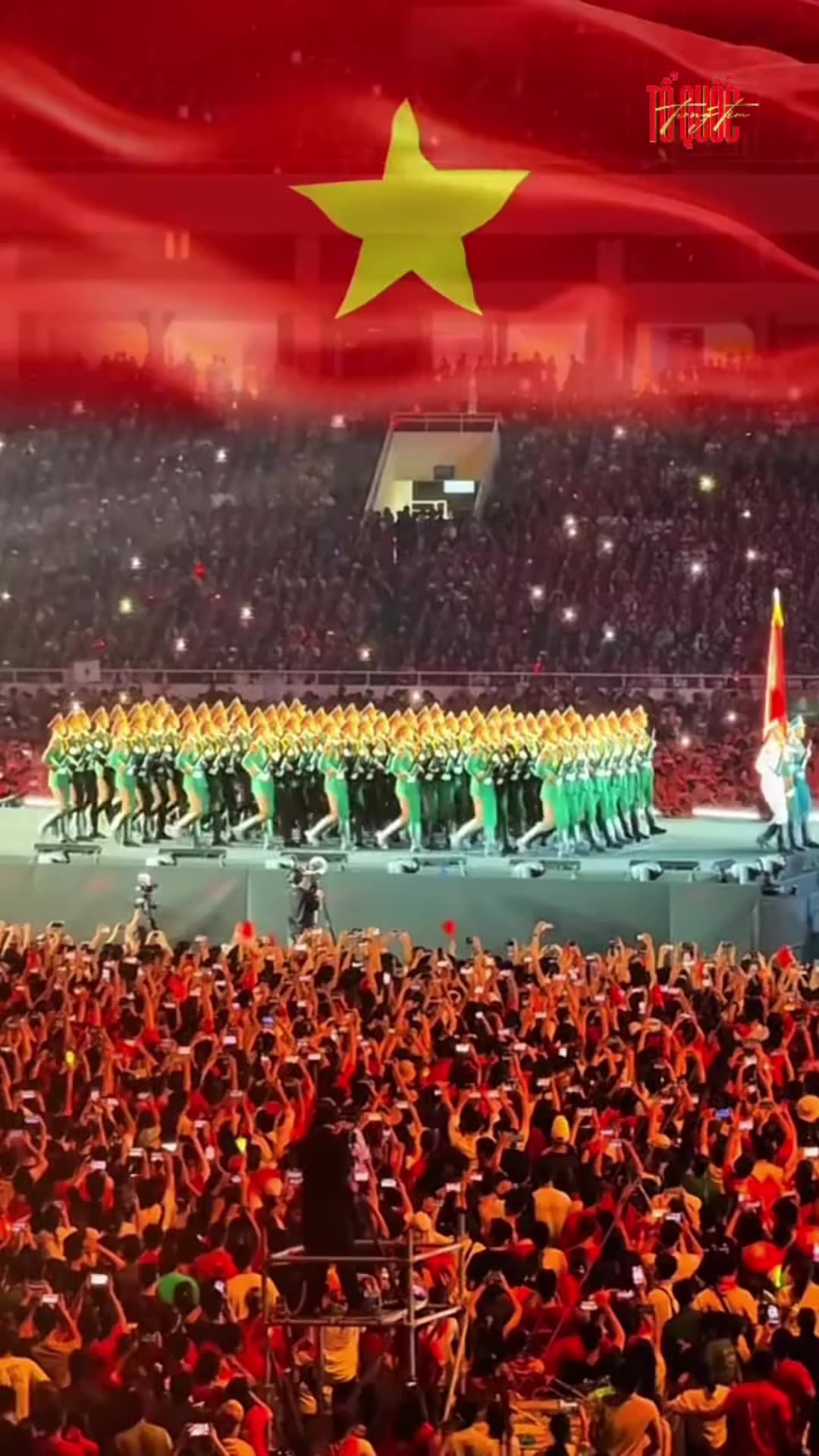
The “Fatherland in Our Hearts” (Tổ quốc trong tim) programme, held at My Dinh Stadium on August 10, 2025, drew an audience of over 50,000 and was affectionately dubbed the "National Concert" by young people.
Many veterans felt a mix of pride and emotion as they witnessed thousands of young people singing along to the very songs that had accompanied their own generation.
It was surprising to see that—whether it was classic revolutionary songs like “The Country’s Joy” (Đất nước trọn niềm vui) and “Marching Forth” (Lên đàng), or newer compositions like “Continuing the Story of Peace” (Viết tiếp câu chuyện hòa bình) and “We Shall Triumph” (Sẽ chiến thắng)—the audience knew the lyrics by heart and sang along, fueling the artists’ energy.
- Amidst an increasingly diverse musical landscape, revolutionary songs and songs about the country still hold strong appeal, especially for young people. In your view, what accounts for that enduring vitality? Does it perhaps stem from a desire among today’s public to connect with history and their national identity?
- I believe there are three layers of reasons.
The first layer lies in the works themselves. Our finest revolutionary songs were written in the trenches, on the march, and on the thin line between life and death. The composers back then did not write to cater to popular tastes, nor did they write to order. They wrote because they simply had to. That authenticity is something no studio technique can replicate, yet listeners—even young people who never experienced the war—can still feel it.
Furthermore, most of these melodies are rooted in folk music, pentatonic scales, and Vietnamese musical modes. They are already embedded in the musical subconscious of the Vietnamese people.
The second layer concerns the mode of presentation. The same song, if staged in a traditional manner, might struggle to resonate with young people. However, when rearranged using a contemporary musical language and set within a modern stage environment—performed by artists whom the youth adore—its vitality can be powerfully reawakened. Recent seasons have demonstrated this very fact.
The third layer—and I believe you hit the nail on the head here—relates to psychosocial needs. Today’s digital lifestyle places such a high premium on the individual that many young people feel lonely amidst a sea of connections. Humans have an innate need to belong to a community larger than themselves, to say “we” rather than just “I”. Songs about the nation fulfill precisely that need. When tens of thousands of people sing the same song together, no one remains merely an isolated individual.
Therefore, I do not think we need to “awaken” patriotism among the youth; that patriotism is always there. What is sometimes missing is simply a space—beautiful and sincere enough—for it to find its voice.
At My Dinh Stadium last year, the most powerful moment wasn’t any specific performance, but the instant tens of thousands of voices merged into one. In that moment, the boundary between the stage and the stands vanished. The audience ceased to be mere spectators; they became part of the performance itself.
- Artworks with a socio-political message always face the challenge of balancing intellectual depth with mass appeal. “The Fatherland in Our Hearts” (To quoc trong tim) chose to tell historical stories through the language of a modern concert. In your view, how can the presentation be innovated while preserving core values?
- The principle we established from the start was concise: we would not lower the intellectual content to pander to popular tastes, nor would we mistake rigidity for seriousness.
There is a common misconception that “political commentary” refers to a specific style of presentation—one that must be solemn, measured, and didactic. This is not the case. Political commentary is a quality of the content and the system of values conveyed by a work, not of its form. A performance can be dynamic and utilise state-of-the-art projection technology while remaining entirely political in nature, provided it speaks accurately, hits the mark, and treats history with respect.
From that principle, we have set several hard boundaries. First, historical facts are inviolable. Every detail, every figure, and every archival image brought onto the stage is verified according to the same procedures as those followed by a newsroom. This is perhaps a distinctive advantage of a programme initiated by a press agency that also oversees its content. Artistic creativity is free in the way the story is told, but must not be detached from the truth.
Second, stories are told through real people, not slogans. A letter, a keepsake, a flesh-and-blood soldier stepping onto the stage — these things touch audiences more deeply than any declaration. Audiences do not need to be told what to feel; they simply need to be placed in a situation where they can feel it for themselves.
Third, restraint is essential. Technology, lighting, and effects are means, not the purpose. Some of the programme's most powerful moments have come when the stage is almost completely dark, with only a voice singing and tens of thousands of lights shining from the audience.
Finally, I think what matters is integrity in our profession. Audiences today are very discerning. They can immediately tell what has been done merely for the sake of it and what has been created wholeheartedly.
– At “The Fatherland in Our Hearts”, the public, particularly young people, did not merely watch but also sang along, shared, and spread the programme's message on social media platforms. What does this suggest about a new approach to young people: instead of simply conveying historical values, should we create experiences that allow them to feel, participate in, and spread them themselves?
– This is the biggest lesson I drew from the first season. In the traditional communications model, we see the public as recipients: we speak and they listen. But today's generation does not operate that way. They trust what they experience themselves and what their friends share more than what they are told. Therefore, the most effective way to convey a value is not to lecture them about it, but to create a space where they can experience it for themselves.
At My Dinh National Stadium last year, the most powerful moment was not a particular performance, but the moment when tens of thousands of people sang together. At that point, the boundary between the stage and the audience disappeared. The audience was no longer simply watching; they became part of the work.
More importantly, after the show, millions of video clips filmed by the audience themselves spread across digital platforms, reaching far beyond all the official communication channels available to us. No communications campaign could have bought that.
The lesson, in my view, has two aspects. First, we need to shift from “talking to the public” to “creating with the public”; from communication to experience; and from seeing young people as the target of communication to seeing them as creators and disseminators in their own right.
Second, and more difficult, we must be willing to relinquish some control. When the public becomes the storyteller, the story will be told in millions of different ways, in their own language, sometimes very differently from how we imagine it. But that is not a risk to be prevented; it is a sign of success. A value truly comes alive only when it is expressed in the voice of a new generation.
FOR CULTURE TO TRULY BECOME A DEVELOPMENT RESOURCE
– History, music, heritage and stories about the country are an enormous cultural resource. Based on the impact of “The Fatherland in Our Hearts”, what does Viet Nam need to do, in your view, to turn this resource into compelling products and make it a genuine driver of the cultural industries?
– We need to make a very clear distinction: a resource is not yet a source of value. Oil beneath the ground creates no value until it is extracted and processed. Culture is the same. We possess a wealth of history, heritage, and music that is among the richest in the region, but most of it remains in the form of raw resources. To transform it, I believe several things need to be done simultaneously.
First, we must cultivate a rigorous a product and market mindset. We must accept that cultural products compete directly with every form of global entertainment available on people’s phones. We cannot afford to operate half-heartedly and passively expect the public to support us out of sheer patriotism. Investment must be substantial, and the resulting quality must meet stringent international standards. “The Fatherland in Our Hearts” was successful in part because we produced it to the standards of an international concert, rather than those of a routine commemorative programme.
Second, we must address the issue of mechanisms. Our experience emphatically demonstrates that a socialised model rooted in public-private cooperation is the master key. The State and the lead agencies provide content direction and safeguard core ideological values, while businesses and creative organisations take full responsibility for resources and production. But for this model to be replicated on a wider scale, clearer mechanisms are needed for commissioned projects, tax incentives, and investment partnerships in the cultural sector.
Third, we must focus on the human element. The cultural industries need far more than artists. They need producers, executive directors, stage designers, sound and lighting specialists, copyright experts, and cultural marketers. This is a critical area where we remain acutely short of skilled personnel and where systematic, long-term investment in training is urgently needed.
Fourth, we must adopt a comprehensive value-chain mindset. When a performance ends, the product’s life cycle should not end with it. The same material can be continuously developed into a documentary, an album, a digital version, merchandise, educational products for schools, and even event-based tourism products. This is something the Republic of Korea has done particularly well and it offers a highly valuable lesson for us.
Fifth, we must implement rigorous measurement. If culture is to be recognised as a genuine economic sector, there must be a set of strictly measurable indicators: its contribution to GRDP, employment, revenue generated by ancillary services linked to events, digital spillover value, and its impact on the country’s international image. If something cannot be quantitatively measured, it is very difficult to make a convincing case for investment commensurate with its true importance.
If culture is to be recognised as a genuine economic sector, there must be a set of strictly measurable indicators: its contribution to GRDP, employment, revenue generated by ancillary services linked to events, digital spillover value, and its impact on the country’s international image.
BUILDING CULTURAL STRENGTH IN A NEW ERA
- “The Fatherland in Our Hearts” was initiated by Nhan Dan Newspaper, a political and social affairs newspaper. Could projects like this also reflect a new way of thinking about the role of the press: moving from producing and disseminating content to creating cultural products, delivering experiences, and connecting communities?
- I would frame it slightly differently: this is both a new way of thinking and a profound return to the very essence of revolutionary journalism. From its inception, revolutionary journalism was never merely about reporting the news. The press was a collective propagandist, a collective mobiliser, and a collective organiser. This third role — organisation — is one that, for many years, we have had fewer opportunities to fully develop because of the relentless pressures of the daily news cycle. Projects such as “The Fatherland in Our Hearts” are, in essence, about powerfully restoring that role through the innovative methods of a new era.
And this is precisely where the new element lies. In the digital environment, the press no longer has a monopoly on information distribution. We are forced to compete every single second with giant cross-border platforms right on our readers’ phone screens. In that fierce competition, if we produce content only in traditional ways, it is very difficult to retain the public’s attention, particularly among the youth.
The press is compelled to be present where the public is, using the formats that audiences enjoy. And an experience – an event, a cultural space – is itself a content format.
This approach delivers multiple benefits simultaneously: disseminating ideological values in a way that thousands of articles would struggle to achieve; building the brand and fostering an emotional connection between the newspaper and the public; and opening up avenues for revenue diversification amidst the challenging economic landscape facing the press.
But I also want to make one point clear to avoid any misunderstanding: this is an expansion, not a replacement. Nhan Dan Newspaper’s core mission remains journalism: providing accurate information, offering incisive analysis, guiding public opinion and safeguarding the Party’s ideological foundation. If a newspaper excels at organising events but fails to produce good journalism, that is a failure.
– Looking beyond the success of a single programme or event brand, what do you think is the greatest legacy that “To Quoc Trong Tim” (The Fatherland in Our Hearts) can leave behind? Could it offer a new perspective on how to transform historical values and national identity into a source of Vietnamese cultural strength in the new era?
– If I could leave only one thought, I would not talk about the records the programme has set or the awards it has received. I would talk about a conviction that has now been affirmed.
For a long time, there have been concerns that today’s young people are indifferent to history and disconnected from traditional values, and that political and ideological content is inherently difficult to make appealing. The programme “The Fatherland in Our Hearts” has provided a compelling answer in practice: when such content is presented with creativity, sincerity and professionalism, even the most sacred values can exert tremendous appeal. The issue has never been the audience. It is how we tell the story.
Therefore, I hope the programme’s enduring legacy will not simply be an event, but a method: absolute respect for historical truth; maximum freedom in the language and forms of expression; placing the public at the centre; and pursuing the highest standards of professionalism in everything we do. This approach can be applied to an artistic programme, a museum, a film, a history lesson in school or a multimedia journalism product.
As for cultural strength, I think that a country’s soft power is not created by talking more about itself, but by creating products that make others want to learn more about it. Viet Nam possesses one of the world’s most emotionally compelling national stories. What we still need is the capacity to retell that story in a language that today’s world is willing and able to hear.
And perhaps the most profound value is also the hardest to quantify. It is the moment when tens of thousands of strangers, from different generations and regions, sing the same song together beneath the red flag with the yellow star. In that moment, all differences recede into the background. That is social cohesion in its purest form – and there is no resource more precious to a country’s development.
Because “The Fatherland is never far away. The Fatherland is in each and every heart.”The
“The Fatherland is never far away.
The Fatherland is in each and every heart.”
Content: Phan La Giang
Photos: Thanh Dat, Sun Bright
Translation: NDO