


The private economic sector currently comprises over 940,000 enterprises and more than 5 million business households, contributing approximately 50% of GDP, over 30% of total state budget revenue, and employing about 82% of the total workforce in economic growth and job creation, serving as a crucial force for innovation. However, the private sector has still faced many obstacles hindering its development, failing to achieve breakthroughs in scale and competitiveness, and not meeting the requirements and expectations of being the core force of the national economy.


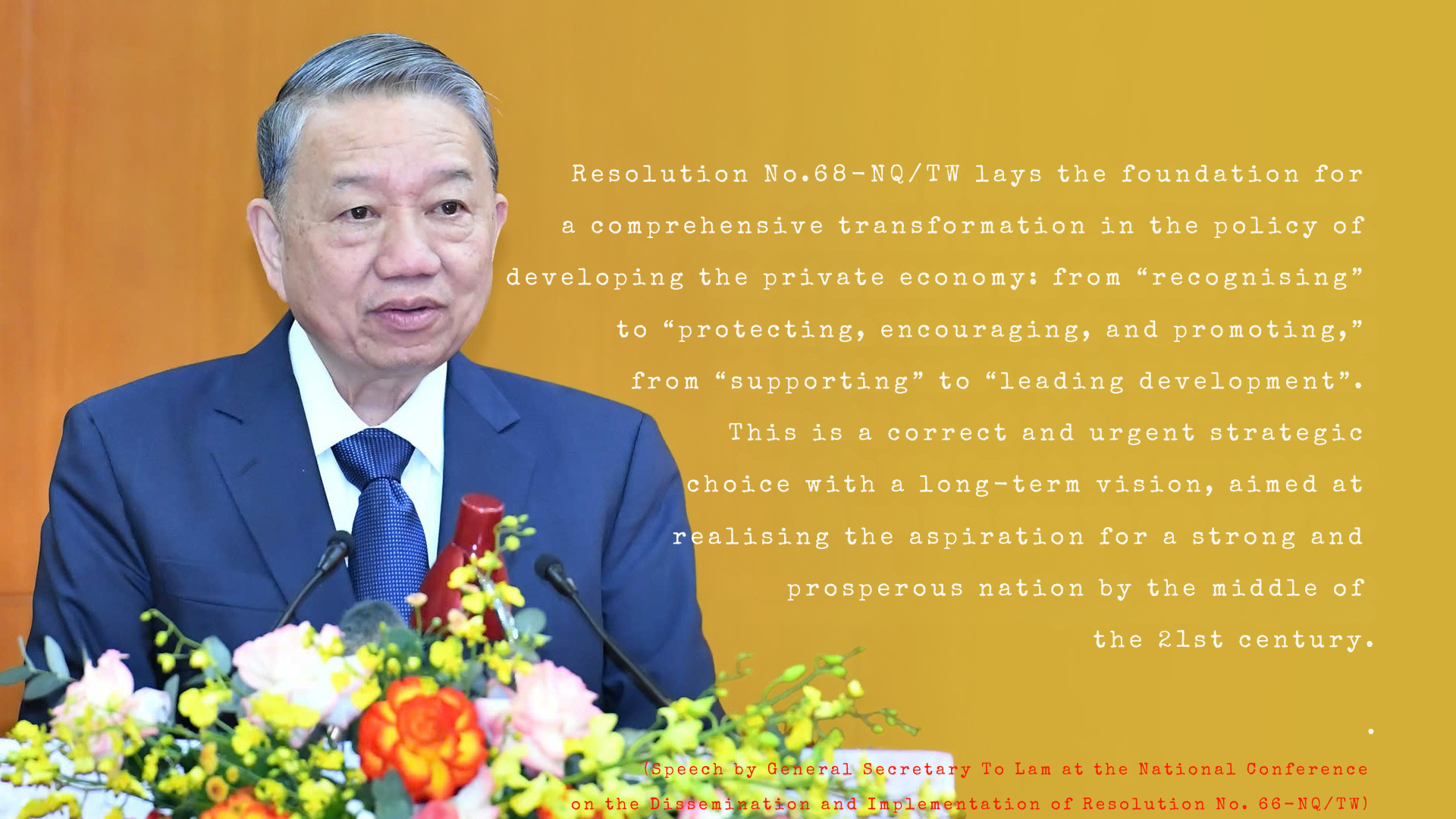
To contribute to realising the national development goals in the new era, on May 4, 2025, the Politburo issued Resolution No. 68-NQ/TW on the development of the private sector. With the perspective of Party leadership, state creation, and enterprises as the central and main actors, Resolution No.68-NQ/TW is considered a powerful institutional impetus, opening a new strategic direction for the development of the private sector. Identifying the private sector as the most important driving force of the national economy, the resolution demonstrates a renewed mindset with the unified understanding and action of the Party and state towards the private sector, creating a strong impetus for comprehensive and sustainable development.


GOALS AND VISION FOR
THE PRIVATE ECONOMY
- The private economy will be the most important driving force of the national economy.
- Striving to have 2 million operating businesses in the economy.
- 20 operating businesses/1000 people.
- At least 20 large businesses participating in global value chains.
- Average growth rate of approximately 10-12% per year.
- Contributing approximately 55-58% of GDP, and 35-40% 35-40% of total state budget revenue.
- Creating jobs for approximately 84-85% of the total workforce.
- Increasing labour productivity by an average of approximately 8,5-9,5%/year.
- Being among the top 3 ASEAN countries và and the top 5 Asian countries in terms of technology capacity, innovation, and digital transformation.
- Rapid, strong and sustainable development, proactively participating in global production and supply chains.
- With High competitiveness in the region and in the world.
- By 2045, at least 3 million businesses will be operating in the economy.
- Contributing over over 60% of GDP.


TASKS AND SOLUTIONS
Innovate thinking, achieve high consensus on awareness and action
- Awaken the spirit of entrepreneurship, startups, self-confidence, self-reliance, and national pride.
Promote the reform, improvement, and enhancement of the quality of institutions and policies; ensure and effectively protect ownership rights, property rights, freedom of business, and the right to fair competition of the private sector; and ensure the enforcement of contracts in the private sector
Ensure that the economy operates in accordance with a socialist-oriented market mechanism
- Minimise state intervention and eliminate administrative barriers, the “ask–give” mechanism, and the mindset of “if it cannot be managed, then prohibit it”.
- In 2025, reduce administrative procedure processing time by at least 30% reduce legal compliance costs by at least 30% and cut by at least 30% of business conditions .
- By 2028, ensure that Viet Nam’s investment and business environment ranks among the top three in ASEAN và and the top 30 worldwide.
- Shift from a public administration model focused primarily on management to one centred on service delivery and development facilitation.
- Strongly shift from pre-inspection to post-inspection mechanisms.
- Ensure fair and equal treatment among all economic sectors.
- Improve the legal framework for new economic models and technology- and digital platform-based businesses, particularly in financial technology, artificial intelligence, virtual assets, virtual currencies, crypto-assets, cryptocurrencies, and e-commerce.
- Clearly assign functions, decentralise authority, and define responsibilities; clearly identify the accountability of heads of agencies in the handling of administrative procedures.
- Adopt special mechanisms and policies to support small and medium-sized enterprises while ensuring compliance with market principles and international commitments.
- Abolish the business licence fee; exempt small and medium-sized enterprises from corporate income tax during their first three years of operation.
Ensure and effectively protect ownership rights, freedom of business, property rights, the right to fair competition, and the enforcement of contracts in the private sector
- Conduct inspections and examinations once a year of enterprises, except in cases where there is clear evidence of violations.
- Develop data systems and artificial intelligence tools for early warning of risks of legal violations.
- Comply with the principle of clearly distinguishing criminal liability from administrative and civil liability; and distinguishing between legal entities and individuals in the handling of violations.
- Prioritise the application of civil, economic, and administrative measures, allowing enterprises and entrepreneurs to proactively remedy violations and damages.
- Clearly distinguish lawfully formed assets from assets derived from unlawful acts and other assets related to a case; and distinguish between the assets, rights, and obligations of enterprises and those of individuals who manage the enterprises.
Facilitate the private sector’s access to resources, including land, capital, and high-quality human resources
Enhance opportunities for the private sector to access land and production and business premises
- In 2025: complete the development of the National Land Database connected with the National Data Centre and other relevant databases.
- Implement electronic transactions in the land sector.
- Using local budgets to support investors engaged in the development and operation of industrial park infrastructure, industrial clusters, and technology incubators.
- Local authorities shall identify land funds for each industrial park or industrial cluster, ensuring an average minimum of Local authorities shall identify land funds for each industrial park or industrial cluster, ensuring an average minimum of 20 ha/park, cluster or at least 5% of the total land fund in which infrastructure has been developed.
- The State shall adopt policies to reduce by a minimum of 30% of land sublease rents during the first five years.
- Policies shall be introduced to support small and medium-sized enterprises, supporting-industry enterprises, and innovative enterprises in renting houses and land that are public assets which are unused or underutilised in the locality.
Promoting and diversifying capital sources for the private economy
- Policies shall be put in place to prioritise a portion of commercial credit for private enterprises, especially small and medium-sized enterprises, supporting-industry enterprises, and innovative start-ups.
- Green credit development shall be accelerated.
- Models of credit guarantee funds for small and medium-sized enterprises shall be improved.
- Research shall be conducted into the establishment of re-guarantee funds and models of cross-guarantees and co-guarantees.
- Seed capital funding shall be provided for start-up projects, start-up lending shall be expanded, and incubators and start-up support programmes shall be developed.
- Co-financing models involving central, local and private funds, as well as financial and credit institutions, shall be encouraged in order to share risks and increase preferential terms for loans to small and medium-sized enterprises.
- Connectivity and information sharing among banking, taxation and relevant authorities’ systems shall be strengthened.
- Enterprises shall be supported in enhancing management capacity and in building transparent, standardised and well-regulated financial systems.
- Inspection, examination and close supervision of credit institutions and credit-granting activities shall be strengthened; lending activities serving internal ecosystems shall be strictly controlled.
- Tax policies shall be reviewed and improved to facilitate investment and capital contribution activities by investment funds into enterprises.
- Research shall be conducted into allowing financial investment institutions to expand their ability to mobilise capital from sources such as social insurance funds and voluntary pension funds.
- The upgrading and restructuring of the stock market shall be expedited, the insurance market shall be developed, and regulations on corporate bonds shall be improved.
- Research shall be undertaken to develop a legal framework for the securitisation of debts.
Improving the quality of human resources for the private economy
- Resources shall be concentrated on developing a network of high-quality higher education and vocational education institutions in key disciplines and sectors.
- Forms of training based on enterprise orders shall be supported and encouraged.
- Training and capacity-building programmes to improve the quality of human resources for the private economy shall be effectively implemented.
- A programme to train and upskill 10,000 chief executive officers.
- Education and training in creative skills, STEM, foreign languages and digital skills shall be promoted at all levels of education.
Promoting science and technology, innovation, digital transformation, green transformation, and efficient, sustainable business practices in the private economy
- Breakthroughs in the development of science, technology, innovation and national digital transformation within the private economic sector shall be promoted.
- Issue a controlled regulatory sandbox framework for new technologies, products, services, and business models.
- Allow enterprises to deduct when calculating taxable corporate income on research and development by200% of actual expenditure.
- Permit enterprises to allocate up to 20% of taxable corporate income to establish funds for science and technology development, innovation, digital transformation, and research and development.
- Allow enterprises and private organisations to use state-owned shared laboratories, testing facilities, design support rooms, and research equipment, as well as state testing, measurement, calibration and certification centres, to develop products at reasonable fees.
- Adopt policies on corporate income tax exemptions and reductions for innovative start-ups.
- Prioritise state resources to support investment in the development of innovation centres to assist enterprises in innovation and start-ups.
Strengthen linkages among private enterprises, and between private enterprises and state-owned enterprises and FDI enterprises
- Build enterprise linkages in the form of industrial clusters, value chains, and supply chains.
- Encourage large enterprises to take the lead in domestic supply chains and connect with small and medium-sized enterprises and household businesses.
- Encourage financial and credit institutions to provide capital financing for private enterprises operating along value chains and supply chains.
- Support enterprises in obtaining certifications and accreditations that meet industry standards required by export markets, thereby enabling participation in value chains and supply chains.
- Apply appropriate localisation ratios, according to a roadmap, in foundational, spearhead and priority industries.
Rapidly form and develop large and medium-sized enterprises and private economic groups of regional and global stature
- Expand private-sector participation in major national projects, such as high-speed railways, urban railways, spearhead industries, energy infrastructure, digital infrastructure, green transport, and defence and security industries.
- Diversify and enhance the effectiveness of cooperation models between the state and the private economic sector through public–private partnerships (PPP), public leadership–private governance, public investment–private management, and private investment–public use.
- Expedite the development and implementation of a programme to foster 1,000 exemplary and pioneering enterprises in science and technology, innovation, digital transformation, green transition, high-tech industries, and supporting industries.
- Develop and implement a Go Global programme to support international market expansion.
Provide substantive and effective support for small, micro-enterprises and household businesses
- Improve the legal framework for household businesses.
- Abolish the lump-sum tax regime for household businesses no later than 2026 2026.
- Provide free digital platforms, shared accounting software, legal advisory services, and training in business administration, accounting, taxation, human resources, and law for small and micro-enterprises, household businesses, and individual entrepreneurs.
- Effectively implement the National Financial Inclusion Strategy, promoting access to and use of financial products for small and micro-enterprises and household businesses, with priority given to young entrepreneurs, women, vulnerable groups, ethnic minorities, and residents of mountainous, border and island areas, as well as inclusive business models that generate social impact.
Uphold business ethics, promote social responsibility, and foster a strong entrepreneurial spirit
- Take business ethics and business culture as the core and uphold the spirit of respect for and compliance with the law.
- Assess private enterprises according to international standards based on core criteria: the level of legal compliance; job creation; contributions to the state budget; and participation in social welfare activities.
- Honour, commend, and reward exemplary and advanced entrepreneurs and enterprises that operate effectively and sustainably and fulfil their social responsibilities well.
- Establish close, substantive, sharing, open, and sincere relationships between Party committees and authorities at all levels and the business community.
- Build Ho Chi Minh Communist Youth Union organisations and develop the Party organisations within enterprises and among entrepreneurs.
🎯 KEY TARGETS







RESULTS OF RESOLUTION IMPLEMENTATION
IMPRESSIVE FIGURES
Since the Politburo issued Resolution No. 68-NQ/TW, there has been an average of more than 18,000 newly established enterprises each month an increase of nearly 37,88% compared with the previous period.
It is estimated that in 2025, more than 300,000 enterprises nationwide were newly registered or resumed operations, up 30,89% year on year.
The total capital added by private enterprises to the economy is estimated at more than 6 million trillion VND, an increase of 71,6% compared with 2024.
Nationwide, nearly 1.1 million enterprises are estimated to be operating in the economy as of the end of 2025.
All ministries, central agencies and 34 out of 34 localities after reorganisation have basically completed the issuance of plans to implement Resolution No. 68-NQ/TW..
Task completion progress
Improving the legal and institutional framework
Many important legal important documents have been issued or amended in a timely manner to institutionalise Resolution No. 68 and the Party’s guidelines, including numerous laws directly governing private sector development: the Law on Investment, the Law on Enterprises (amended in 2025), the Law on Corporate Income Tax, the Law on Personal Income Tax (amended in 2025), the Law on Science and Technology; and decrees guiding the Law on High Technology, the Law on PPP, and the Law on Bidding.
Implementing units:
Party Building Department, Nhan Dan Online Department, Nhan Dan Newspaper Representative Office in the South