Pressure to disburse investment capital
According to statistics, as of September 30, Hue City had disbursed 3,159.2 billion VND out of the total public investment capital plan of 6,257 billion VND assigned by the Prime Minister, equivalent to 50.5%. Compared with September 23, the rate had risen by 4.8%, with more than 302 billion VND in additional disbursements in just one week. Against the total capital plan of more than 10,934.5 billion VND from all sources, the city had disbursed 4,663.1 billion VND, or 42.6%, leaving more than 6,271 billion VND yet to be disbursed. The pressure to accelerate disbursement in the fourth quarter is substantial.
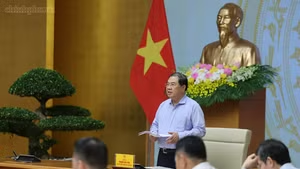
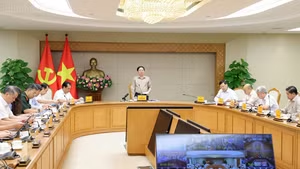
At a meeting of the Standing Board of the Hue City Party Committee on September 29, Hue City Party Committee Secretary Nguyen Dinh Trung described the disbursement rate as low and called for stronger measures to be implemented, with a target of achieving at least 95% of the plan.
In practice, disbursement progress varied considerably among project owners. The Department of Agriculture and Environment increased its disbursement rate from 35.9% on September 23 to 96.3% by the end of the month. The Infrastructure Management and Exploitation Centre reached 59.7%, while the Hue Monuments Conservation Centre reached 55.9%, disbursing an additional 91 billion VND in one week. The Area 3 Construction Investment Project Management Board achieved 58.7%, among other results.
These changes show that once procedures, documentation, and implementation conditions are unblocked, capital disbursement can accelerate rapidly. The challenge is to sustain this pace throughout the fourth quarter rather than merely achieve a sudden surge at the end of the period. Hue City Party Committee Secretary Nguyen Dinh Trung requested that the City People's Committee work with the State Treasury to review disbursement procedures, facilitate payments to contractors for completed work, and focus on resolving projects suffering from delays and prolonged obstacles.
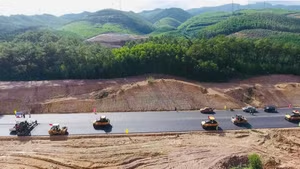
Alongside capital availability, site clearance remains one of the city's major bottlenecks. The main obstacles concern determining land origins and dates of use, land prices, compensation and support plans, resettlement arrangements, and the allocation of resettlement land. These issues have prevented some projects from being implemented in a coordinated manner. In addition, shortages of construction materials such as stone, sand, and fill soil, together with the risk of adverse weather towards the end of the year, are putting further pressure on construction schedules.
In the third quarter of 2026, the City People's Committee held more than 20 meetings directly related to site clearance and conducted several rounds of on-site inspections. As a result, the city issued Decision No. 89/2026 amending and supplementing regulations on compensation, support, and resettlement to address problems arising in practice. Progress has been recorded: approximately 180 hectares have been cleared for the Viet Nam – Singapore Industrial Park (VSIP) Hue project, and the city has leased 109.7 hectares out of the total 467 hectares; only one household has yet to hand over its land for the Ba Trieu Road project; and work is continuing to resolve site clearance issues along the To Huu Road route to Phu Bai Airport, with 587 metres remaining out of the total length of 10.1 kilometres.
During inspections of construction sites, Hue City People's Committee Chairman Le Tri Thanh called for site clearance to be managed as a key task, with clear completion deadlines, designated responsible units, and regular monitoring mechanisms, rather than being treated merely as an ancillary project procedure.
Removing bottlenecks and accelerating progress towards year-end
The city is translating the requirement to speed up implementation into concrete action on individual projects. Throughout the first days of September, city leaders conducted on-site inspections, while efforts focused on resolving numerous site clearance bottlenecks. During inspections of key projects, including Hue High School For The Gifted and the Don Sam Multifunctional Cultural Area and Park, Vice Chairman of the Hue City People's Committee Tran Huu Thuy Giang called on project owners to mobilise resources, closely follow implementation plans, and ensure construction progress and quality.
For the Don Sam Park project, the Department of Agriculture and Environment along with Thanh Thuy Ward were instructed to complete the land allocation to Central Park Joint Stock Company for the area where site clearance had been completed. City leaders also urged relevant units to strictly implement the conclusions of the Hue City People's Committee Chairman on resolving obstacles affecting public investment projects and projects financed by non-budgetary capital, ensuring that administrative procedures did not hamper progress.
Alongside site clearance, Hue City is focusing on projects that could be completed but are being held up by procedures, acceptance inspections, and payment processes. The city is also proactively reallocating capital, in accordance with regulations, from projects unable to disburse their full allocations. Projects with favourable construction conditions must be prioritised for the mobilisation of labour, equipment, and materials, with construction organised appropriately to make the most of the remaining time in the year.
Another resource that needs to be unlocked soon is public property. As of September 30, the city had dealt with only 296 of the 597 surplus buildings and land sites, equivalent to 49.6%. Delays in reorganising and putting these assets to use not only cause waste but also slow their conversion for public services, service provision, and other appropriate development purposes.
Regarding revenue, state budget revenue in the city had reached 12,195 billion VND as of September 30, equivalent to 76.2% of the 16,000 billion VND estimate. In the final week of September alone, budget revenue increased by a further 125 billion VND. However, land-use fees and land rental payments accounted for 3,337 billion VND of total revenue, indicating that the city still needs to strengthen sustainable revenue sources from production, business, and services rather than rely heavily on land-related income.
According to the City Department of Finance, total investment capital implemented in the city during the first nine months of 2026 was estimated at 28,516 billion VND, up 12.4% year on year. Of this, state capital accounted for approximately 8,112 billion VND, an increase of 19.2%, while non-state capital reached 18,142 billion VND, up 15.1%. This provides an important foundation for further mobilising social resources, but investment effectiveness depends on the ability to bring projects into operation on schedule.
Meanwhile, Hue's GRDP was estimated to have grown by 9–9.5% over the first nine months, against a full-year target of at least 10%. This gap underscores the need for public investment to play a stronger role in stimulating production, creating jobs, improving infrastructure, and expanding development opportunities.
Hue City Party Committee Secretary Nguyen Dinh Trung said that the key task between now and the end of the year was to review each project, identify obstacles, set deadlines for resolution, and clarify the responsibilities of each agency and unit. Issues falling within the jurisdiction of local authorities must be resolved definitively, while difficulties beyond their authority must be reported promptly. Inspections must be tied to implementation results, with resolute action to address the avoidance and shifting of responsibilities.
“The target of disbursing at least 95% of planned capital cannot be achieved solely through short-term acceleration drives. What matters is converting capital into actual completed construction work, ensuring quality and effectiveness, and bringing projects into use as soon as possible,” Nguyen Dinh Trung emphasised.
With site clearance obstacles removed, procedures streamlined in accordance with regulations, and responsibilities clearly assigned, public investment can truly become a lever for driving economic sectors forward and helping Hue City achieve its double-digit GRDP growth target in 2026.