

Viet Nam’s benchmark VN-Index fell by 0.38% to 1,698.35 points on October 15.
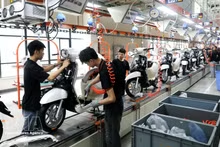
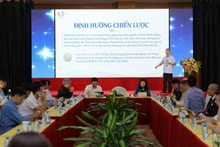
As localisation in FDI production chains currently stands at just 20-25%, Viet Nam is moving to link investment incentives to foreign firms’ commitments to develop domestic suppliers, a shift expected to tighten business linkages, lift added value and sharpen competitiveness.
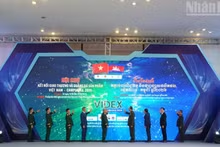
The Viet Nam-Cambodia Business Networking and Product Promotion Exposition (VIDEX CAMBODIA 2026) opened in Phnom Penh on October 14, bringing together 150 organisations and businesses with 189 booths to promote trade, investment and bilateral cooperation.

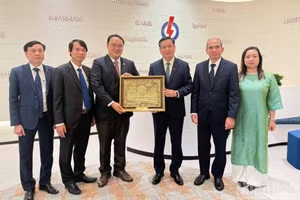
A delegation from the State Bank of Viet Nam (SBV), led by Governor Pham Duc An, participated in key activities in Bangkok, Thailand, on October 13-14 within the framework of the ongoing 2026 Annual Meetings of the International Monetary Fund (IMF) and the World Bank (WB) Group.
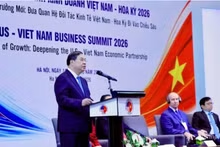
A series of major events aimed at promoting bilateral economic and trade cooperation took place in Ha Noi on October 14, including the ninth Viet Nam-US Business Summit and a seminar entitled “The US Market in 2026: Opportunities, challenges and breakthrough solutions”.
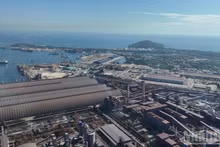
With a commitment to working alongside investors to resolve difficulties and obstacles, Dung Quat Economic Zone and Industrial Parks in Quang Ngai Province continue to affirm their role as a key growth driver and a major investment hub for the province, helping to increase budget revenue and shift the economic structure towards industrialisation and modernisation.

Resolution No. 27-NQ/TW sets out an entirely new philosophy of spatial governance: regional development is a method of organising national growth, shifting from a management mindset based on administrative boundaries to the creation, guidance, and unlocking of resources based on integrated ecosystems.

Within efforts to increase value and expand markets for OCOP products, one approach that has been promoted recently is to bring them into spaces that are frequented by tourists, such as restaurants, hotels, resorts, tourist attractions, ecological sites, and airports.

Public investment disbursement in the first nine months of 2026 increased in both rate and value compared with the same period last year. Alongside efforts to resolve obstacles affecting individual projects, methods of monitoring and assessing progress are also changing. From October, the disbursement performance of ministries, sectors and localities will be officially scored.

In the first nine months of 2026, banking activities in Ho Chi Minh City recorded positive growth, supported by flexible monetary policy. Credit flows were directed strongly towards key production and business sectors, as well as global supply chains, laying a solid foundation for the city to achieve its target of double-digit economic growth.

The annual flood season in the Mekong Delta not only brings abundant aquatic resources but also helps store water, deposit sediment and improve soil quality. By understanding and adapting to the natural flow of floodwaters, many localities are adopting flexible approaches that create new livelihoods for residents.

The banking sector is focusing on solutions to make cashless payments a genuine driver of financial inclusion. Nhan Dan spoke with Nguyen Phi Lan, Director of the State Bank of Viet Nam’s Forecasting and Statistics Department, about the issue.
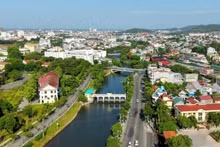
Public investment disbursement in Hue City surged in the final week of September but remained below the national average. Under pressure to complete the annual plan and strive for Gross Regional Domestic Product (GRDP) growth of at least 10%, the city is focusing on resolving site clearance bottlenecks and accelerating project implementation in the fourth quarter of 2026.

The Minister of Industry and Trade has signed Decision No. 2433/QD-BCT approving the scheme entitled “Developing Viet Nam’s commodity derivatives trading market for 2026–2030, with a vision to 2045.”
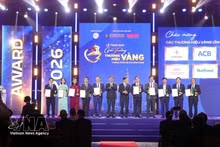
Ho Chi Minh City's Department of Industry and Trade and Tuoi Tre Online on October 13 presented the sixth Golden Brand Awards 2026, honouring 50 companies and organisations for achievements in brand building, innovation and sustainable development.
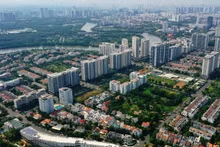
The apartment market in Ho Chi Minh City and neighbouring areas saw a clear shift, with price growth slowing down and buyers becoming more selective based on their financial capacity in the third quarter of 2026, while rising development and input costs continued to push up prices of newly launched landed-property projects, according to a report by Avison Young Viet Nam.
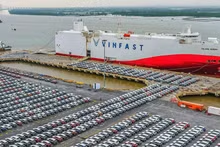
To elevate their position within the global value chain, Vietnamese enterprises must progressively master technology, develop high-value-added products, and build competitive brands capable of reaching the international stage.
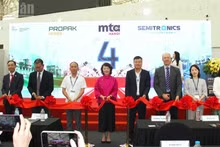
The opening ceremony for three international exhibitions of MTA Ha Noi 2026, SemiTronics Viet Nam 2026, and ProPak Ha Noi 2026 was held simultaneously at the Viet Nam Exhibition Centre (VEC) in Ha Noi on October 13.

Global gold prices fell to 4,187.1 USD per ounce on October 13. Domestically, SJC gold bar and ring prices declined in tandem with global rates, traded at 144.3 million VND per tael and 143.8 million VND per tael, respectively.

According to reports from specialised agencies in Dien Bien Province, a total of 350 projects and models to support production development have been implemented across the province using funding from the 2021–2025 National Target Programmes and funds carried forward into 2026.