However, against the backdrop of sustainable development requirements, the industry is facing a number of challenges. Among the most pressing is the shortage of timber suitable for value-added processing - a bottleneck that must be addressed without delay.
Paradox of harvesting immature timber
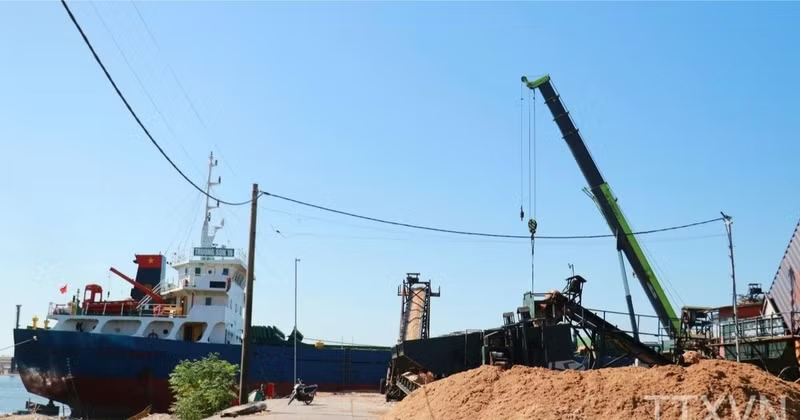
Viet Nam currently has around 4.9 million hectares of planted forests. Nevertheless, many wood-processing enterprises are struggling to secure sufficient raw materials for value-added processing and the production of high-quality products because a large proportion of timber is exported in the form of woodchips and wood pellets.
Pham Thanh Long, Raw Material Procurement Director of Trieu Thai Son Company Limited, a plywood manufacturer and exporter based in Trieu Son Industrial Park in Thanh Hoa, said that although the province has an extensive area of planted forests, the company faces considerable uncertainty in sourcing raw materials. This is largely due to the widespread harvesting of acacia trees after only three to four years of growth. Small, unregulated woodchip facilities have sprung up like mushrooms after the rain, purchasing timber at any price and creating persistent instability in the raw material market.
According to Long, this represents a paradox that must be acknowledged. Around 3 tonnes of freshly harvested acacia timber will generate only about 4 million VND when processed into export woodchips, or around 5 million VND if converted into wood pellets. However, if the same volume enters a value-added processing chain, such as plywood manufacturing, with by-products also fully utilised, it can generate as much as 20 million VND in value. Trieu Thai Son is not alone; many wood-processing manufacturers have had to reduce production or temporarily suspend production lines because of raw material shortages.
According to the Viet Nam Timber and Forest Product Association (VIFOREST), the total raw material demand - converted into timber volume - for the four principal export wood product categories in 2025 reached approximately 59.5 million cubic metres. Of this, woodchips and wood pellets accounted for 46.5 million cubic metres, or 78.1%, while engineered wood panels and exported wooden furniture consumed 13 million cubic metres, equivalent to 21.9%. These figures indicate that although Viet Nam possesses abundant timber resources, most are exported in low-value forms such as woodchips and pellets.
Doan Van Tinh, Chairman of the Board of MDF Mekong, noted that although woodchips contribute little to the industry's value chain, they continue to account for a significant share of forestry exports because export tax on woodchips is low, at around 2%, and is refunded, making the effective rate almost 0%. By contrast, value-added wood products are subject to taxes of 8% to 10%. Moreover, investment in a woodchip production line is relatively modest, whereas establishing a value-added processing plant requires substantial capital investment and compliance with stringent licensing requirements.
At present, planted forest production in Viet Nam is dominated by small-scale household forestry. Holdings are fragmented, technical capacity varies considerably, and financial resources remain limited. Under financial pressure and faced with everyday living expenses, many forest owners have little choice but to harvest plantations after only three to five years, despite recognising that immature timber commands lower prices. Some households with greater financial capacity are able to extend the rotation period beyond seven years, but because they lack documentation proving the legal origin of their timber, they are unable to sell to processing enterprises. As a result, they often harvest plantations after only three to four years to recover capital quickly and minimise exposure to natural disasters and market risks.
Building a sustainable timber supply chain
Removing the raw material bottleneck has become an urgent priority if the wood industry is to achieve sustainable growth and meet its target of 19 billion USD in export value in 2026. While enterprises require stable supplies of large-diameter timber with full traceability and compliance with international standards, many forest growers continue to favour short production cycles in order to recover capital quickly and reduce risk. This divergence in objectives has created a mismatch between market demand and production decisions, which requires immediate measures as well as long-term structural solutions.
Many businesses in the wood industry have proposed that regulatory authorities reduce exports of raw timber by increasing export taxes on woodchips; introducing export quotas; strengthening inspections of woodchip mills, purchasing points, and unauthorised weigh stations; and taking firm action against facilities that fail to meet regulatory requirements. Any restrictions on raw material exports should be implemented in a manner that avoids disrupting the market while encouraging greater use of timber in value-added processing. To achieve long-term competitiveness, the industry must focus on products with higher technological content, greater labour input, and increased added value.
Ngo Sy Hoai, Secretary General of VIFOREST, believes that Viet Nam does not lack planted forests capable of supplying the wood industry. Rather, it lacks a stable supply of large-diameter, high-quality, legally sourced timber suitable for value-added processing. In practice, most household plantations continue to be harvested after three to five years and supply mainly woodchips, pellets, and certain engineered wood products which do not meet the requirements for manufacturing high-value furniture. He argued that four fundamental issues must be addressed simultaneously: fragmented landholdings and small-scale production; insufficient economic incentives for growing large-diameter timber; inadequate tree varieties and silvicultural techniques for longer rotations; and weak linkages between processing enterprises, forest growers, and cooperatives.
One of the most important transformations required is a shift in forest growers' mindset towards sustainable plantation forest management. Rather than treating forests as short-term crops for rapid capital turnover, plantations should be managed as long-term assets through the selection of appropriate tree varieties, optimisation of planting density, effective pest management, protection of soil and water resources, carbon management, and harvesting based on quality objectives. Under this approach, forest owners would no longer sell timber solely by weight but could market it according to diameter, quality, certification status, and suitability for further processing.
According to Nguyen Van Dien, Deputy Director General of the Department of Forestry and Forest Protection under the Ministry of Agriculture and Environment, the time has come for Viet Nam's wood industry to shift its focus from export volume to export value and establish a new development vision. Timber supplies must satisfy five essential criteria: legality, full traceability, zero deforestation, sustainable forest management certification, and low carbon emissions.
These are the foundations for deeper participation in global value chains. The department will continue to advise and direct efforts to expand large-diameter timber production areas; improve the productivity, quality, and value of planted forests; increase the area of forests meeting sustainable certification standards; establish a digital traceability system down to individual forest plots; strengthen cooperation among forest owners, cooperatives, and processing enterprises to create stable raw material zones; and refine policies on credit, investment, forest insurance, forest environmental services, and carbon credit market development.