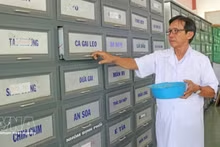
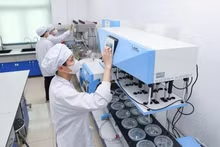
The Vietnamese pharmaceutical market has reached a value of approximately 7 billion USD and is growing by around 12 to 15% annually. Alongside improving production capacity, digital transformation is gradually changing the way medicines are managed, produced, distributed and used, thereby reducing procedures, increasing transparency and enhancing the ability to control the market.
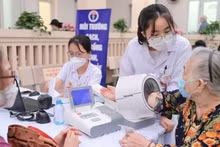
The Vietnamese people have a rich tradition of the moral values of “when drinking water, remember its source" and “respecting the elderly and honouring longevity”. This is a noble cultural value, carrying not only cultural significance but also political, social, economic, national defence and security significance in the new era.

International visitors are in need, hospitals have the necessary capacity, but the door to Viet Nam’s healthcare services remains blocked by a “bottleneck” in visa procedures. Medical visas therefore need to become the “key” to opening this procedural door so that patients do not have to turn to another country simply because of administrative barriers.
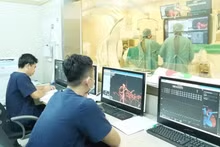
The healthcare sector is entering a new stage of development, with people’s demand for healthcare continuing to rise. Disease patterns are changing rapidly, non-communicable diseases are increasing, the population is ageing quickly, and issues related to mental health, the environment and nutrition are posing unprecedented requirements.
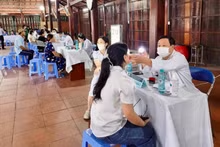
After more than three months of implementation, the health check-up programme for residents of Ho Chi Minh City has surpassed the four-million mark. The result reflects the coordinated efforts of local authorities and healthcare facilities, as well as strong public participation.

Prime Minister Le Minh Hung has directed the health sector to resolve supply bottlenecks and establish transparent mechanisms that ensure an adequate supply of medicines and medical equipment at reasonable prices.
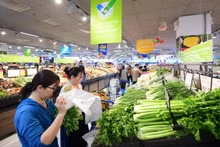
Food safety transcends an individual meal; it fundamentally impacts public health and demands accountability across the entire supply chain. At schools, where millions of pupils eat school meals every day, the need for food controls becomes increasingly critical.
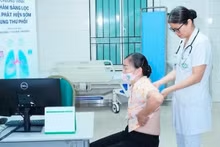
Viet Nam’s health insurance policy is entering a new phase of development, with participants entitled to greater benefits in healthcare and medical examination and treatment. In addition, a suite of new health insurance policies have recently taken effect, alongside plans for additional pilot schemes and the goal of achieving 100% health insurance coverage by 2030.
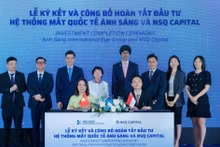
Anh Sang International Eye Care System and Singapore-based investment fund NSQ Capital have announced the completion of an investment designed to enhance professional expertise, training human resources, applying technology, and expanding access to ophthalmic services in Viet Nam.
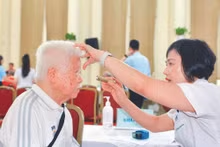
In order to build a network of healthcare facilities that meets the needs of the people in the new situation, particularly with the implementation of the two-tier local government model, the Ministry of Health has recently issued a decision to adjust the planning of the healthcare facility network for the 2021-2030 period, with a vision to 2050.
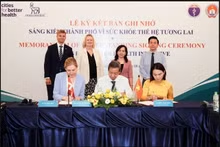
Ho Chi Minh City has become the first city in Viet Nam and the 57th globally to join the Cities for Better Health network, a Novo Nordisk-led initiative aimed at strengthening disease prevention, improving health literacy and building healthier communities.
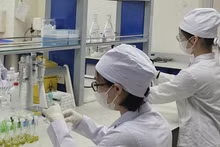
Pharmaceutical management is not confined to documents, dossiers or licences. It is a chain of responsibility extending from manufacturing plants to hospitals, and from management data to individual pharmacies and patients. The health sector is gradually standardising and harmonising its regulations while aligning with international practices, with the aim of ensuring that people have access to medicines that are safe, effective, of high quality and reasonably priced.
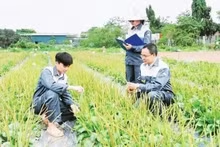
Traditional medicine is recognised as a pillar of Viet Nam's healthcare system in protecting and improving people's health. However, many experts believe that the sector has not realised its full potential due to the lack of a comprehensive legal framework and effective implementation mechanisms.
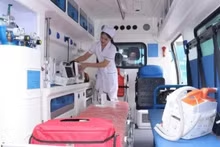
On August 10, the Prime Minister issued Decision No. 1515/QD-TTg approving the project “Development of the pre-hospital emergency care system for the 2026-2030 period”.

With rich medicinal herb resources and a long-standing traditional medicine system, Viet Nam is now well-positioned to build a modern, sustainable medicinal herb industry with international competitiveness. However, translating this potential into reality requires many mechanisms and policies, in which science, technology, and digital transformation play a pivotal role.

The Drug Administration of Viet Nam under the Ministry of Health hosted a ceremony on August 7 to commemorate its 30th anniversary (August 13, 1996–August 13, 2026).
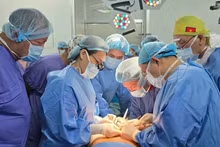
Politburo Resolution No. 72-NQ/TW, issued on September 9, 2025, sets out the goal of developing a modern, equitable, high-quality, efficient, and internationally integrated healthcare system. Achieving this objective will require a broad range of measures, including investment in specialised medical centres alongside improvements across the healthcare system, as well as greater application of science and technology, innovation, digital transformation, and international cooperation.
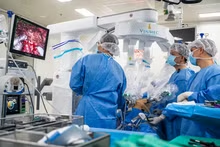
The Ha Noi Department of Health, in collaboration with the Vinmec Healthcare System, announced the successful completion of two-way remote robotic surgeries on August 3, with a network between Ha Noi and Can Tho enabling two hospitals, located more than 1,700 kilometres apart, to alternate as both the remote command centre and the site where the patient undergoes surgery.
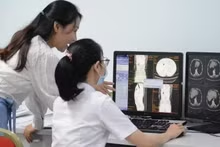
The Da Nang Oncology Hospital has successfully treated a patient with non-small cell lung cancer (NSCLC) carrying both EGFR and ALK gene mutations simultaneously – an exceptionally rare condition in both medical literature and clinical practice.
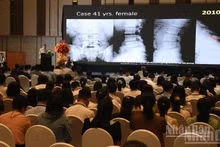
The International inter-hospital scientific conference 2026, held under the theme "Evidence-based medicine from multidimensional perspectives", opened at the Ariyana International Convention Centre in Da Nang on the morning of August 1, attracting more than 800 delegates from Viet Nam and overseas.