

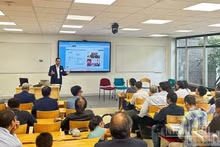
Experts said that urgent requirements for Viet Nam’s nuclear power programme include preparing human resources, absorbing international knowledge and experience, and establishing cooperation mechanisms that enable overseas Vietnamese intellectual resources to make effective contributions to the country.
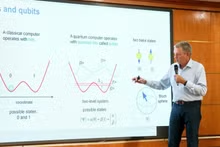
After more than one year of implementing Politburo Resolution No. 57-NQ/TW dated December 22, 2024, on breakthroughs in science, technology, innovation and national digital transformation, quantum technology has been placed at the centre and specified in the list of strategic products and technologies. Therefore, this technology is not merely a matter of scientific research, but a strategic issue for national development.
Resolution No. 19-NQ/TW, dated July 28, 2026, adopted at the third Plenum of the 14th Party Central Committee on renewing Viet Nam’s development model, sets out the task of strongly developing new growth drivers from high-tech industries.
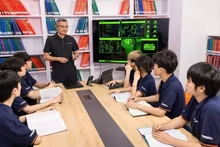
The “three-party” cooperation model, which involves the state, universities, and enterprises, is opening a new means of organising resources for science, technology, and innovation. However, for knowledge to truly move from laboratories to the market, the three actors need to be closely connected within a unified coordination mechanism.

The second World Humanoid Robot Games took place at the National Speed Skating Oval, known as the “Ice Ribbon”, in Beijing from August 22 to 26.
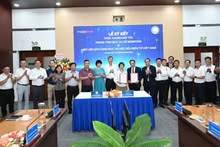
The MobiFone Digital Services Centre and the Viet Nam Association of Educational Books and Electronic Learning Materials (VAEDR) have signed a Memorandum of Understanding on cooperation towards researching and building a national learning portal and a shared open learning resource repository, while also coordinating in national education digital transformation tasks and projects.
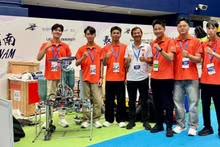
The journey of LH-FOF team from Viet Nam's Lac Hong University at the 2026 Asia-Pacific Broadcasting Union Robot Contest (ABU Robocon) in Hong Kong (China) officially came to an end on the evening of August 23, securing third place overall.

An additional 7.1GW is augmenting future supply, while 1.4GW of new capacity has commenced operations across the Asia-Pacific (APAC) region. Southeast Asia accounts for around 50% of the region’s total capacity under construction. The investment surge in AI and hyperscale data centres is advancing into emerging markets, including Viet Nam.
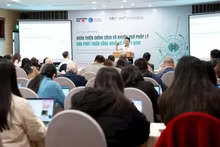
Alongside its undeniable benefits and positive value, cyberspace is facing a rise in harmful, deviant, and even unlawful content, with worrying consequences for social life.
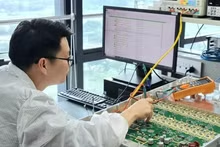
Under a new financial mechanism for strategic technology research and development tasks, chief engineers may receive remuneration reaching up to 300 million VND per month. Funding will be disbursed based on the results of each stage, while controlled research risks will also be accepted.
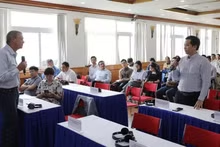
International cooperation in science and technology enables Viet Nam to absorb knowledge, affirm its position, narrow the development gap, master new technologies and enhance national competitiveness.
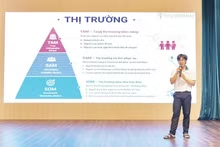
The green transition is placing demands on comprehensive innovation across the processes of production, processing and circulation of goods. In this context, many universities and colleges have created spaces for students to propose solutions to increase the value of agricultural products and local products through technology, circular thinking and supply chain management.
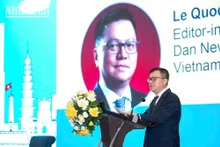
The WAN-IFRA Viet Nam 2026 International AI Forum, held on August 14 in Ha Noi, became a gathering place for innovative thinking, where leading news organisations shared evidence-based lessons on integrating AI into the modern news flow.

On the morning of August 14, the National Innovation Centre (NIC) under the Ministry of Finance held a launch ceremony in Ha Noi for the Viet Nam-Asia Quantum Summit 2026, opening the way for the official programme scheduled to take place in November 2026.
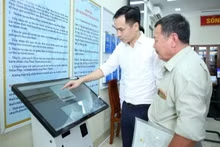
Deputy Prime Minister Ho Quoc Dung signed Decision No. 1555/QD-TTg, issuing a training and professional development framework on data governance, on August 13.

Ha Noi will emerge as the epicentre for the region's media industry as it hosts the 2026 WAN-IFRA Viet Nam International Artificial Intelligence (AI) Forum, on August 14.
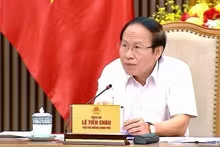
Deputy Prime Minister Le Tien Chau signed Decision No. 1528/QD-TTg, on August 11, approving the National Programme on Developing Artificial Intelligence Human Resources through 2030, with a vision to 2035 (the Programme), designed to cultivate a workforce of sufficient scale, structure, and quality to meet the development needs of strategic technology industries and enhance national technological self-reliance.

After the Government issued Decree No. 174/2026/ND-CP on penalties for administrative violations in the fields of postal services, telecommunications, radio frequencies, electronic transactions, and information technology, which took effect on July 1, 2026, some fabrications and inaccuracies about the decree began circulating in cyberspace.
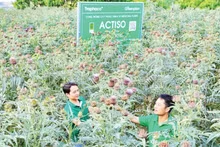
With rich medicinal herb resources and a long-standing traditional medicine system, Viet Nam is now well-positioned to build a modern, sustainable medicinal herb industry with international competitiveness. However, translating this potential into reality requires many mechanisms and policies, in which science, technology, and digital transformation play a pivotal role.
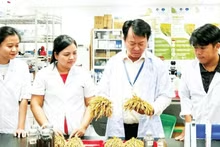
As science, technology, innovation and digital transformation increasingly become the principal drivers of economic growth, Can Tho is regarded as having significant advantages to emerge as the innovation hub of the Mekong Delta.