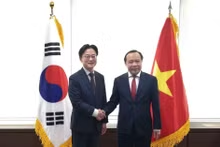
The Korean Ministry of Trade, Industry and Resources (MOTIR) was urged to share practical lessons from its nuclear sector with Viet Nam, including institutional and policy frameworks governing the roles of policymaking and regulatory agencies, advanced nuclear power technology, experience in building a domestic nuclear supply chain, and long-term workforce training through specialised courses, hands-on work and staff exchanges.
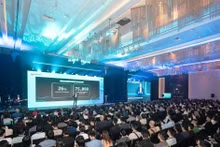
Viet Nam is working towards building a technology ecosystem that enables it to harness, master and develop artificial intelligence (AI), cloud computing and sustainable digital infrastructure, thereby fostering innovation.
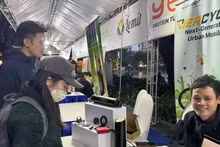
The Ministry of Science and Technology has approved the national programme for innovative startups for the 2026–2035 period, shifting the focus from general startup support to removing bottlenecks and connecting the various links within the ecosystem.
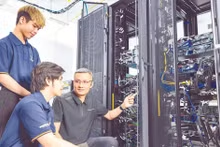
Amid rapid digital transformation, personal data is not only closely linked to every individual’s right to privacy but has also become an important resource for national governance, the development of digital government and the digital economy, and the building of a digital society.

As science, technology, and innovation become key drivers of socio-economic development, scientific data is emerging as a strategic resource that is no less valuable than traditional resources such as human resources, finance, and physical infrastructure.
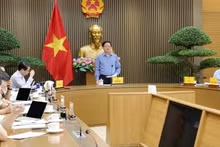
Deputy Prime Minister Ho Quoc Dung has requested the urgent selection and development of national key laboratories based on their capacity, practical needs, and potential to reach high standards, with a focus on strategic technology fields under Decision No. 1483/QD-TTg.
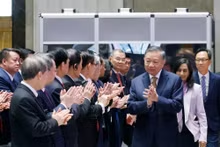
Viet Nam-Canada relations are expanding from trade cooperation to knowledge-intensive fields, including science, technology and innovation. More than two decades ago, Vietnamese businesses had already established a presence and cooperation in Canada, and the shift in relations between the two countries is opening up many new opportunities.
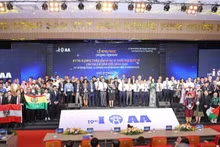
The 19th International Olympiad on Astronomy and Astrophysics (IOAA 2026) officially opened at Phenikaa University in Ha Noi on September 26, drawing 67 teams and 320 contestants from 66 countries and territories.

Innovating communication and the dissemination of knowledge remains a critical mission for the intellectual community. In recent years, science communication and knowledge dissemination efforts led by scientific intellectuals have expanded widely, yielding positive results. However, communication and knowledge dissemination require more professional and effective approaches.

Over the past period, numerous public services have been brought onto digital platforms, with the rate of online dossiers reaching a high level. However, behind digital interfaces, manual processing steps and requirements for paper documents still remain. Resolving this bottleneck is a prerequisite for digital transformation to truly reduce time and costs for people and businesses, while also easing administrative pressure.

As the 6G network, unmanned aerial vehicles, and high-speed rail develop, demand for frequency usage is growing in both scale and diversity. Effective planning and allocation of frequency resources need to stay one step ahead, creating safe and stable connectivity infrastructure for strategic technologies.

From unmanned substations and remote control to monitoring robots, technological solutions are gradually transforming power grid operations in central Viet Nam.
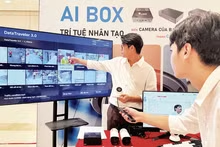
Developing artificial intelligence (AI) models in Viet Nam requires large volumes of high-quality and diverse data. However, harnessing this resource raises concerns regarding intellectual property rights and the scope of lawful use of protected content.
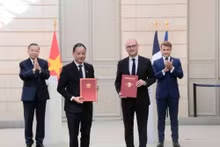
In the technological era, science and technology diplomacy is not merely an option but an inevitable trend for all countries, particularly developing ones. International integration through cooperation and connectivity in science and technology enables countries to gain faster access to the global flows of knowledge, technology and high-quality human resources.
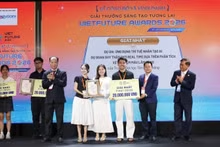
The Viet Nam Software and IT Services Association (VINASA) held a ceremony to announce and honour the winners of the VietFuture Awards 2026 in Ho Chi Minh City on September 18.
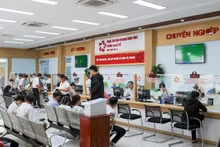
Digital transformation is entering a phase in which its effectiveness is being demonstrated through concrete changes in governance and people's daily lives. During the 100-day campaign to remove bottlenecks — from connectivity and data sharing to simplifying administrative procedures and implementation — the requirement is to remove barriers so that the government can serve people more quickly, effectively, and transparently.
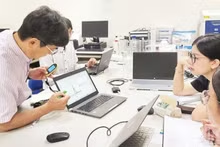
Viet Nam's system of national key laboratories and research and testing centres has laid the foundations for advances across a range of science and technology fields. However, it has not yet developed the research and testing capacity needed to master strategic technologies.
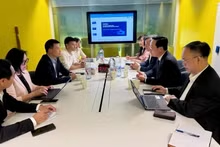
A delegation from the Communist Party of Viet Nam (CPV) Central Committee’s Commission for Policy and Strategy paid a working visit to France from September 13-16, focusing on exchanging experience in science and technology, innovation, startup ecosystems and human resources development.
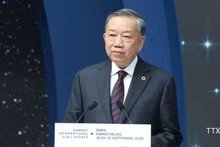
International cooperation in science and technology is facing a requirement to not only expand connections or acquire knowledge but also to contribute to building research capabilities, creating products, and enhancing technological mastery. For businesses, this means that every cooperation partnership must result in additional capabilities that can continue to be developed domestically.
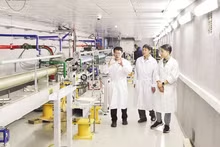
Despite various policies and measures to promote science, technology and innovation, basic research in nuclear science continues to face constraints in human resources, facilities, funding and management mechanisms.