Science, technology, innovation, and digital transformation are gradually becoming important drivers of socio-economic development, enhancing governance effectiveness, and improving the quality of services provided to people and businesses.
From mindset to action
According to the provincial Steering Committee, as of July 31, Phu Tho had implemented 276 tasks related to Resolution No. 57 and tasks assigned by the central authorities; 169 had been completed, eight were on schedule, and 99 were regular tasks.
Digital transformation has brought clear changes to governance methods. Digital platforms have been deployed consistently from the provincial to grassroots levels, meeting the requirements of operating the two-tier local administration. The rate of online administrative procedure applications exceeded 98%, while the rate of electronic document processing within Party agencies exceeded 94%, the highest in the country.
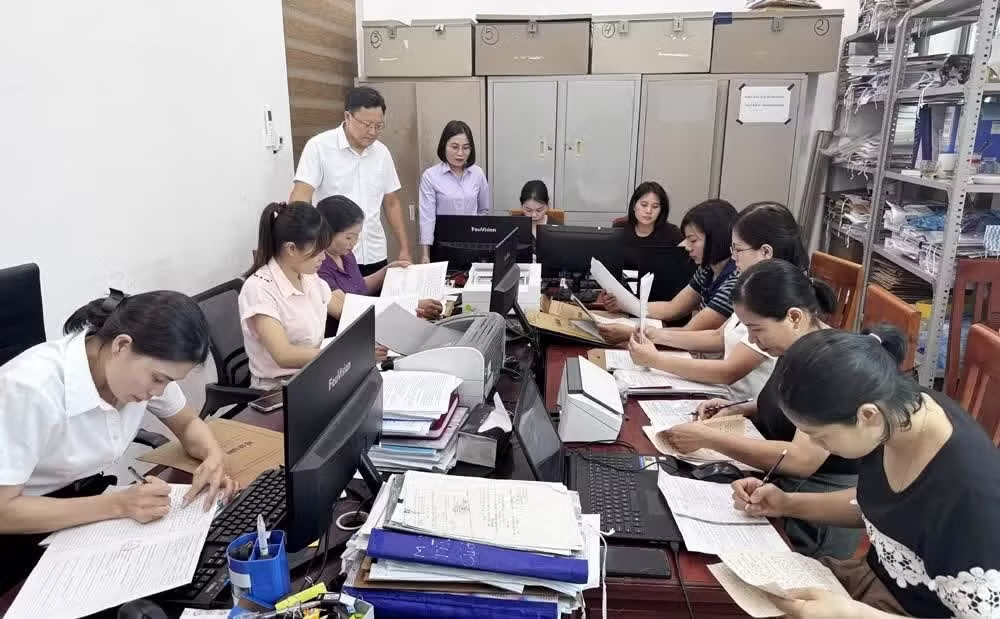
From the provincial to grassroots levels, digital transformation is being translated into practical models. In Long Coc Commune, more than 80% of documents are processed entirely in the electronic environment. In 2025, more than 90% of over 1,400 administrative applications were submitted online, with about 99% processed on or ahead of schedule, and all applications digitised.
Notably, Long Coc selected Dong Khoai Hamlet, home to a large Dao ethnic community and facing difficult economic conditions, as a pilot model for digital transformation. Commune Public Security officers directly helped residents purchase SIM cards, obtain identity cards, and complete electronic identification procedures. To date, the hamlet has achieved 100% completion in the issuance of identity cards and electronic identification and the integration of various digital services.
Secretary of the Long Coc Commune Party Committee Nguyen Hoang Trung said digital transformation must start with things that are close and relevant to people. Commune officials go to every alley and every household, assist people who cannot travel to obtain identity cards, and guide elderly people in using VNeID and updating their documents. Through such practical actions, digital transformation is gradually reaching every household.
As a particularly disadvantaged mountainous commune, Trung Son is digitising records, standardising procedures, and improving the quality of services for residents, despite limitations in personnel, equipment, and connectivity. Secretary of the Trung Son Commune Party Committee Dinh Hai Nam said the locality had assigned officials to specific groups of tasks, strengthened mutual support, and made use of time outside working hours to complete data, ensuring progress.
Once data are digitised and procedures standardised, management becomes easier, while people can access services more quickly and transparently. However, to deepen digital transformation, continued investment in infrastructure and equipment, skills training, and additional resources for personnel directly involved in implementation are needed.
Laying the foundation for new growth

Phu Tho is gradually establishing a foundation for the digital economy and digital society, not only building a digital government. The digital economy is estimated to account for 22.71% of GRDP, ranking third among the country's 34 provinces and centrally-run cities. The province has around 600 businesses operating in the digital technology sector, while exports of digital industrial products are worth more than 7 billion USD. Electronics, computers, and optical products account for more than 38% of the total industrial sector.
Digital infrastructure continues to receive comprehensive investment. Fibre-optic broadband covers 100% of communes and wards, 4G covers 98% of the area, and nearly 1,000 new 5G stations have been developed, covering all central urban areas and industrial parks. The province no longer has any hamlets without mobile coverage under the criteria set by the Ministry of Science and Technology.
An important shift is that Phu Tho is changing its governance approach from a traditional administrative model to data-based governance. A real-time socio-economic management and administration system has been built on a “correct, sufficient, clean, and live” data platform, integrated with artificial intelligence to analyse, forecast, issue early warnings, and support administration.
Instead of relying mainly on manually compiled reports, provincial leaders can directly monitor and analyse data and issue directives through the system. Agencies and units can also track progress, task completion rates, and KPI and OKR indicators. This represents an important step forward in improving governance effectiveness.
At the same time, the province has synchronously deployed six national databases and seven key specialised databases, as well as 47 specialised databases managed by the province. It has completed the synchronisation of 100% of land data, implemented electronic academic records at 100% of educational institutions, and completed the digitisation of data on Party organisations and Party members.
Digital transformation is also making a clear impact on social life. More than 3.1 million citizens have been issued identity cards, while more than 2.4 million electronic identification accounts have been activated. All hospitals have implemented electronic medical records, and all general education schools use digital management and learning-resource systems. Models such as “Digital Family”, “Digital Market-Rural Digitalisation”, “Digital Village”, and community digital technology teams are helping improve digital skills and narrow the digital divide.
According to Director of the Phu Tho Department of Science and Technology Nguyen Minh Tuong, the core of implementing Resolution No. 57 is that digital transformation is no longer the sole responsibility of the information technology sector but has become a task for the entire political system. The goal is to improve management effectiveness, enhance services for people and businesses, and create new growth drivers.
Looking ahead, Phu Tho has determined that science, technology, and innovation must directly contribute to addressing major challenges, helping achieve the target of double-digit economic growth and build a new development model. As an immediate priority, the province is focusing on six “major challenges” centred around three pillars: enhancing the capacity of the governance system; developing the economy based on local advantages; and ensuring sustainable development and adaptation to natural changes.
To realise these goals, the province will continue to improve mechanisms and policies; develop an innovation ecosystem with businesses at its centre; promote the “State-School-Business” linkage; accelerate digital transformation across all sectors and fields; expand digital infrastructure; build a provincial data warehouse; and replicate effective grassroots models.
Director of the Phu Tho Department of Science and Technology Nguyen Minh Tuong added that Phu Tho will shift strongly from a mindset of “implementing tasks” to “creating value”, using socio-economic development outcomes, administrative reform, and the satisfaction of people and businesses as measures of success. Alongside improving mechanisms, the province will develop its innovation ecosystem, expand digital infrastructure, build a data warehouse, and replicate models such as community digital technology teams, “Digital Market-Rural Digitalisation”, and “Digital Ambassadors”.
With tangible results as the benchmark, science, technology, innovation, and digital transformation will continue to expand Phu Tho’s development potential, enhance its competitiveness, and lay a foundation for rapid and sustainable growth in the new period.