Bringing digital transformation into practical education governance
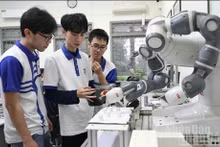
In the field of education, digital transformation is identified as one of the key approaches to supporting school governance, teaching organisation, and data management.
#digital transformation
Có 118 kết quả
In the field of education, digital transformation is identified as one of the key approaches to supporting school governance, teaching organisation, and data management.
The 14th National Congress of the Communist Party of Viet Nam (CPV) demonstrates the Party’s strong capacity for self-renewal and its ability to draw lessons from practice, as reflected in its frank acknowledgement of the limitations of the current development model and its firm commitment to continued reform, according to former Indian Deputy National Security Adviser S.D. Pradhan.
Viet Nam is seeking the United Nations (UN)'s policy guidance and international expertise to design AI and data governance frameworks, with the goal of developing practical guidelines for the public and private sectors, Minister of Public Security General Luong Tam Quang has said.
In the digital era, data is considered as a special resource that creates a driving force for socio-economic development. For tourism, an industry with strong connection and experience-based services, a standardised data system is a crucial condition to improve management capacity, competitive efficiency, and service quality.
Minister of Public Security General Luong Tam Quang on January 15 held talks with Singapore’s Minister for Digital Development and Information Josephine Teo, who is in Ha Noi to attend the 6th ASEAN Digital Ministers' Meeting (ADGMIN).
Viet Nam remains firmly committed to being a proactive, active and responsible member of ASEAN’s digital cooperation, Prime Minister Pham Minh Chinh affirmed while addressing the opening ceremony of the 6th ASEAN Digital Ministers' Meeting (ADGMIN 6) and related meetings in Ha Noi on January 15.
National Assembly Chairman Tran Thanh Man on January 14 presented certificates of merit from the NA Standing Committee to three collectives and 11 individuals for their outstanding performance in the legislature’s digital transformation in 2025.
Digital transformation has gradually brought many benefits to citizens and businesses. However, it remains necessary to renew governance thinking, improve institutions, and narrow the digital divide to ensure people truly become the centre of development.
As the country enters a new phase of development, two important resolutions of the Party Central Committee – Resolution No. 57-NQ/TW and Resolution No. 68-NQ/TW – have been identified as key foundations to help the private sector unlock resources, expand its development space, and create new breakthroughs in science and technology and digital transformation.
The “Party Member E-handbook” application stands out as a highlight. Implemented by Thai Nguyen Province since 2020, the app has achieved a registration rate of more than 92%, making the locality one of four selected by the central authorities for piloting.
The term of the 13th National Party Congress marked a turning point, as digital transformation was for the first time placed within an integrated strategic framework alongside science and technology, and innovation, becoming one of the foremost breakthrough priorities and a strategic pillar for national development in the new era.
Digital transformation is creating fresh momentum for the country’s development, but it is also bringing new challenges regarding information safety and cybersecurity. To protect a safe and healthy cyberspace, the decisive factor lies not only in technology, but also in having a high-quality workforce — the foundation for safeguarding national security and digital sovereignty.
The resolution has affirmed that in the digital era, science, technology and digital transformation are no longer optional but mandatory conditions, while innovation has evolved from a research activity into a core driver of national growth.
The 2025 Autumn Economic Forum, themed “Green transition in the digital era”, had been a success in terms of scale, content and external engagement. It had served as a practical platform for policy dialogue, bringing together policymakers, international organisations, experts and businesses to discuss major global trends, identify emerging challenges and propose policy directions and solutions in the context of green and digital transformation.
The State leader highly valued the dedication and efforts of the leadership, staff, and employees of the Presidential Office for effectively advising and supporting State leaders in completing a heavy workload in December and throughout the term.
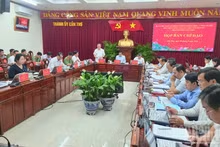
The Steering Committee for Digital Transformation in Party agencies held a conference on December 29 to review digital transformation work in Party agencies in 2025 and outline key tasks and solutions for 2026. Permanent member of the PCC’s Secretariat Tran Cam Tu, Head of the Steering Committee attended and chaired the conference.
The draft documents to be submitted to the 14th National Party Congress continue to affirm science, technology, innovation, and digital transformation as the core driving forces of the new growth model. These are decisive factors in improving productivity, quality, efficiency, and the competitiveness of the economy in the coming period.
Party General Secretary To Lam has highlighted groundbreaking actions and spreading results as the guiding motto for 2026, marking a shift from the “start-up and runway” phase in 2025 to a period of acceleration in the development of science, technology, innovation and digital transformation.
The Central Steering Committee for the Development of Science, Technology, Innovation and Digital Transformation held a conference in Ha Noi on December 25 to review its work in 2025 and outline key tasks and solutions for 2026. Party General Secretary To Lam chaired the conference and delivered a keynote address.
On the mist-covered mountain slopes by Muong Hoa Stream, brocade looms have long been intertwined with the livelihoods of generations of Giay and H’Mong women. There was a time when this traditional craft faced the risk of fading away as markets shrank, tourism was disrupted, and outlets became increasingly unstable.