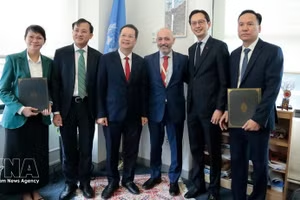
Chinese President Xi Jinping will pay a state visit to the United States from Sept. 23 to 25 at the invitation of U.S. President Donald Trump, a Chinese foreign ministry spokesperson announced on Monday. During the visit, Xi and Trump will have an in-depth exchange of views on major issues concerning China-U.S. relations and world peace and development, Chinese foreign ministry spokesperson Guo Jiakun said at a regular news briefing.
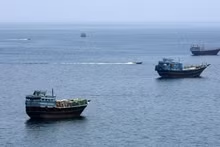
The world is facing a severe energy supply shock as disruptions occur simultaneously along two strategic shipping routes — the Red Sea and the Strait of Hormuz.

Paraguayan President Santiago Pena arrived in Caracas on Saturday for talks with Venezuela's acting President Delcy Rodriguez, aimed at restoring institutional contacts and gradually normalizing bilateral relations.
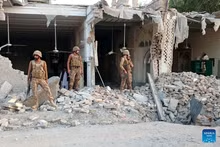
Swedish Parliament Speaker Andreas Norlen on Friday tasked Social Democratic Party leader and former Prime Minister Magdalena Andersson with exploring the prospects for forming a new government.
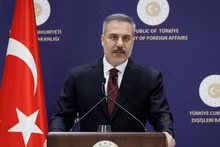
The Middle East is witnessing new, tense developments, with Syria at risk of becoming a flashpoint for confrontation between Israel and Türkiye. Firm statements from both sides, coupled with deterrent airstrikes by Israel against Syria, are exposing the tug-of-war for influence between Tel Aviv and Ankara on the Syrian geopolitical chessboard.

Elections for deputies to the ninth convocation of the State Duma, the lower house of parliament, have kicked off across Russia, with the first polling stations opening in the country's easternmost regions.

The 70th session of the International Atomic Energy Agency (IAEA) General Conference recently opened in Vienna (Austria), with a key focus of discussion being the promotion of nuclear energy development for peaceful purposes.
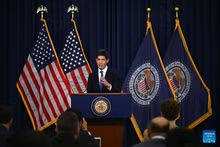
The Central Bank of Cuba said Wednesday it had put new 10,000- and 20,000-peso banknotes into circulation as part of measures to facilitate cash transactions and adapt currency denominations to current economic conditions.
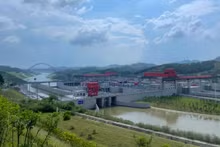
The Pinglu Canal, a key project along China's New International Land-Sea Trade Corridor, has officially been completed and put into operation, providing the shortest, most cost-effective and convenient route to the sea towards connecting southwestern China with ASEAN.
In just a few years, artificial intelligence (AI) has moved beyond being a new technology to become a field that is attracting a powerful wave of investment and reshaping the global economy.
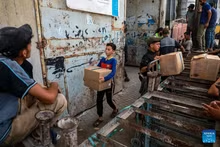
The U.S. State Department on Tuesday urged American citizens to reconsider travel to Saudi Arabia, citing heightened security risks amid Iranian drone and missile attacks.
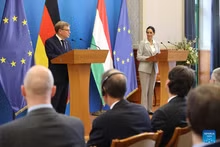
Japanese Prime Minister Takaichi Sanae, who also heads the ruling Liberal Democratic Party (LDP), announced Tuesday that she will reshuffle the party's executive lineup on Wednesday and her cabinet on Thursday, Jiji Press reported. The announcement was made at a meeting of LDP executives held at the party's headquarters in Tokyo.
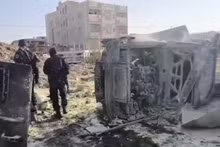
Fierce clashes between Houthi forces in Yemen and Saudi Arabia in recent days have caused serious concern among the international community. The tit-for-tat attacks between the two sides have added fuel to the already burning Middle East — a region that remains fraught with tensions.

A meeting between Iran and Gulf states scheduled to take place in the Omani city of Salalah on Monday has been postponed, according to a social media post by Omani Foreign Minister Sayyid Badr bin Hamad Al Busaidi on Sunday.
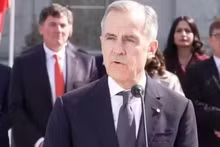
Canadian Prime Minister Mark Carney has held frank discussions with US President Donald Trump regarding outstanding issues in their bilateral trade relationship. This move signals an easing of tensions over tariffs between the two North American neighbours.

Polling stations opened across Sweden on Sunday morning in a closely watched parliamentary election that could see the far-right Sweden Democrats (SD) enter government for the first time or the center-left return to power after four years in opposition.
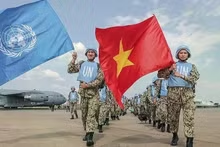
Over more than 80 years of its existence and development, the United Nations has consistently been a “flagship” in efforts to prevent conflicts, maintain peace and build a better life for its member states.
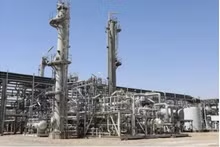
The conflict in the Middle East has driven up energy costs and disrupted supplies, putting pressure on Europe, which remains heavily dependent on imported fossil fuels. Amid surging inflation, the European Central Bank (ECB) has raised its key interest rate by 0.25 percentage points to 2.5%, while the European Union (EU) is pursuing strategies to strengthen its resilience to global energy shocks.

When addressing the Session I of the 18th BRICS Summit on Saturday in New Delhi, Chinese President Xi Jinping said that the BRICS cooperation mechanism has become the world's most influential platform for cooperation among emerging markets and developing countries.

The Asia-Pacific Economic Cooperation (APEC) CEO Summit 2026 will be held in Shenzhen, south China's Guangdong Province, from Nov. 17 to 18, the China Council for the Promotion of International Trade (CCPIT) said on Thursday.