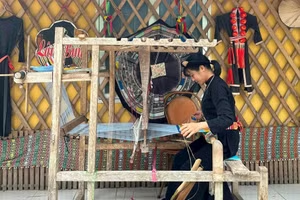
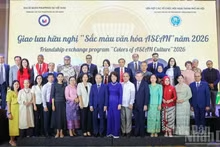
A friendship exchange programme featuring traditional music, costumes, dances, and cuisine from Viet Nam and other Southeast Asian countries was held in Ha Noi on August 19, highlighting the region’s rich cultural diversity and promoting people-to-people ties.
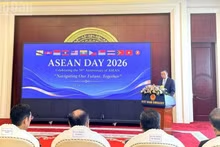
On August 13, the Vietnamese Embassy in China, in its capacity as rotating Chair of the ASEAN Committee in Beijing (ACB), held an event to mark the 59th anniversary of ASEAN, with the participation of ambassadors and representatives of ASEAN member states and the ASEAN-China Centre.
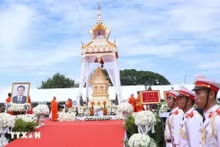
A State memorial service and burial ceremony for Xaysomphone Phomvihane, Politburo member of the Lao People's Revolutionary Party (LPRP) Central Committee and President of the Lao National Assembly, was solemnly held at That Luang Square in Vientiane on August 12.
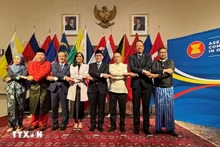
Amid geopolitical and international trade uncertainties, ASEAN and Canada are expanding cooperation under their Strategic Partnership, with a focus on trade, market diversification, technology and clean energy, and Viet Nam is seen as well-positioned to play a positive role.
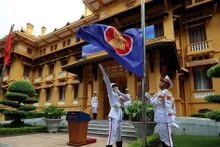
Viet Nam will continue to serve as a positive factor in helping shape major strategic shifts and the future development of ASEAN, Minister of Foreign Affairs Le Hoai Trung has affirmed.
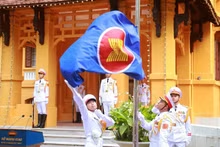
Since joining ASEAN in 1995, Viet Nam has consistently regarded the bloc as a cornerstone of its foreign policy, actively engaging in all three ASEAN Community pillars and cooperation mechanisms.
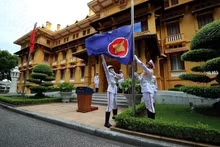
Minister of Foreign Affairs Le Hoai Trung said ASEAN has grown from a historic decision to replace division with dialogue and confrontation with cooperation into a community of peace, progress, and shared prosperity, with an economy worth 3.9 trillion USD and a population of nearly 700 million.
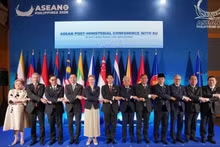
Thirty-one years ago, on July 28, 1995, Viet Nam formally acceded to the Association of Southeast Asian Nations (ASEAN), marking a historic milestone in the country’s development and international integration.
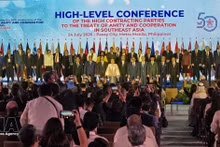
Minister of Foreign Affairs Le Hoai Trung led a Vietnamese delegation to a ceremony in Manila, the Philippines, on July 24 marking the 50th anniversary of the Treaty of Amity and Cooperation in Southeast Asia (TAC).
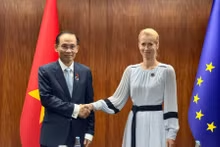
Vietnamese Minister of Foreign Affairs Le Hoai Trung held separate bilateral meetings with Philippine Secretary of Foreign Affairs Maria Theresa Lazaro, Vice-President of the European Commission and EU High Representative for Foreign Affairs and Security Policy Kaja Kallas, and Norwegian Minister of Foreign Affairs Espen Barth Eide, on the sidelines of the 59th ASEAN Foreign Ministers' Meeting (AMM-59) and related meetings in the Philippines on July 23.
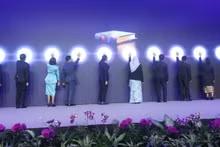
At ASED 14, the ASEAN Education Work Plan 2026–2030 was launched, setting out the region’s shared priorities for building inclusive, comprehensive and transformative education systems. The plan focuses on nurturing resilient and well-rounded individuals, developing a highly skilled and competitive workforce, and strengthening a common ASEAN identity rooted in shared values.
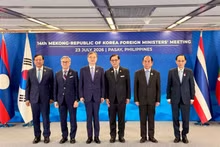
In its capacity as co-chair in 2025, Viet Nam worked closely with the RoK and the Mekong countries to maintain high-level exchanges, enhance the effectiveness of the Mekong–RoK Business Forum, organise the Mekong–RoK Forum for the first time to share project outcomes and implementation experience, and promote innovative solutions in water resource management through the third Mekong–RoK Water Forum.
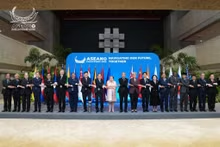
Vietnamese Minister of Foreign Affairs Le Hoai Trung stressed the importance of maintaining peace and stability and upholding international law and commonly accepted norms of conduct across all regions, including the East Sea/South China Sea.
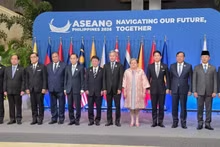
Vietnamese Minister of Foreign Affairs Le Hoai Trung affirmed that ASEAN would continue working with China to fully and effectively implement the Declaration on the Conduct of Parties in the East Sea/South China Sea (DOC) and to conclude at an early date a substantive and effective Code of Conduct in the East Sea (COC) that is consistent with international law, particularly the 1982 United Nations Convention on the Law of the Sea (UNCLOS).
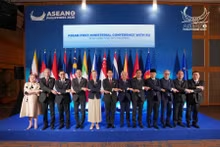
Looking ahead, Viet Nam proposed the two sides prioritise stronger regional resilience by scaling up energy cooperation, pooling financial resources and cracking down on illegal, unreported and unregulated fishing, all aimed at building a resilient and sustainable blue economy.
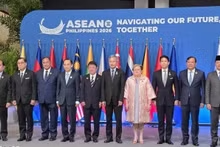
The Vietnamese minister underscored ASEAN+3's role as a strategic platform for deepening regional economic integration, strengthening resilience and helping build a peaceful and prosperous future for the region.
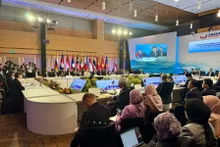
Minister of Foreign Affairs Le Hoai Trung proposed that ASEAN–UK cooperation shift its focus from growth to enhancing resilience, self-reliance and innovation on the basis of increasingly strengthened mutual trust.
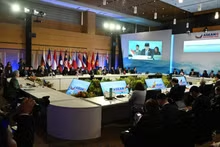
The Vietnamese delegation proposed making energy security and transition a pillar of ASEAN-Canada relations, and urged Canada to support the implementation of the ASEAN Power Grid and expand cooperation in renewable energy, hydrogen, energy storage and nuclear power for civilian purposes.
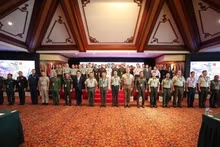
Viet Nam has shared its experience and reaffirmed its commitment to United Nations (UN) peacekeeping at the 22nd ASEAN Defence Ministers' Meeting-Plus (ADMM-Plus) Experts' Working Group (EWG) on Peacekeeping Operations, with a strong focus on advancing the Women, Peace and Security (WPS) agenda.
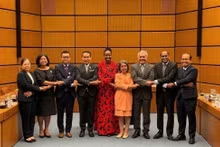
Viet Nam highly values UNODC’s support for ASEAN and the region and calls on the organisation to continue prioritising capacity-building programmes, technical assistance, and the effective implementation of international legal instruments against transnational crime, Vietnamese Ambassador to Austria Vu Le Thai Hoang has said.