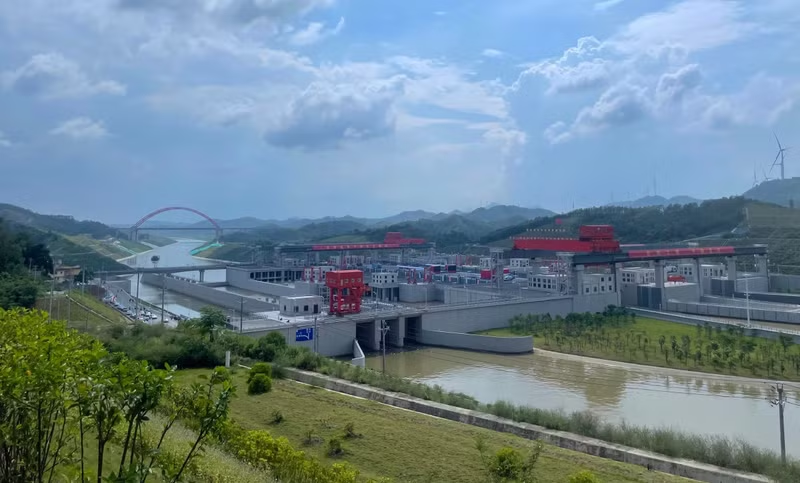
The first international shipping route on the Pinglu Canal, connecting Nanning and Can Tho of Viet Nam, and the first domestic route, connecting Nanning and Yangpu in Hainan, were launched in both directions, on September 16.
Fourteen cargo vessels carrying sugar, construction materials, minerals, steel and other goods began their maiden journeys from inland areas to the sea, while 16 cargo vessels carrying coal, iron ore, bauxite, fertiliser, stone and other goods successfully travelled upstream into the Xijiang River basin.
The 134.2-kilometre project allows vessels of up to 5,000 tonnes to pass through.
The project has set a number of world records in terms of traffic capacity, vessel transit speeds through ship locks and the scale of its ship-lock system, among other areas.
Once the Pinglu Canal is put into operation, the distance to major ASEAN ports will also be significantly reduced, while total logistics costs are expected to fall by 18% to 30%.
With the construction of the China-ASEAN Free Trade Area 3.0 advancing in depth, the Pinglu Canal serves as a core physical artery, deeply connecting the industrial, supply, and value chains of China and ASEAN. It is more than just a logistics corridor; it is a cooperation corridor, facilitating the flow of goods and fostering new opportunities for development, thus providing strong support for the China-ASEAN partnership.