
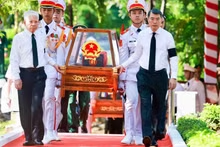
On the morning of October 14, a ceremony was held in Ho Chi Minh City to commemorate and bury the remains of 731 fallen soldiers, whose remains were recovered at Le Thi Rieng Park. The ceremony was attended by Prime Minister Le Minh Hung.
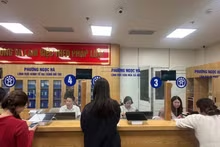
In the coming period, ministries, sectors, and localities will continue to effectively and synchronously implement administrative procedure reform tasks, especially the 11 resolutions recently issued by the government on the delegation of powers, decentralisation, reduction and simplification of administrative procedures, etc., ensuring that people and businesses genuinely benefit from the results.

Prime Minister Le Minh Hung attended a memorial and reburial ceremony in Ho Chi Minh City on October 14 for the remains of 731 fallen soldiers recovered from Le Thi Rieng Park, paying tribute to those who sacrificed their lives for national peace, independence and freedom.
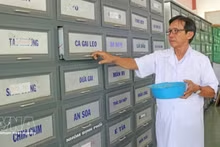
Viet Nam aims to develop a comprehensive, modern and science-based traditional medicine sector with stronger international integration, making it an important part of the national healthcare system by 2030, according to a newly-approved national strategy.
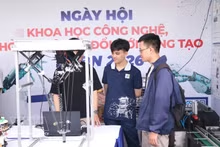
Deputy Prime Minister Ho Quoc Dung has signed a decree stipulating breakthrough development mechanisms for innovation and the exploitation of national data, as well as activities at the Data Innovation and Exploitation Centre under the National Data Centre.
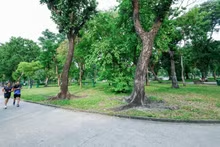
As land becomes increasingly scarce and demand for urban infrastructure continues to grow, underground space is emerging as a potential development resource for Ho Chi Minh City, particularly with transport infrastructure becoming an urgent priority.

Social media and smart devices are transforming the way young people participate in society. In the past, cyberspace was primarily used for entertainment and personal expression. In recent years, however, a growing number of Vietnamese youth have actively expressed their views on issues of public concern through online platforms.

The giant softshell turtle of Hoan Kiem Lake, an extremely rare species, faces formidable conservation challenges. Determining whether any individuals remain in Dong Mo Lake will require further scientific evidence and practical measures, which could help locate and conserve the last known genetic resources of this unique species.
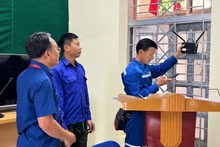
To help residents access the internet, use online public services, and benefit from digital utilities within their communities, Muong Mun Commune in Dien Bien Province has completed the installation of community Wi-Fi networks in all 18 villages.
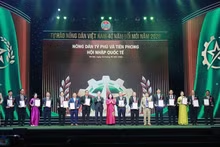
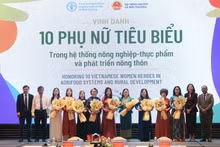
The Viet Nam Farmers’ Union Central Committee held a ceremony to honour 96 outstanding farmers for their achievements during the country’s 40 years of Doi Moi (Renewal) in Ha Noi on the evening of October 12.
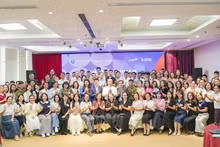
The Department of Cybersecurity under the Ministry of Public Security, in coordination with the United Nations Children's Fund (UNICEF), has launched a training course on child protection in cyberspace under the "Training of Trainers" (ToT) model. The programme runs from October 12 to 14 in Ha Noi and will continue in Ho Chi Minh City from October 15 to 17, as part of the “Not Alone: Connect Without Harm” campaign.
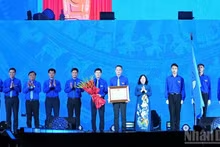
The Viet Nam Youth Federation celebrated the 70th anniversary of its traditional day on the evening of October 11 at Dong Kinh Nghia Thuc Square in Ha Noi, receiving the First-Class Labour Order and presenting the inaugural Nguyen Chi Thanh Awards to 70 outstanding youth association officials.

European Higher Education Week 2026 officially concluded following a series of lively activities held in Ha Noi and Ho Chi Minh City from October 8 to 11. The event brought together nearly 70 universities and educational institutions from 17 European Union member states, attracting more than 2,700 pupils, students, and parents.
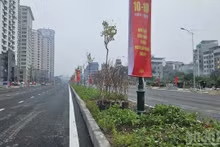
Ha Noi is accelerating progress on a series of key transport projects while also implementing urban renovation schemes to mark the 72nd anniversary of Capital Liberation Day. These changes are helping remove long-standing bottlenecks, strengthen connectivity and expand development space, with the aim of improving people’s quality of life.

The International Conference on Education Cooperation in the Digital Era has provided a platform for technology businesses, higher education institutions, educational organisations, and solution developers to connect. Numerous agreements and cooperation initiatives have been undertaken, helping expand cooperation networks between domestic educational institutions and businesses, and international partners.
![[Video] Renewal and growth milestones of Ha Noi through the lens](https://en-cdn.nhandan.vn/images/OZ2AA_tg9hZQn3XW53Z5ZPwrya9InOpdtOMBS5jh-VVu7tCZ4pzXGTkJyV1HLXmVm8yJIhROL03wmoet3hV6EQ/10-10-hanoi-cover.jpg.avif)
In celeration of the 72nd anniversary of the Liberation Day of Ha Noi (October 10), the Ha Noi Newspaper, Radio, and Television Agency is collaborating with other entities to organise the 21st photo exhibition emtiled Ha Noi in Me. The event is themed “Two-Tier Local Government: Streamlined, Efficient, and Close to the People”.

After more than a year of operating under the two-tier local government model, the health sectors of Ha Noi and Ho Chi Minh City have achieved positive transformations — ranging from organisational restructuring and management to the enhancement of healthcare service quality. These efforts have better met the public’s health protection and care needs, advancing an equitable, modern, and sustainable healthcare system.
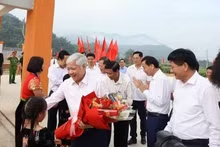
On October 10, Do Van Chien, Politburo member and Standing Vice President of the National Assembly, accompanied by leaders of Dien Bien Province, visited Sam Mun Primary and Secondary Boarding School to inspect the students’ learning and living conditions.
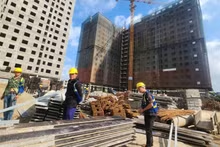
Demand for social housing in major economic centres is growing, while supply remains insufficient. To address this, many localities have earmarked land, shortened administrative procedures and sped up housing projects with full infrastructure.

Ha Noi inaugurated projects, opened a road section to technical traffic and broke ground on major works on October 9 to mark the 72nd anniversary of Capital Liberation Day (October 10, 1954-2026).