After nearly a year, 108 schools in 19 provinces and cities under the first phase of the programme have largely fulfilled their construction targets.
A dream school in the border area
In August, teachers and pupils at Yen Son Primary and Lower-Secondary Boarding School in Son La Province attended a particularly meaningful event: the inauguration of their new, spacious, and modern school.
According to school principal Tran Van Lam, for many years, geographical distances and inadequate facilities had had severely hindered local pupils’ pursuit of education. However, the new school has fortified their aspirations to study and improve their lives.
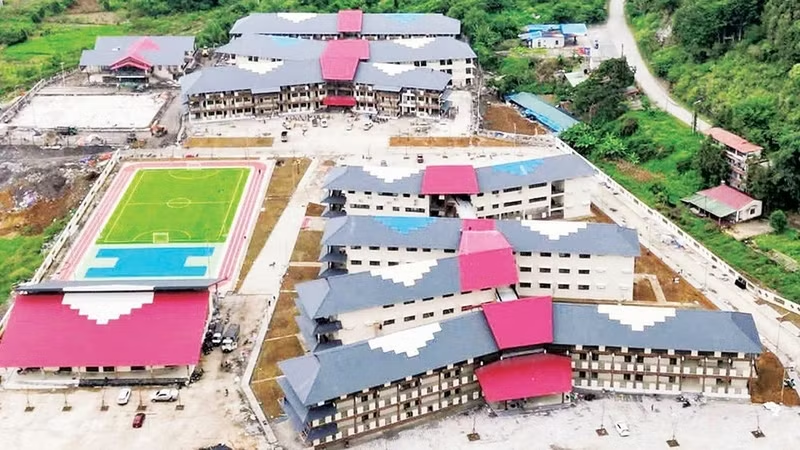
The school has 12 primary classes and 18 lower-secondary classes, meeting the boarding education needs of 1,050 pupils. The biggest change is the modern infrastructure and teaching equipment that pupils and teachers had previously only dreamed of.
Classrooms, laboratories, computer rooms, and foreign-language facilities have been fully equipped with projectors and smart interactive devices. Auxiliary facilities for daily life have also been completed.
Teachers can now confidently remain at the school, while pupils have much better conditions for eating, living, and studying, with both their physical and mental well-being cared for to support their all-round development.
At Muong Khuong Primary and Lower-Secondary Boarding School in Lao Cai Province, teachers were racing to prepare for the opening ceremony of a new academic year. The classrooms, multi-purpose sports hall, and football pitch still carry the smell of fresh paint.
School principal Mong Thi Duyen could not hide her delight, saying that on August 25, the school assumed control of the entire system of classrooms, functional rooms, administrative and staff offices, staff accommodation, semi-boarding accommodation, kitchen, and other facilities, and was ready to welcome pupils to school from August 28.
This school year, Lu Thi Yen, a literature teacher at Muong Khuong Primary and Lower-Secondary Boarding School, has also been assigned responsibility for managing boarding pupils.
According to Yen, multi-level boarding schools bear the unique responsibility of not only organising teaching and learning but also managing pupils’ meals, accommodation, and daily activities safely and on schedule. Therefore, each teacher is assigned responsibility for two to three boarding rooms so that they can promptly remind and encourage pupils.
For younger primary school pupils who are away from their families for the first time, teachers will spend considerable time helping them adjust to their new environment, from personal hygiene and eating to studying and going to bed on time.
At a meeting organised by the school, Mai Thi Thanh, a parent from Sang Chai Village in Muong Khuong Commune, expressed her gratitude to the local authorities and the school for enabling her child to study at the new school, which is spacious and equipped with modern facilities.
Coordinated and high-quality operation
Lao Cai is one of the localities that have striven to construct and launch four multi-level boarding schools into operation before August 30, 2026.
According to Luyen Huu Chung, Director of the Lao Cai Department of Education and Training, the locality has fulfilled its targets for school construction, pupil enrolment, and staff arrangements with the participation of the entire political system, agencies, organisations, and individuals.
Since late 2025, the department has reviewed staffing needs and executed recruitment of teachers for subjects at different levels of general education for the four communes with multi-level boarding schools.
To date, all four schools have arranged sufficient numbers and appropriate structures of teachers, management staff, and other employees as required.
Son La Chairman Nguyen Dinh Viet asserted that investment in spacious, well-equipped boarding schools in border communes would provide a long-term foundation for human development, improving educational attainment, the quality of the workforce, and socio-economic development in border areas.
The newly built schools provide children with safer, more spacious, and better-equipped learning environments, unlocking opportunities to access knowledge, nurture dreams, develop character, cultivate determination and aspirations to advance, and prepare pupils in mountainous areas to take charge of their future.
Minister of Education and Training Hoang Minh Son stated school construction should be regarded as an initial milestone. However, the ultimate quality of education depends to a great extent on the operation of the new schools and their teachers. Therefore, the teaching workforce must be adequately planned for numbers, structure, capacity, and long-term commitment to the schools.
Meanwhile, pupils must be equipped with a solid general education foundation and sufficient capacity to progress to upper-secondary education, vocational training, college or university, or enter the labour market in fields suited to their abilities and aspirations.
Alongside knowledge, pupils need to develop foreign-language proficiency, digital skills, understanding of science and technology, artificial intelligence, creative thinking, and adaptability.
The Ministry of Education and Training hopes that in the future, when discussing pupils in border areas, the story will no longer begin with the difficulties they must surmount, but with their abilities, dreams, aspirations, and the contributions they can make to their homeland and country.
This is the deeper meaning and the truest measure of the policy of investing in multi-level boarding schools in border communes.