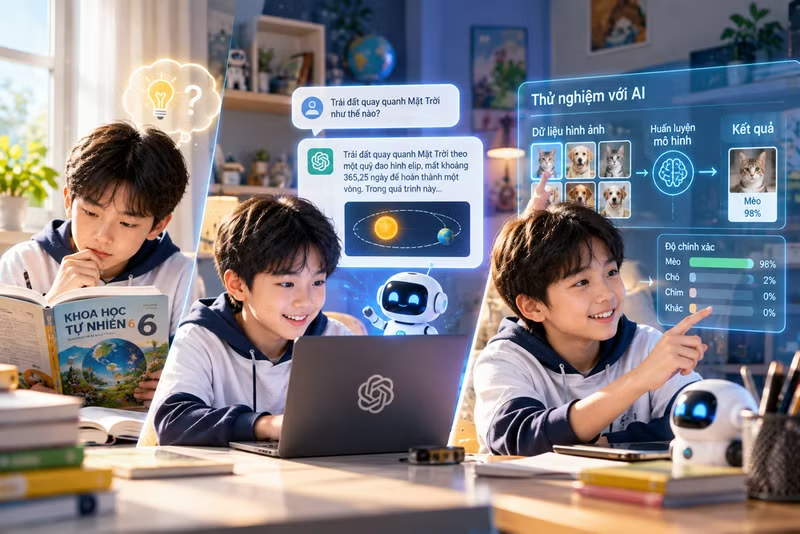
Minh Quyet, a sixth-grade student in Ha Noi, is working on a Natural Sciences assignment. He could open his textbook, read the relevant material and work out the answer himself. A quicker option would be to ask an AI tool such as ChatGPT, which could provide an answer almost instantly, often accompanied by a detailed, easy-to-understand explanation.
However, in that case, Quyet would simply be asking a question and receiving an answer. How did the machine learn? What data led it to produce a correct or incorrect response? How would the result change if the data were flawed? More importantly, if AI produced an inaccurate or potentially harmful result, who would verify it and take responsibility?
Answering these questions requires students to learn more than simply how to use an AI tool.
Not everyone who uses AI understands how it works
In Viet Nam, AI is moving from a technological topic outside the classroom to an official component of general education. In August 2026, the Ministry of Education and Training issued the AI Education Content Framework for general education students. From the 2026-2027 academic year, its core content is being introduced through 12 lessons per grade each year, with the aim of developing not only AI skills but also critical thinking, information verification and the safe and responsible use of technology.
This means students need to understand how AI is designed to serve people, what ethical issues may arise, how the underlying technology works and how to design an AI system to solve a real-world problem.
To gain this understanding, students must have opportunities to experiment with data, observe how machines learn, verify results, write code and create products. AI education therefore needs to cover four areas of knowledge: human-centred thinking, AI ethics, AI techniques and applications, and AI system design.
This is also the approach adopted by Viet Nam Education Publishing House and Viettel Solutions in their Artificial Intelligence learning materials for students from Grades 1 to 12.
While a traditional textbook usually ends with its final page, this learning package offers a further stage of learning beyond it. Alongside printed books, it includes digital learning materials and practical tools such as AI Buddy, an AI-powered question-and-answer assistant; Block Studio, a drag-and-drop programming platform; and Sense Learner, software for creating artificial intelligence and machine learning models, developed with the involvement of Viettel Solutions and connected to the K12Online learning management system.
Students can put each concept into practice as soon as they learn it. Knowledge from the printed page is immediately transformed into hands-on experience in a digital environment, rather than requiring students to complete the theoretical lessons before moving on to practical activities.
The learning pathway also progresses from simple to more complex concepts. At primary school, students become familiar with how machines “see”, “hear” and learn from examples and data. At secondary school, they explore machine learning, image and sound recognition, and chatbots. At high school, they move on to generative AI, large language models, retrieval-augmented generation (RAG), AI agents and practical projects.
Learning AI through experiments
In a Grade 6 image recognition lesson, instead of simply reading about how machines learn from data, Minh Quyet can use Sense Learner to upload images to the system, train the machine and then test the results.
If the machine makes an incorrect prediction, Quyet can modify or add data and try again. Through what happens on the screen, the concept of "data quality" becomes much easier to understand.

If the training data are not sufficiently diverse, the system may correctly recognise one group of images but make mistakes with another. A technical error can therefore lead students to questions about AI ethics: Is the data biased? Are the results fair? Should people place complete trust in decisions made by machines?
At the same time, students must answer another question: What problem was this AI created to solve, and whom is it intended to serve? This helps develop human-centred thinking, in which technology serves as a supporting tool rather than a complete replacement for human judgement.
Quyet can also move on to Block Studio, using drag-and-drop coding blocks to become familiar with algorithmic thinking and create simple products such as image classification tools or chatbots. When he encounters something he does not understand, AI Buddy is designed to offer hints and ask guiding questions rather than always providing the answer immediately.
A lesson therefore follows three stages: “read to learn, experiment to understand and create to verify”. Such a learning environment can help students gradually develop a more comprehensive understanding of AI. It is a system created by humans, trained on data provided by humans and designed to serve human needs. Therefore, its outputs must also be verified and controlled by humans.
From an educational solution to an AI learning ecosystem
Over the years, Viettel Solutions has contributed to comprehensive digital transformation in the education sector. Its SMAS platform supports school management, K12Online facilitates online teaching, learning, examinations and assessment, the sectoral database helps connect information, and SmartLMS is used for teacher training.
With Viettel Solutions’ Artificial Intelligence learning package, technology no longer simply works behind the scenes to support classroom operations or manage data. Instead, it accompanies students throughout the learning process, from reading lessons and asking questions to experimenting with training AI models, programming and creating simple products.
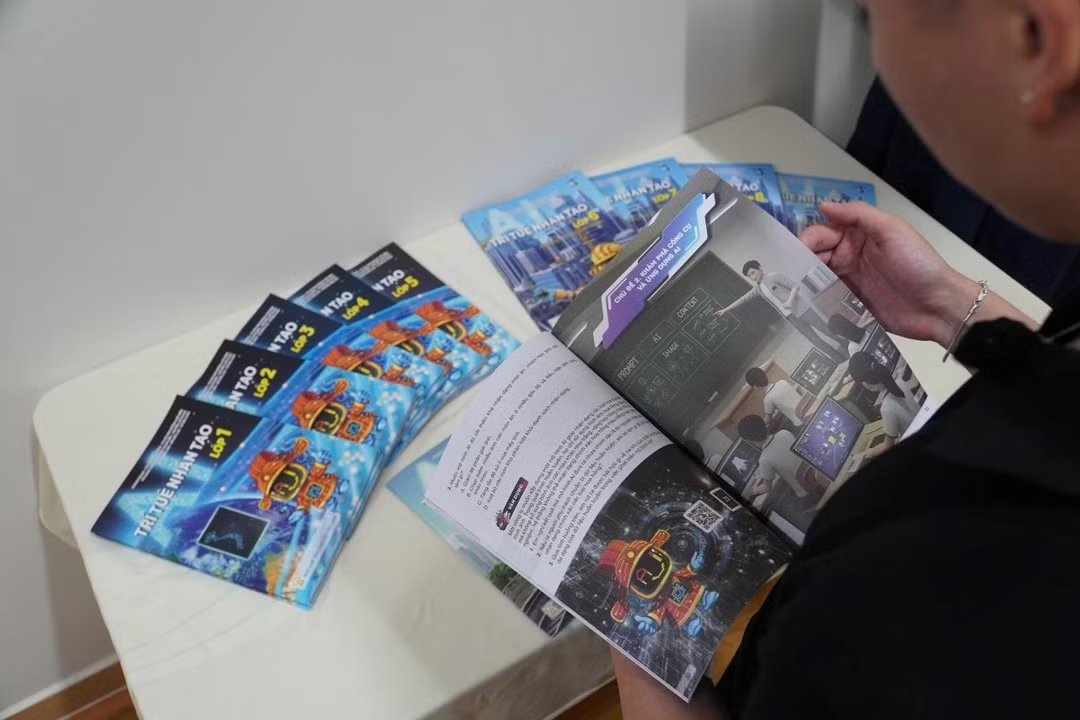
Viet Nam Education Publishing House is responsible for content, pedagogical quality and publishing. Drawing on its technological expertise, Viettel Solutions contributes to the development of the textbooks’ content while also bringing practical tools into classrooms, allowing students to extend what they read on paper into digital lessons, AI interactions and hands-on activities.
In other words, Viettel Solutions is not merely providing software and digital infrastructure. It is acting as a technology partner in jointly developing an integrated ecosystem for teaching and learning AI.
The resulting product is therefore much more than a textbook supplemented by several software applications. It is designed as a seamless AI learning environment, where the textbook provides the starting point and exploration and practical activities continue on digital platforms.
At a time when children can use AI before they understand how it works, the challenge for schools is no longer simply to introduce students to technology as early as possible. More importantly, schools must help students gradually learn how to master it.