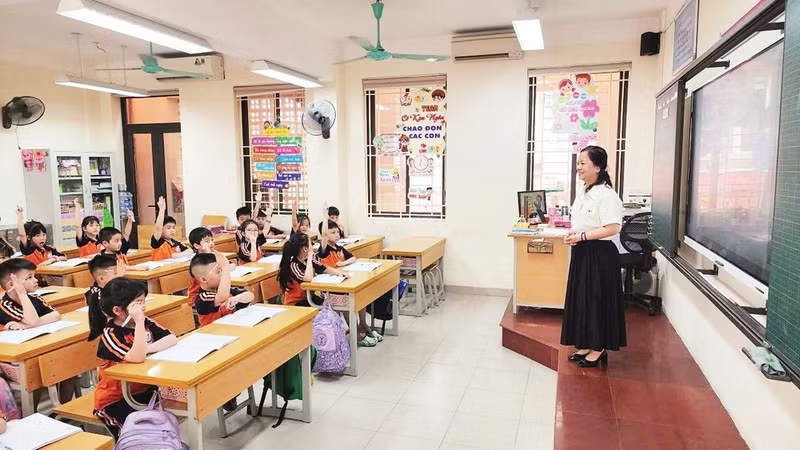
As a result, schools can expand in scale, teaching staff and professional activities can be strengthened, and students can enjoy more opportunities for development.
Vu Ngoc Hoa, a teacher at Ngo Quyen High School in Dong Nai Province, said that after a merger, the core issue was not simply stabilising the organisation and arranging personnel, but also developing an operating model suited to the new scale. Larger schools have greater resources, but they also face higher demands in terms of management, coordination, and accountability.
If management methods remain unchanged, the organisational structure can easily become cumbersome and administrative workloads increase, reducing the available time for professional activities and students.
From a teacher’s perspective, Hoa said that schools needed to make full use of the capabilities, experience, and strengths of their teaching staff. Larger schools are better placed to bring together teachers with diverse specialisations, creating resources for professional development.
Experienced teachers can support younger colleagues, while those with strengths in technology, foreign languages, scientific research, gifted-student education, and other educational activities can become key contributors to professional development.
Therefore, the assignment of duties following a merger should be based on each teacher’s actual capabilities, strengths, and level of contribution, rather than solely on their administrative position.
Where kindergartens, primary schools, and lower secondary schools are organised within the same system or linked through management arrangements, the professional characteristics of each education level must be safeguarded.
Preschool education focuses on childcare, nurturing, and child development; primary education lays the foundations for students’ qualities, capabilities, and learning methods; and lower secondary education consolidates knowledge while addressing students’ psychological and physical development and guiding their learning choices.
Therefore, unified management does not mean making professional activities identical. Instead, it should strengthen continuity, ensure that education builds progressively from one level to the next, and prevent different levels from operating in isolation.
Drawing on his experience in education management, Dr. Le Duc Thuan, former head of the Ba Dinh District Division of Education and Training in Ha Noi, said that school mergers reduced the number of organisational units but made management more complex.
If schools continued to use old management methods, concentrating all matters in the hands of the principal and relying on meetings, phone calls, messages, and manual reports, the head of the school could easily become a “bottleneck”, even after the organisational structure had been streamlined.
Therefore, digital transformation needs to be accelerated to improve schools’ operational capacity and management efficiency. A principal cannot be physically present at every school site on a regular basis, but they can still monitor key indicators such as attendance, staffing, safety, facilities, work progress, and educational quality.
This allows the head of the school to maintain control over objectives, standards, progress, and risks without having to handle every task personally. It marks a shift from management based on physical presence to system-based governance.
For example, when student absences rise unusually, a safety incident remains unresolved or a task becomes overdue, the system can automatically assign the task to the appropriate person, track progress, and issue alerts. The prerequisite is that data must be updated promptly and accurately at the point where it is generated.
Luyen Huu Chung, Director of the Lao Cai Provincial Department of Education and Training, highlighted three key solutions: stabilising teaching staff while maintaining educational quality; reorganising schools and classes alongside developing the workforce, with priority given to assigning teachers to subjects matching their specialisations and ensuring sufficient teachers for subjects facing shortages; and improving school management capacity through training for managers, particularly in managing large schools, satellite campuses, boarding and semi-boarding arrangements, and the application of digital technology.
Above all, every decision on reorganising the school network and classes must aim to ensure that students can learn in better and safer environments, receive more attentive care, and have greater access to high-quality education.
Hoang Minh Son, Minister of Education and Training, said that following the restructuring, the key priorities were to ensure the smooth operation of schools, stabilise teaching staff, use facilities efficiently, avoid interruptions to professional activities, and safeguard the rights and interests of students and teachers.
For schools comprising multiple education levels, satellite campuses, and separate school sites, duties and delegated authority must be clearly defined to prevent activities at secondary locations from depending entirely on the main school. At the same time, educational institutions must renew their management methods and clarify responsibilities, authority, information-sharing arrangements, financial management, data management, and accountability.
Unified management does not mean making educational activities identical. Each education level and location must continue to meet appropriate requirements for curricula, teaching methods, instructional time, testing, assessment, and age-specific care.
According to the minister, the effectiveness of restructuring should not be measured solely by the reduction in the number of organisational units. More importantly, it should be assessed in terms of the quality of school operations, the ability to make full use of teaching staff, the efficiency of resource utilisation, and the tangible benefits for students.