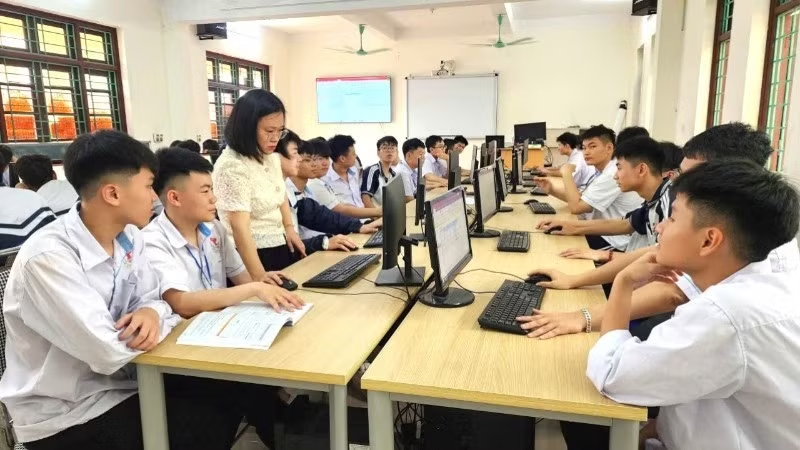
Following the restructuring, the number of administrative units is projected to decrease by 30–50%, in line with the goal of “reducing education management staffing while increasing the number of teaching staff”, alongside expanding the scale of schools and classes to optimise the use of facilities and the teaching workforce.
Safeguarding learners' access to education
Along with the rest of the country, Ha Noi has promulgated a plan to reorganise public pre-schools, primary schools, lower secondary schools, upper secondary schools, and specialised schools across the capital.
Under the plan, primary and lower secondary schools located within the same ward or commune operating with a small number of classes and are situated in close proximity to one another will be reorganised into multi-campus schools, comprising a main campus together with branch campuses and multi-level schools.
Each newly established school will be staffed with one principal and deputy principals, with each campus overseen by a deputy principal. The reorganised schools will preserve the existing teaching and support staff of the merged institutions.
Teaching staff will remain largely stable and will be deployed according to teaching positions and the number of classes at each school. Teachers whose teaching hours fall short of the prescribed workload will be deployed to instruct at the main campus or branch campuses to meet the required teaching quota.
Library, healthcare, and laboratory staff will continue operating across the main campus and branch campuses. Each school will be allocated no more than two accountants and one administrative officer.
Pham Thanh Ha, Head of the Culture and Social Affairs Division of Giang Vo Ward in Ha Noi, stated that the ward currently operates 17 public schools, including six pre-schools, five primary schools, and six lower secondary schools.
Under the restructuring plan, the number of public schools in the ward will be reduced to eight. Co Nhu Dung, Chairman of the Giang Vo Ward People's Committee, affirmed that the reorganisation would neither reduce class capacity nor affect students' access to education. Changes to school locations would be minimised to ensure safety and convenience for students and their parents.
Ho Tuan Anh, Principal of Quynh Phuong Lower Secondary School in Nghe An Province, noted that the school would receive a new name in the coming days following its merger with another lower secondary school in the locality. He characterised the restructuring as both necessary and appropriate under the current model.
In reality, many schools are small in scale and geographically dispersed, making it difficult to fully utilise the capacity of management staff and teachers. The restructuring seeks to elevate school governance in line with the trend towards digital transformation.
While the merger will yield benefits, it will also generate pressure due to the compressed implementation schedule. A key concern is how the new management mechanism will operate to ensure that principals and deputy principals possess sufficient capacity to administer larger schools more effectively.
Local authorities and the education sector therefore must institute appropriate mechanisms and policies, together with clear regulations defining the authority of school leaders to enhance management efficiency.
In Thanh Hoa Province, school consolidation is advancing vigorously.
According to Do Duc Que, Director of the provincial Department of Education and Training, the education sector is implementing two consolidation models. The first involves merging schools at the same educational level, such as pre-schools, primary schools, or lower secondary schools. The second follows the model already deployed by combined schools in border communes, consisting of a main campus and branch campuses.
A shift in school governance mindset
Le Duc Thuan, former Head of the Education and Training Division of the former Ba Dinh District in Ha Noi, asserted that school consolidation should not be viewed as the end of an administrative decision but rather the starting point of an entirely new governance challenge. Many assume that reducing the number of administrative units also reduces the management workload, but reality proves otherwise.
When two or three schools become one, the number of administrative units decreases, yet the number of students, teachers, classes, campuses, records, professional activities, and day-to-day operational issues remains virtually unchanged.
What schools require now is not merely a new organisational structure but a new governance model.
Schools established through mergers can operate effectively only when three elements are designed and implemented in a coordinated manner.
The first is decentralisation. A principal cannot be omnipresent across every campus. For the system to operate seamlessly, clear authority must be delegated to management teams at each campus, accompanied by accountability and transparent oversight mechanisms.
The second is the standardisation of procedures. The same tasks must be executed consistently across all campuses.
This is vital for ensuring consistent educational quality and reducing dependence on individuals.
The third is data-driven governance. The larger an organisation becomes, the less it can rely on memory or subjective judgement. Decisions on professional activities, personnel, examinations, and educational quality must all be underpinned by up-to-date, accurate, and analysable data.
Nguyen Van Khoa, Director of the Nghe An Department of Education and Training, noted that during the restructuring process, many parents had expressed concerns about whether their children would have to travel farther to school or whether educational quality would be affected.
The education sector has therefore underscored that the restructuring must not impose geographical barriers or increase the financial burden on students' families. The core solution adopted by Nghe An is the model of "one main school with multiple branch campuses".
This ensures that any structural changes remain confined to the management structure, while branch campuses will remain unchanged and continue operating seamlessly. Children, particularly those at pre-school and primary levels, will continue attending classes at their familiar locations.
The provincial Department of Education and Training has also organised school transport services, expanded boarding and semi-boarding school models, and introduced targeted support measures for disadvantaged students.
The education sector is streamlining only the management structure and will in no way diminish students’ educational access. For surplus management staff following the mergers, the province has proactively developed detailed and humane redeployment plans.
Vu Minh Duc, Director General of the Department of Teachers and Educational Administrators under the Ministry of Education and Training, stated that as part of the review and restructuring of the pre-school and general education system in line with the two-tier local government model, the Ministry has been proactively guiding localities throughout the process.
The restructuring will inevitably impact teachers and educational management staff at schools.
However, teachers will experience minimal disruption as staffing arrangements remain largely stable. During the restructuring, the Ministry has instructed localities to review management staff and teachers to ensure staffing levels meet prescribed standards, while transferring teachers from areas with surpluses to those facing shortages to address imbalances in teacher distribution.
In the period ahead, school management staff must transition their mindset, from administrative management to modern school governance. This represents a vital transformation essential to meeting the demands of the new model.