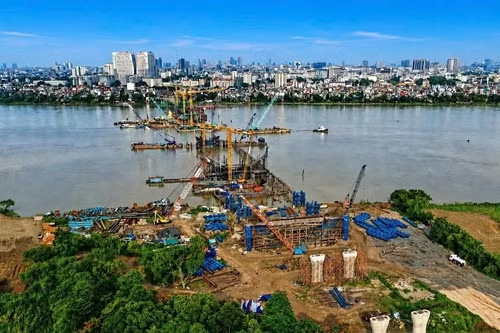

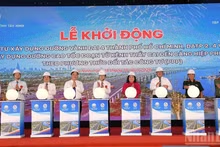
On October 15, Tay Ninh Province held a ceremony to launch component projects 2-4 and 2-5 of the Ho Chi Minh City Ring Road 4 project, with a combined length of approximately 78.3km and total investment of around 43.298 trillion VND. The projects are expected to expand development space, strengthen regional connectivity and create new growth momentum for the locality.
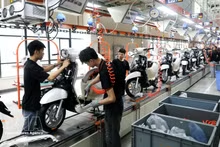
As localisation in FDI production chains currently stands at just 20-25%, Viet Nam is moving to link investment incentives to foreign firms’ commitments to develop domestic suppliers, a shift expected to tighten business linkages, lift added value and sharpen competitiveness.

Resolution No. 27-NQ/TW sets out an entirely new philosophy of spatial governance: regional development is a method of organising national growth, shifting from a management mindset based on administrative boundaries to the creation, guidance, and unlocking of resources based on integrated ecosystems.

The Minister of Industry and Trade has signed Decision No. 2433/QD-BCT approving the scheme entitled “Developing Viet Nam’s commodity derivatives trading market for 2026–2030, with a vision to 2045.”

Artificial intelligence (AI) is transforming the way businesses operate and compete. To harness this technology effectively, Vietnamese entrepreneurs need to rethink their management approaches, reorganise operations, and capitalise on their companies’ core competitive advantages.

Ho Chi Minh City is charting a path towards rapid and sustainable development by restructuring its economy while ensuring social welfare. Through these efforts, the city continues to consolidate its position as the country's leading economic powerhouse, with the ambition of becoming a modern, liveable global city in the new era.
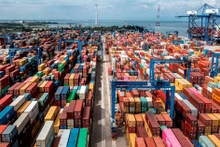
Viet Nam's network of new-generation free trade agreements (FTAs) spans almost every continent, covering nearly 60 economies that together account for nearly 90% of global GDP. These agreements offer opportunities for Viet Nam to deepen its integration into global value chains and production networks. However, such opportunities can only become drivers of growth if the country translates its FTA commitments into institutional reforms and improvements in business capabilities.
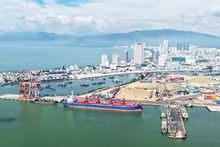
In the current context of interregional development, investment in transport infrastructure integrated with urban development is becoming a key to unlocking new competitive advantages for the South Central Coast and Central Highlands regions. Modern and well-connected infrastructure not only reduces geographical distances but, more importantly, transforms the region’s natural and cultural heritage potential into sustainable green economic value.
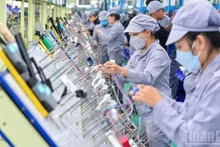
The target of double-digit growth is placing Viet Nam’s economy under pressure to grow faster, but it can no longer continue relying mainly on capital, low-cost labour and resource exploitation.
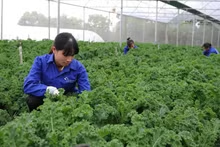
In recent years, organic agriculture in Viet Nam has developed strongly, rising to fifth place in Asia in terms of cultivated area. However, to achieve the goal of expanding scale and increasing product value, the agricultural sector needs to focus further on addressing difficulties and challenges.
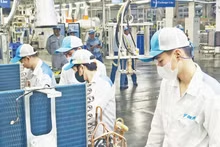
Companies must ensure records and data truthfully reflect the substance of transactions and engage in dialogue early when complex issues arise. Tax authorities, in turn, need to publish policies, give clear guidance, enforce rules consistently and deliver information in a timely manner.

Viet Nam's domestic market surveillance force and Procter & Gamble (P&G) have renewed their cooperation to strengthen efforts to combat counterfeit goods and protect intellectual property (IP) rights.
![[Infographic] GRDP growth scenarios for 34 provinces and cities in fourth quarter of 2026](https://en-cdn.nhandan.vn/images/tfuJ0mi1QUbgDLV14qaRUitTZvrRlTjB4r-XmCX4E4U54DodwvMaLcbtzTRIrjQr07g95RvDgruO02neYBtQo08FzQGv3vZvxBpShXxDQWLvRG9huo7sAb_8EQ1pjTMyG0KSyNYexTN5uQU9Jm7ewukCXC15RNdRSN6O4WZL6eQ/grdp-growth-scenarios-for-34-provinces-and-cities-in-q42026-anh-dai-dien.jpg.avif)
Under Government Resolution No. 312/NQ-CP dated October 5, 2026 on the Government’s regular September 2026 meeting and its online conference with localities, nine provinces and cities are required to record GRDP growth of more than 15% in the fourth quarter of 2026.

Currently, as outstanding credit to the real estate sector exceeds 5.1 quadrillion VND, accounting for around one quarter of total outstanding credit across the economy, the priority is to reduce the cost of capital and, more importantly, ensure that funds reach the right destinations.
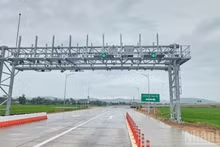
Standing Deputy Prime Minister Pham Gia Tuc has asked for prompt measures to remove bottlenecks for the implementation of key projects in the industry and trade and construction sectors.

The role of the industrial and service value chain in offshore wind power and electricity generation is very important to Viet Nam’s economy. This was affirmed by Bui Vinh Thang, Country Director in Viet Nam of the Global Wind Energy Council (GWEC), during an interview with a reporter from Nhan Dan Newspaper.

High expectations surrounding the 2026 National Innovation Day are spreading across the industry and trade sector. Rather than being merely an event-driven campaign, innovation has been identified as a key to enhancing productivity, quality and national competitiveness.
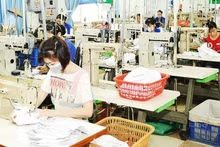
Major markets are tightening emissions and environmental requirements. Vietnamese businesses have to accelerate their transition to retain orders and maintain access to export markets.
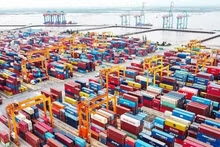
Conclusion No. 18-KL/TW, issued on April 2, 2026, by the second plenum of the 14th Party Central Committee, reaffirmed the determination to strive for double-digit growth while maintaining macroeconomic stability, controlling inflation and ensuring the major balances of the economy.
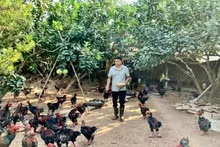
Over the past years, Hung Yen province has implemented the “Project on developing biosafety livestock production and VietGAHP livestock production to ensure disease prevention, food safety and environmental protection”, contributing to the safe, efficient and sustainable development of livestock production.