In the Vision and Development Orientation section of the Resolution, the “Guiding viewpoints” clearly state: “Promote the building and comprehensive improvement of institutions for the country’s rapid and sustainable development; resolutely and promptly remove bottlenecks and obstacles, unblock and unleash productive forces and all resources, and promote every growth driver.” Accordingly, one of the core principles of the double-digit economic growth target emphasised by General Secretary of the Communist Party of Viet Nam Central Committee and State President To Lam is to ensure substantive growth, resolutely eliminating the mindset of chasing achievements and not trading quality for speed. In the context of mounting growth pressure, the requirement is to create strong changes in implementation, remove fundamental bottlenecks, with the principle of “Choosing correctly – implementing quickly – carrying through thoroughly – measuring by results.”
Linking individual responsibility to common tasks
In recent times, the Bac Ninh Provincial Party Committee has regularly discussed and oriented the building of a new development model to meet the requirements of rapid and sustainable growth. The reality of the 2021–2025 tenure shows that although the province’s economic scale ranks fifth nationwide, the FDI sector still accounts for up to 88% of production value, posing the requirement to enhance the economy’s self-reliance. On that basis, the province has identified a new growth model in the direction of: “Foreign investment leads – domestic investment develops – internal strength makes breakthroughs – technology serves as the foundation – innovation acts as the driving force.” The goal is not only to maintain double-digit growth but more importantly to ensure substantive growth while improving the economy’s resilience and independence.
Admitting that the quality of the economy’s internal strength has yet to meet requirements, Mai Son, Vice Chairman of the Bac Ninh Provincial People’s Committee, said that the FDI sector still plays a dominant role, while domestic enterprises, especially small and medium-sized enterprises, have yet to deeply participate in the value chain. The Provincial Party Committee agreed on the viewpoint that it is necessary to proactively face difficulties and challenges. Without improving the “resistance” and self-reliance of the domestic economic sector, the goal of sustainable growth will be difficult to achieve.
Based on the new growth model, the Standing Board of the Bac Ninh Provincial Party Committee has agreed to assign 417 key tasks to heads of agencies, units, and localities this year. Among them, members of the Provincial Party Committee Standing Board, the Standing Committee of the Provincial People’s Council, and leaders of the Provincial People’s Committee are each assigned at least three tasks directly linked to personal responsibility; implementation results are included in quarterly and annual evaluations. The clear assignment of responsibilities and tasks, linked to specific results, is expected to create substantive changes, gradually shaping Bac Ninh’s new growth model in a modern, sustainable direction based on internal strength.

Removing institutional bottlenecks
Double-digit growth is a highly challenging target that requires political determination to be materialised through substantive reforms. In 2025, Hai Phong City achieved GRDP growth of 11.81%, ranking second nationwide, and was also the only locality to maintain double-digit growth momentum for 11 consecutive years, with an economic scale of nearly 30 billion USD. To sustain this momentum, the City Party Congress identified industrial restructuring, including the development of eco-industrial parks, as a strategic direction.
In that picture, Nam Dinh Vu Industrial Park, with an area of 1,329 hectares and synchronised, modern infrastructure, is considered a typical example. In recent years, the industrial park has gradually implemented a roadmap to transform into an eco-industrial cluster model. However, the transformation process is not merely a technical matter but also poses difficult practical choices. Since the beginning of this year, the enterprise has had to consider approving a 120 million USD project specialising in importing scrap metal for recycling into high-strength aluminium production. The project promises large revenues, but also entails high requirements in energy consumption, wastewater treatment, and potential environmental risks. This is not an easy equation to balance between growth and sustainable development.
Sharing the pressures during the transformation process, Nguyen Thanh Phuong, General Director of Sao Do Group, the investor of Nam Dinh Vu Industrial Park, said there is no universal “formula” to completely solve this problem. While departments, especially the business division, are always under pressure to fulfil targets, the group’s leadership has determined that part of the growth rate must be sacrificed. Investment attraction progress may slow by two to three years, but this is necessary to ensure long-term quality and efficiency.
However, not every enterprise has sufficient capacity to pursue such a choice, especially when mechanisms, policies, and legal regulations remain inconsistent. According to Nguyen Thi Bich Dung, Deputy Head of the Hai Phong Economic Zone Authority, although the law has stipulated environmental standards such as emission control and resource use, the criteria remain inconsistent, causing difficulties in implementation. In particular, many requirements of the eco-industrial park model remain challenging, especially for enterprises that had already been operating stably beforehand.
Institutional bottlenecks not only appear in the industrial sector but are also present in many key fields such as science and technology, innovation, and the digital economy. Discussing this issue, Prof., Dr. Tran Tho Dat, Chairman of the Science and Training Council of the National Economics University, said that Viet Nam does not lack correct orientations, but the process of institutional improvement and reform remains slow, while implementation lacks synchronisation. “Institutional bottlenecks are currently the biggest barrier that needs to be removed to create momentum for substantive and effective double-digit growth,” he stressed.
Dr. Nguyen Tri Hieu, Head of the Institute for Research and Development of Global Financial and Real Estate Markets, believes that one of the major current barriers is rigid implementation. The mechanical application of regulations, lacking initiative and flexibility in handling arising situations, is reducing governance effectiveness. When officials lack an innovative spirit and merely “follow procedures,” the apparatus can easily fall into stagnation.
Creation must come from both top-down and bottom-up approaches
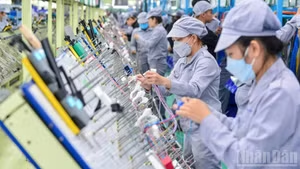
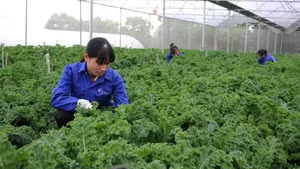
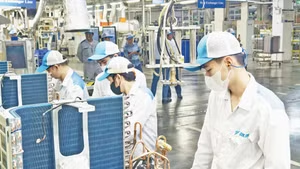
Substantive development must begin with substantive implementation. To remove bottlenecks, resolve difficulties, and realise sustainable growth goals, officials must act decisively, dare to think, dare to act and take responsibility to the end. The story of Hanel PT Company, a typical science and technology enterprise in Bac Ninh, clearly illustrates practical obstacles. With 26 years of operation specialising in producing electronic components for the FDI sector, while also possessing freeze-drying technology serving the preservation and enhancement of agricultural and food products, the enterprise has yet to complete procedures for recognition as a science and technology enterprise. Tran Duc Tung, Deputy General Director of the company, shared that the current obstacle lies in regulations on the criteria for recognition as a science and technology enterprise. The company is continuing to cooperate with the Bac Ninh Department of Science and Technology to complete the dossier.
Explaining the reasons, Nguyen Phuc Thuong, Deputy Director of the Bac Ninh Department of Science and Technology, said that although legal regulations encouraging the development of science and technology enterprises have been issued, difficulties still arise during implementation due to inconsistent interpretation and application among management agencies. Many issues require local authorities to seek opinions from central agencies, but responses remain slow and incomplete, preventing timely handling of difficulties.
Reality shows that science and technology enterprises not only need recognition in name but also substantive support in infrastructure, equipment, financial mechanisms, and risk-sharing, especially the state’s leading role in creating an initial market for products. Without decisive actions to remove obstacles and bring policies into reality, the goal of making science and technology a growth driver will be difficult to achieve.
Substantive growth, therefore, must be created simultaneously from both directions, top-down and bottom-up, spreading through every link of the economy, from households and production establishments to enterprises. In this process, the leading role and implementation capacity remain decisive.

![[Infographic] GRDP growth scenarios for 34 provinces and cities in fourth quarter of 2026](https://en-cdn.nhandan.vn/images/nyM650OGFWrOVWc-xajqN-rTZ68Rlmc1fiGJOhBRYHFSa4DhrHNDxEFdnz313Vk5dNJuxdkHglPA3rLeaPeiaUheNuCI723k2lNssd-YLJuKR58epWq7s21lV5WjM-HR2-Qpbi4MwAzqt9wRjL4WjGkfEz7RO9qhcwg8o8LQFK8/grdp-growth-scenarios-for-34-provinces-and-cities-in-q42026-anh-dai-dien.jpg.avif)