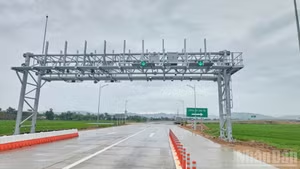
According to the Ministry of Finance, the State budget-funded public investment plan for 2026 approved by the Prime Minister exceeds 1 quadrillion VND, including more than 363 trillion VND (13.8 billion USD) from the central budget and over 650 trillion VND (24.7 billion USD) from local budgets. Including additional locally balanced capital allocations and funds carried forward from previous years, total public investment capital for 2026 amounts to more than 1.1 quadrillion VND (41.8 billion USD).
Lever for growth
As of the end of April, ministries, sectors and localities had allocated detailed 2026 public investment plans worth more than 980 trillion VND (37.2 billion USD) to specific programmes and projects. However, 14 ministries and central agencies and 17 localities had yet to allocate more than 46 trillion VND (1.7 billion USD), equivalent to 4.56% of the capital plan assigned by the Prime Minister.
Regarding disbursement progress, the Ministry of Finance reported that, by April 30, ministries, sectors and local authorities had disbursed more than 144 trillion VND, equivalent to 14.2% of the plan assigned by the Prime Minister. Eight ministries and central agencies and 16 localities recorded disbursement rates above the national average, while 27 ministries, agencies and localities remained below that benchmark. The primary reason for the slow pace in many areas has been difficulties in site clearance.
In addition, construction material prices have risen significantly above initial estimates, while shortages in building materials have increased project costs and necessitated contract adjustments. Furthermore, the capacity and accountability of some investors, project management boards and contractors have fallen short of requirements. A lack of specialised personnel at the grassroots level and shortcomings in project preparation have also led to project delays and adjustments.
Associate Professor and Dr Ngo Tri Long, an economic expert at the Viet Nam Financial Consultants Association (VFCA), noted that public investment capital has begun to gain momentum, with many projects moving into implementation following the preparatory phase at the beginning of the year. However, given the ambitious growth targets set for 2026, the current disbursement results remain insufficient to inspire confidence. While the problem of “capital waiting for projects” has eased, the bottlenecks of “projects waiting for land clearance, administrative procedures or payment approval” still require more decisive action.
“According to calculations, a one-percentage-point increase in public investment disbursement could raise GDP growth by approximately 0.058 percentage points. If the entire 1.1 quadrillion VND public investment plan for 2026 is fully disbursed, public investment could contribute around 1.7 percentage points to GDP growth.
At a time when the economy needs to maintain strong recovery momentum, every delayed money of budget investment carries a substantial opportunity cost. Public investment must become the runway for the economy to take off. The runway already has resources, plans and targets in place. What remains is effective implementation with discipline, transparency, accountability and efficiency,” he said.
Tightening implementation discipline
Experience shows that, even under the same policy framework, localities where Party committees and authorities take early and decisive action, assign responsibilities clearly, regularly review progress and directly address obstacles relating to land clearance, procedures and construction materials tend to achieve better disbursement results.
From the outset of the year, Ha Noi identified public investment as a primary growth driver and a key policy tool for achieving double-digit economic expansion. The city has aggressively pursued public investment disbursement under a strategy of commencing disbursement from the very first months and quarters of the year to maximise available time.
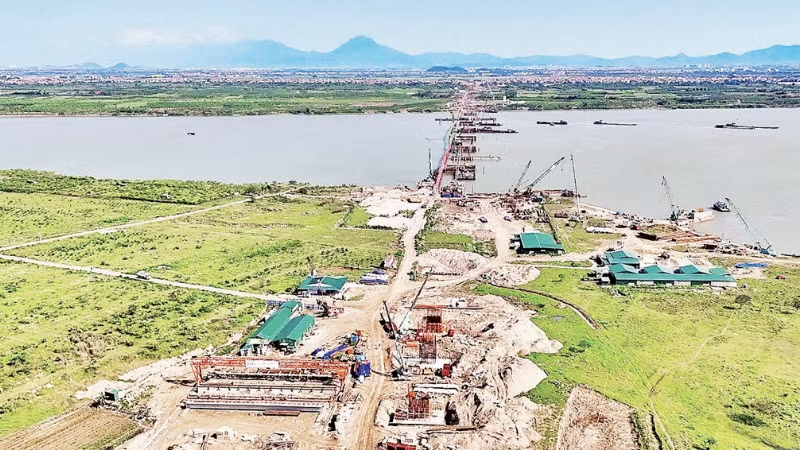
Major infrastructure projects, including Ring Roads No.1 and 2.5, regional transport links and bridges crossing the Red River, have been prioritised for accelerated site clearance and round-the-clock construction schedules, including during holidays.
Ha Noi has also established a “Public Investment Disbursement Command Team”, headed by chairpersons of People’s Committees of the communes and wards, to directly oversee implementation and resolve difficulties at the grassroots level. Relevant departments and agencies have been instructed to promptly address all outstanding tasks within their authority.
Thanks to strong political commitment and the implementation of synchronised and determined measures, by May 6, Ha Noi had disbursed more than 36.2 trillion VND in public investment capital, equivalent to 30.17% of its allocated plan, significantly exceeding the national average.
“Lessons from Ha Noi’s experience suggest that public investment disbursement cannot be accelerated through general directives alone. It must be organised as a concrete management campaign. Simply demanding faster progress without specifying who is responsible, what needs to be done, deadlines and consequences for delays will inevitably lead to a familiar pattern: slow progress at the start of the year, growing anxiety in the middle of the year and a last-minute sprint towards year-end,” Dr Long explained.
To improve the quality of capital allocation and achieve full disbursement of public investment funds during the remaining quarters of 2026, the Government has instructed the Ministry of Finance to urgently develop a key performance indicator (KPI) system to assess disbursement performance among ministries, sectors and localities.
According to Deputy Minister of Finance Nguyen Duc Chi, the legal and policy framework governing public investment is now largely comprehensive and favourable. If implementation outcomes remain unsatisfactory, the shortcomings lie in execution. Under the proposed KPI mechanism, officials responsible for approved and funded projects that fail to achieve effective disbursement and implementation may be assessed as having performed inadequately or failed to fulfil their duties.
Among the measures proposed to promote rapid and sustainable economic growth, a research group from the National Economics University highlighted the role of public investment in supporting, facilitating and stimulating both private investment and foreign direct investment.
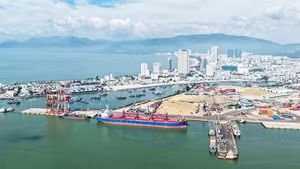
Professor To Trung Thanh, head of the research group, said that priority should be given to projects with strong spillover effects capable of encouraging investment from multiple economic sectors, particularly transport infrastructure linking key economic regions, industrial parks and tourism zones. Once operational, such projects can significantly stimulate production and consumption activities, thereby providing substantial support to overall economic growth.
The research team also proposed the establishment of independent monitoring and evaluation mechanisms, along with stronger accountability throughout the allocation, implementation and operation of public investment projects. It recommended accelerating the digitalisation of public investment management and applying big data and artificial intelligence to real-time project evaluation. Through these innovations, public investment would become not only a financial instrument but also an institutional lever and strategic filter for selecting high-value, sustainable development options with broad economic spillover effects.







![[Infographic] GRDP growth scenarios for 34 provinces and cities in fourth quarter of 2026](https://en-cdn.nhandan.vn/images/nyM650OGFWrOVWc-xajqN-rTZ68Rlmc1fiGJOhBRYHFSa4DhrHNDxEFdnz313Vk5dNJuxdkHglPA3rLeaPeiaUheNuCI723k2lNssd-YLJuKR58epWq7s21lV5WjM-HR2-Qpbi4MwAzqt9wRjL4WjGkfEz7RO9qhcwg8o8LQFK8/grdp-growth-scenarios-for-34-provinces-and-cities-in-q42026-anh-dai-dien.jpg.avif)