After more than three decades of restructuring and reform, the number of SOEs has fallen from more than 12,000 in the early 1990s to 695 by the end of 2025. Of these, 497 are wholly state-owned, while the State holds controlling stakes in the remaining 198 enterprises. By the end of 2025, total assets of the SOE sector had reached approximately 4.5 quadrillion VND, with revenue of nearly 2.9 quadrillion VND and budget contributions of around 390 trillion VND, representing a marked increase compared with 2021.
Persistent obstacles in management framework
Despite these achievements, the restructuring of SOEs has fallen short of expectations. Many enterprises have yet to deliver performance commensurate with the resources entrusted to them, while corporate governance reforms have progressed slowly. Their capacity for innovation and digital transformation also remains limited.
In particular, the progress of equitisation and state capital divestment during the 2021–2025 period failed to meet the targets set. By the end of 2025, only 180 out of 616 enterprises had completed restructuring plans. No enterprise had completed equitisation, while only 17 of the 146 enterprises scheduled for state capital divestment had carried out the process.
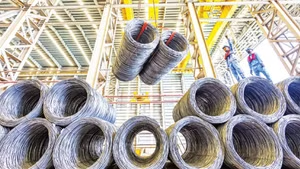
Under the restructuring plan approved by the Prime Minister, the Viet Nam Northern Food Corporation (Vinafood 1) was required to fully divest its stakes in 14 enterprises and reduce its holdings in several others by the end of 2025. The objective was to concentrate resources on its core food business, improve the efficiency of state capital utilisation and safeguard national food security.
However, according to Nguyen Vu Hoan, a member of Vinafood 1’s Members’ Council, the food industry operates on extremely thin profit margins, while many businesses in the sector are relatively small, making them unattractive to investors.
Many auctions have failed to attract any investors. At the same time, overlapping and frequently changing regulations on land, investment and the management of state capital have continued to delay the restructuring process,
Nguyen Vu Hoan,
Member of Vinafood 1’s Members’ Council
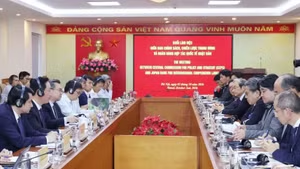
Speaking at the seminar: “Restructuring state-owned enterprises: From resource reorganisation to driving growth”, Nguyen Tuan Linh, a representative of the Department for State-Owned Enterprise Development under the Ministry of Finance, said that, in addition to external factors, the restructuring process had been hampered by numerous shortcomings in the current management framework.
First, decentralisation and delegation of authority remain inadequate. Enterprises have not been granted sufficient decision-making powers over investments, particularly for large-scale or high-risk projects. In many cases, they still have to seek approval from the state ownership representative agency and other relevant authorities, prolonging project implementation. Moreover, performance targets are largely assigned through business plans proposed by enterprises themselves and subsequently approved by the authorities, while oversight still relies mainly on written reports rather than the widespread use of modern monitoring tools.
At the same time, some equitisation plans have failed to offer sufficiently attractive terms to investors, resulting in unsuccessful initial public share offerings. Linh also pointed to subjective factors, particularly the role and accountability of enterprise leaders and state ownership representative agencies.
Granting SOEs greater autonomy
The Ministry of Finance believes that the international environment will remain highly uncertain, with US tariff policies, trade tensions and geopolitical conflicts continuing to exert significant pressure on the economy. Against this backdrop, the Party, the National Assembly and the Government have introduced a series of new policies aimed at improving the performance of the SOE sector and supporting the goal of achieving double-digit economic growth.
Politburo Resolution No. 79-NQ/TW identifies the development of large state-owned economic groups, corporations and commercial banks as pioneers in leading strategic industries and sectors, while strengthening linkages with the private sector and fostering innovation. Meanwhile, the Law on the Management and Investment of State Capital in Enterprises (Law No. 68/2025/QH15) is expected to bring about a significant shift in state capital governance by expanding decentralisation, granting enterprises greater autonomy and reducing administrative intervention.
On this basis, the Ministry of Finance has proposed several groups of measures to accelerate SOE restructuring. The key priorities include further improving the institutional framework, strengthening decentralisation alongside greater accountability for enterprise leaders, accelerating administrative reforms, removing investment bottlenecks and reducing regulatory compliance costs. Resources held by state-owned economic groups and corporations should be used more effectively to invest in key projects with strong spillover effects. Management agencies should also strengthen cooperation between SOEs, private enterprises and foreign-invested enterprises (FDI).
Regarding equitisation and state capital divestment, the ministry has proposed allowing state ownership representative agencies to proactively develop and adjust lists of enterprises for restructuring in each phase, rather than applying a fixed list throughout an entire period. SOE restructuring should be regarded as an ongoing task closely linked to reforms in corporate governance, organisational structures, capital and asset management, thereby enhancing operational efficiency and reinforcing the leading role of the SOE sector in the economy.
Phan Duc Hieu, standing member of the National Assembly's Economic Committee, argued that the most important task in the coming period is to establish a unified approach to SOE restructuring. In his view, restructuring should not be confined to mergers, consolidation or state capital divestment. Instead, its primary objective must be to improve operational efficiency, strengthen competitiveness and enable SOEs to fulfil the leadership role envisaged in Politburo Resolution No. 79-NQ/TW.
He stressed the need to comprehensively resolve long-standing issues relating to finance, land and legal obligations, describing them as persistent bottlenecks that continue to impede equitisation and enterprise restructuring. The Ministry of Finance should review and classify these issues according to their respective jurisdictions and propose appropriate solutions for consideration by the National Assembly, the Government or relevant ministries and agencies. If necessary, a dedicated resolution should also be considered.
In addition, he called for higher standards of corporate governance in line with international best practice while remaining appropriate to Viet Nam’s circumstances. This should be accompanied by further improvements to the legal framework governing modern corporate governance, the recruitment of professional executives and the appointment of independent board members. He also stressed that restructuring should move decisively away from an administrative mindset towards a market-oriented approach.
The State Capital Investment Corporation (SCIC) should be upgraded into a sovereign investment fund operating on market principles, with greater autonomy in managing its investment portfolio and restructuring state capital. This would improve the efficiency of state capital utilisation and strengthen the competitiveness of the SOE sector in the years ahead.
Phan Duc Hieu,
Standing member of the National Assembly's Economic Committee