From “building urban areas” to “creating a development ecosystem”
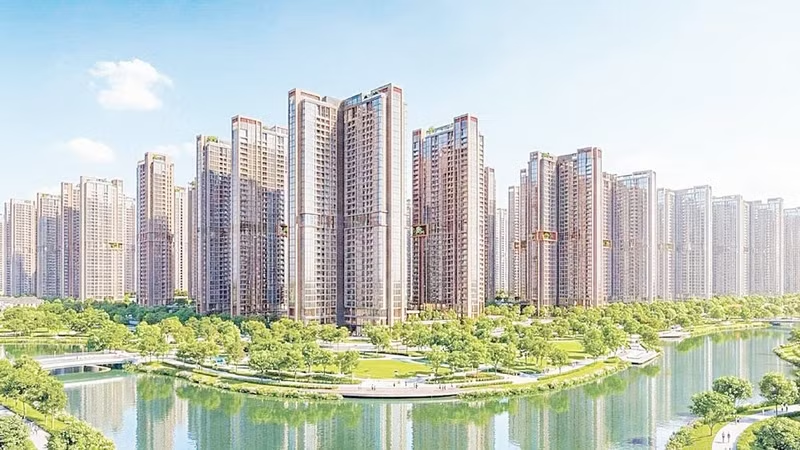
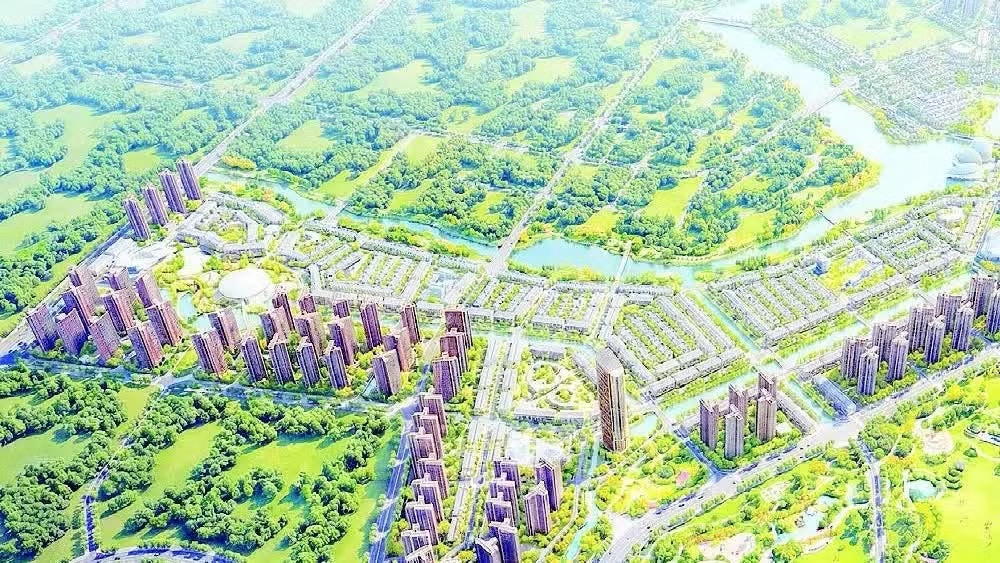
With the development of multi-purpose urban areas, Ha Noi is taking an important step in restructuring its urban space towards building a civilised, modern, sustainable, distinctive, and happy capital city with global value. The project is not only aimed at expanding the urban land fund but also at comprehensively addressing issues related to social welfare, technical infrastructure, and quality of life for residents in the long term.
In the history of the development of major cities around the world, few cities have had the conditions to plan with a century-long vision. This is not merely a matter of spatial planning with new modern roads but one of shaping the future for generations of citizens.
Ha Noi is facing a major opportunity by choosing a development orientation for multi-purpose urban areas linked to a master plan with a 100-year vision. Realising this strategic vision requires not only master plans and large-scale investment projects but also governance capacity, policy consistency, and the ability to overcome inherent limitations in urban development thinking.
For many decades, urban planning in Viet Nam has mainly been understood as dividing land into residential areas, industrial zones, commercial areas, green spaces, and technical infrastructure. This approach has created multifunctional cities in which various types of land use coexist. However, modern cities around the world are no longer focused solely on the question of “what to build” but have shifted to “what to build for”.
An urban area today must not only meet housing needs but also create jobs, attract investment, promote innovation, reduce carbon emissions, preserve culture, adapt to climate change, and improve quality of life. Multi-purpose urban areas do not reject traditional multifunctional planning but expand it with a new way of thinking. While multifunctional urban areas focus on spatial structures, multi-purpose urban areas place the emphasis on development outcomes. The success of an urban area is no longer measured by the number of apartments or the floor area constructed but by its ability to generate economic, social, and environmental value over many decades.
Rare advantages
Few capitals in Southeast Asia simultaneously have a large population, the status of the national political centre, a history and culture spanning more than 1,000 years, and ample room for spatial development like Ha Noi.
First, Ha Noi has the capacity to plan on a regional scale rather than only within the historic inner city. This allows the redistribution of population and employment across nine major urban centres and nine development poles, with a view to comprehensively restructuring urban space and economic centres towards a polycentric model and reducing pressure on the central area.
Second, the ring roads, urban railway lines, new development corridors, and connections with the capital region create opportunities to restructure the entire development space. If implemented in a coordinated manner, Ha Noi could avoid the “fan-shaped urban” pattern in which all flows of people and vehicles converge on the central core.
Third, the digital and knowledge economies are becoming new growth drivers for the capital, helping create conditions for urban areas to serve not only as places to live but also as centres for research, innovation, finance, education, and technology.
More importantly, planning with a 100-year vision allows city governance to move beyond short-term investment cycles. A metro line, a green belt, or a cultural heritage conservation area may not fully realise its benefits within 10 years but could become an invaluable asset after decades, 100 years, and beyond.
Planning vision and governance effectiveness
A master plan may set dozens of objectives: greener, smarter, more innovative, more liveable, more sustainable, more competitive, etc. However, if it does not clearly identify which objectives are priorities, which can be measured, or which involve trade-offs, then “multi-purpose” will amount to no more than a wish list, because no city can maximise all benefits at the same time.
Expanding transport infrastructure may reduce green space and affect the assets and livelihoods of part of the community. Heritage conservation may limit commercial exploitation and economic development. Attracting investment quickly may put pressure on social infrastructure. Uncontrolled development of affordable housing may reduce a project’s financial efficiency and the land value. Therefore, modern urban governance is not about avoiding conflicts of interest but managing such conflicts transparently and on a scientific basis.
Administrative management mechanisms usually operate on five-year terms. If each term adjusts the master plan according to its own priorities, then after several decades, the original plan may be fragmented into many small parts with inconsistent objectives. Meanwhile, international experience shows that successful cities are not successful because they never change but because they maintain core principles consistently over many decades. Plans can be adjusted, but their philosophy and development orientation should not change with each term. This creates a requirement to establish institutions strong enough to safeguard long-term orientations from pressure arising from short-term interests.
In many developing countries, the concept of a “new urban area” is often equated with large-scale real estate projects. A city cannot become an innovation centre simply by building more offices, nor can it become a green city simply by increasing the area of parks in a few projects. Multi-purpose urban areas must put people at the centre and communities at the heart of their service provision, requiring simultaneous investment in education, science, culture, governance, public transport, digital infrastructure, and human resource quality. These fields all have long payback periods but generate sustainable value. If resources are concentrated solely on real estate development, the remaining objectives will be very difficult to achieve.
Ha Noi differs from many new cities because of its rich history and culture. Every decision to widen streets, construct high-rise buildings, or renovate residential areas can affect cultural heritage. The concern is not that the city is developing rapidly, but that development could result in the loss of irreplaceable values. A modern urban area does not necessarily have to erase the memories of the old city. On the contrary, its historical and cultural identity is precisely what creates an advantage for long-term urban competitiveness and value in the context of globalisation. The world’s most attractive cities have not traded their heritage for short-term growth.
A master plan cannot be based solely on today’s conditions. Over the coming decades, temperatures, extreme rainfall, flooding, and pressure on water resources will change significantly. If new urban areas continue to be concreted over, lakes, and ponds filled in, and green spaces reduced, the costs of addressing the consequences in the future will be much greater than investing from the outset. Modern multi-purpose urban planning must regard rivers, lakes, parks, ecological corridors, and wetlands as essential infrastructure, on a par with the development of transport systems and renewable energy.
Ultimately, it should be recognised that the success of multi-purpose urban areas depends not only on planning but also on governance. A good master plan that is poorly implemented will quickly become an archival document. Conversely, a flexible plan, updated on the basis of reliable data, with public participation and transparent oversight, will have lasting vitality. Ha Noi needs to build a unified urban data system, with quantitative assessment indicators for each objective, effective coordination mechanisms among sectors, and meaningful community participation. Only then can “multi-purpose” go beyond an idea and become a verifiable outcome.
Every planning decision made today must simultaneously serve economic growth, social equity, community well-being, environmental protection, and the preservation of cultural identity for generations to come. If this can be achieved, Ha Noi will build new multi-purpose urban areas on a sustainable development foundation, accompanying the country throughout the 21st century and beyond.