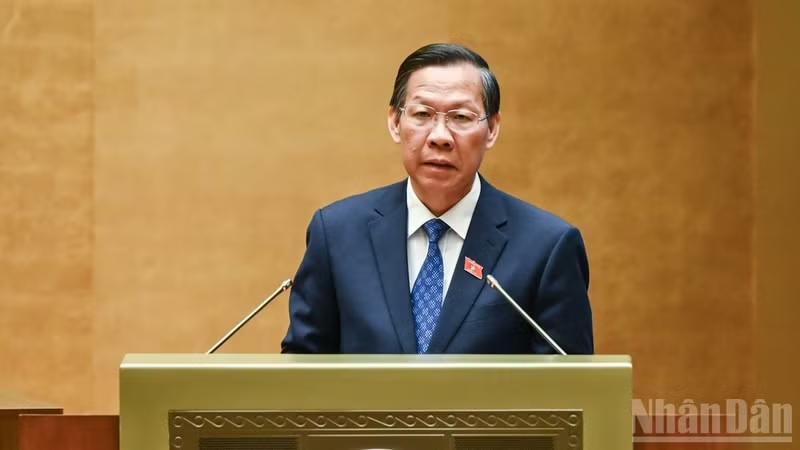
On the morning of October 17, continuing its second session, the National Assembly (NA) heard an appraisal report on the implementation of the 2026 socio-economic development plan and the proposed socio-economic development plan for 2027.
Phan Van Mai, Chairman of the Economic and Financial Committee, said that despite numerous difficulties and challenges, the socio-economic situation in 2026 has continued to record important and relatively comprehensive achievements across various sectors.
Nine of the 15 key targets are expected to be met or exceeded and five remain within reach, while the multidimensional poverty reduction target is projected to fall short.
GDP growth in the first nine months was estimated at 9.01%, exports increased by 24.5%, disbursed foreign direct investment (FDI) rose by 12.1%, public investment disbursement reached 62.9% of the annual plan, and the average consumer price index (CPI) increased by 4.52%.
Macroeconomic stability was broadly maintained, and major economic balances were ensured. Positive progress was recorded in institutional reform, strategic infrastructure, science and technology, digital transformation, and the operation of the two-tier local government system. Numerous strategic infrastructure projects were accelerated, while obstacles facing long-stalled projects were gradually removed. The government also focused on addressing and largely clearing the backlog of legal documents detailing the implementation of laws and regulations.
"The achievements recorded in the first year of the tenure are highly encouraging, demonstrating the economy's ability to adapt and maintain macroeconomic stability amid considerable volatility. In particular, strategic decisions on institutions, infrastructure, science, technology, and organisational restructuring have begun to be translated into practice, strengthening confidence and laying an important foundation for acceleration and breakthroughs during the 2026-2030 period," Mai stated.
Private investment has yet to achieve a breakthrough
In its report, the Economic and Financial Committee also highlighted six key issues requiring attention in policy direction and management in the coming period.
First, despite high economic growth, its foundations remain fragile. The four largest local economies — Ho Chi Minh City, Ha Noi, Hai Phong, and Dong Nai — which together account for nearly 47% of total GRDP, are all projected to miss their 2026 growth targets. Private investment has yet to gain real momentum, accounting for 53% of total social investment but growing by only 14% — the lowest rate among the three investment sectors.
Second, pressures on macroeconomic stability and financial security are mounting. The average consumer price index (CPI) rose by 4.52% in the first nine months, already reaching the full-year target of around 4.5%, while the increase in the third quarter alone stood at 4.80%. Prices of essential goods and services continued to rise, while real purchasing power has been recovering slowly.
Third, substantial investment resources have been mobilised but have been slow to translate into productive capacity and new growth drivers. Public investment disbursement in the first nine months reached 62.9% of the plan, however, unrecovered advance payments accounted for as much as 37% of the disbursed amount. Investment procedures have been completed for only around 58% of the central budget capital announced for the 2026-2030 period.
Several major projects remain behind schedule. Power generation and transmission grid projects, particularly those involving liquefied natural gas (LNG), have progressed slowly, while limited energy reserves pose potential risks to energy security.
Regarding science and technology, although approximately 95 trillion VND has been earmarked, only 37.26% of the allocated funding had been disbursed after nine months, while around 24 trillion VND remains unallocated. Investment in strategic technologies has also fallen short of requirements.
Another issue highlighted by Mai was that, despite accelerated institutional reforms, implementation remains a bottleneck.
The two-tier local government model has generally operated smoothly, but performance remains uneven, particularly at commune level. In some places, decentralisation and delegation of authority have not been accompanied by sufficient resources, personnel, and implementation responsibilities, potentially shifting bottlenecks from higher administrative levels to the grassroots.
Enterprises and household businesses continue to face considerable difficulties. During the first nine months, the number of enterprises entering or re-entering the market fell by 3.2%, while the number completing dissolution procedures surged by 118.8%.
Small and medium-sized enterprises face difficulties in accessing capital and are under pressure from rising input costs, logistics expenses, and compliance costs. Household businesses are dealing with a slow recovery in purchasing power while also having to adapt to requirements relating to digital transformation, management, and tax policies.
These difficulties directly affect investment, employment, incomes, and domestic demand.
In addition, the quality of social development remains uneven. There is a shortage of highly skilled workers, informal employment accounts for a large share of the workforce, and youth unemployment remains high.
Significant disparities persist among regions in access to education, healthcare, and essential services. Many people have reported difficulties in purchasing textbooks under the unified textbook series, even in some major cities, raising concerns about possible shortages in disadvantaged areas.
Counterfeit goods, fake medicines, food safety violations, online scams, environmental pollution, fire and explosion risks, and natural disasters continue to affect people's health and livelihoods.
According to the Economic and Financial Committee, alongside objective factors, it is necessary to fully recognise structural limitations in productivity, internal economic capacity, and implementation.
The most important requirement for the remainder of 2026 is not simply to mobilise additional resources but to improve the efficiency of their allocation and utilisation and turn them into higher productivity, stronger productive capacity, and greater economic competitiveness.
Regarding the proposed socio-economic development plan for 2027, the committee stressed that economic management scenarios should take the lagged effects of shocks in 2026 into account, particularly the possibility of energy prices remaining high and pent-up inflationary pressures emerging as tax and fee support measures are adjusted.
The committee assessed that the GDP growth target of 10% or higher reflects strong determination but poses major challenges, given the fragile foundations of growth, mounting inflationary pressures, and increasing demand for capital and energy. Some opinions called for greater clarity on growth scenarios and specific measures for individual sectors, localities, and new growth drivers. They also urged a realistic assessment of the growth potential of major economic centres, the scope for keeping CPI growth at around 4.5%, and the consistency and feasibility of major economic balances.
Clearly defining responsibilities, deadlines, resources, and expected outcomes for each task
Regarding tasks and solutions, the NA’s Economic and Financial Committee stressed the need to establish clear priorities. With the goal of achieving double-digit growth, the key is not to introduce more measures but to identify the right areas for breakthroughs, improve implementation effectiveness and productivity, and strengthen the economy’s capacity for self-reliance.
Highlighting several priorities, the committee emphasised the need to firmly maintain macroeconomic stability as a prerequisite for high growth, placing coordination among fiscal policy, monetary policy, and price management at the centre of economic management.
It also called for shifting towards a more intensive growth model and increasing domestic value added. Resources from public investment, private investment, state-owned enterprises, FDI, and financial markets should be unlocked, allocated, and utilised in a coordinated and effective manner.
Priority should be given to measures supporting small and medium-sized enterprises and household businesses, developing foundational and supporting industries, and attracting FDI selectively, with an emphasis on technology transfer, domestic supplier development, and higher localisation rates.
In particular, strategic infrastructure and energy security should receive priority. Efforts should focus on inter-regional infrastructure projects, reducing logistics costs, and expanding development space.
Coordination must also be ensured among power generation, electricity grids, LNG, fuel supplies, reserves , and contingency arrangements, with energy security regarded as a fundamental condition for high growth.
Regarding investment in science, technology, innovation, and digital transformation, the Economic and Financial Committee recommended shifting the focus from resource inputs to developing practical applications, improving productivity, and commercialising research outcomes.
Priority should be given to strategic technologies, shared data resources, and results-based commissioning, alongside training human resources in semiconductors, artificial intelligence, and energy in line with business demand.
Institutional reform must shift its focus from the number of legal documents issued to the effectiveness of implementation. Overlapping regulations should be addressed, while decentralisation must be accompanied by adequate resources, implementation capacity, and accountability.
Another priority emphasised by the committee was linking high economic growth with cultural and social development. Greater attention should be paid to sustainable employment, substantive poverty reduction, access to essential services, regional disparities, and the sustainability of the social welfare system amid rapid demographic changes.
Affirming that implementation is the decisive factor, the Economic and Financial Committee proposed clearly defining the responsibilities, deadlines, resources, and expected outcomes of each task.
It also called for stronger inspection and supervision, with implementation results linked to the accountability of agency and organisational leaders.
The overarching requirement is to ensure that high economic growth goes hand in hand with macroeconomic stability, sustainable development, and substantive improvements in people's material and spiritual well-being.








![[Infographic] GRDP growth scenarios for 34 provinces and cities in fourth quarter of 2026](https://en-cdn.nhandan.vn/images/nyM650OGFWrOVWc-xajqN-rTZ68Rlmc1fiGJOhBRYHFSa4DhrHNDxEFdnz313Vk5dNJuxdkHglPA3rLeaPeiaUheNuCI723k2lNssd-YLJuKR58epWq7s21lV5WjM-HR2-Qpbi4MwAzqt9wRjL4WjGkfEz7RO9qhcwg8o8LQFK8/grdp-growth-scenarios-for-34-provinces-and-cities-in-q42026-anh-dai-dien.jpg.avif)