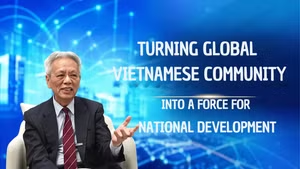
Dr Le Hung Cuong, CEO of FPT Digital under FPT Corporation, shared these views in an interview with Nhan Dan Newspaper on the occasion of Viet Nam Entrepreneurs’ Day.
Starting with business challenges
Q: AI is exerting an increasingly profound impact on business operations. In your view, what is the most fundamental shift this technology presents for Vietnamese entrepreneurs?
A: In my view, the most profound shift lies in management mindsets and the role of business leaders. Technology is evolving rapidly, and business models will adapt accordingly. However, it remains up to executive leaders to determine how their organisations respond to these disruptions.
AI is significantly expanding our ability to access knowledge, identify problems, test assumptions, and make decisions. Tasks that previously required weeks of information gathering, synthesis, and analysis can now be executed in a fraction of the time.
As AI tools become increasingly accessible, the difference between businesses will no longer simply be whether they use AI, but rather their ability to ask the right questions, identify opportunities, and translate technological insights into sound strategic decisions.
This requires leaders to maintain a long-term vision while creating an environment for their organisations to experiment, learn, and adapt quickly. Entrepreneurs do not necessarily need to become AI experts, but they must understand how this technology reshapes their businesses. They also need to recognise its limitations and pinpoint decisions that still require human experience, judgement, and accountability.
Q: Many businesses have invested in AI tools, but the results have fallen short of expectations. Where should they begin to deploy it effectively?
A: In my view, the best starting point is not AI itself, but the business problem requiring resolution. McKinsey's 2025 global survey found that, among 25 factors analysed, workflow redesign exerted the strongest influence on whether gerative AI boosted operating profits. However, only 21% of respondents at organisations using generative AI said their companies had fundamentally redesigned at least some workflows.
This demonstrates that value does not stem merely from layering AI onto existing processes, but from reimagining how work is organised. Manufacturing enterprises, for example, could begin by targeting equipment downtime. Retailers might focus on sharpening demand forecasts, while financial institutions could streamline loan and application processing. For office-based departments, the priority might be reducing the time spent searching for, compiling, and processing information.
Once businesses have clearly identified the problems they need to address, they can select appropriate data, tools, and workflows while establishing criteria for evaluating results. Enterprises should start on a sufficiently small scale to learn quickly, while choosing challenges significant enough to deliver tangible gains. Once effectiveness has been demonstrated, they can scale up their initiatives and accumulate experience in data management, human resources, and governance. Ultimately, results should be measured against specific metrics, such as productivity, processing time, costs, customer experience, and the generation of new value streams.
Q: Looking ahead over the next five to ten years, which capabilities will define the competitiveness of Vietnamese enterprises in the AI era?
A: Competitive advantage will gradually shift from hsheer resource accumulation to how quickly an enterprise can utilise and reconfigure those assets. In my view, three capabilities will be decisive.
The first is the ability to transform proprietary data and knowledge into competitive assets. AI models are becoming increasingly commoditised, but customer data, operational information, product knowledge, supply chain insights, and experience accumulated over many years are what truly differentiate competitors. When AI is integrated with these knowledge repositories, enterprises can fully leverage their distinctive strengths.
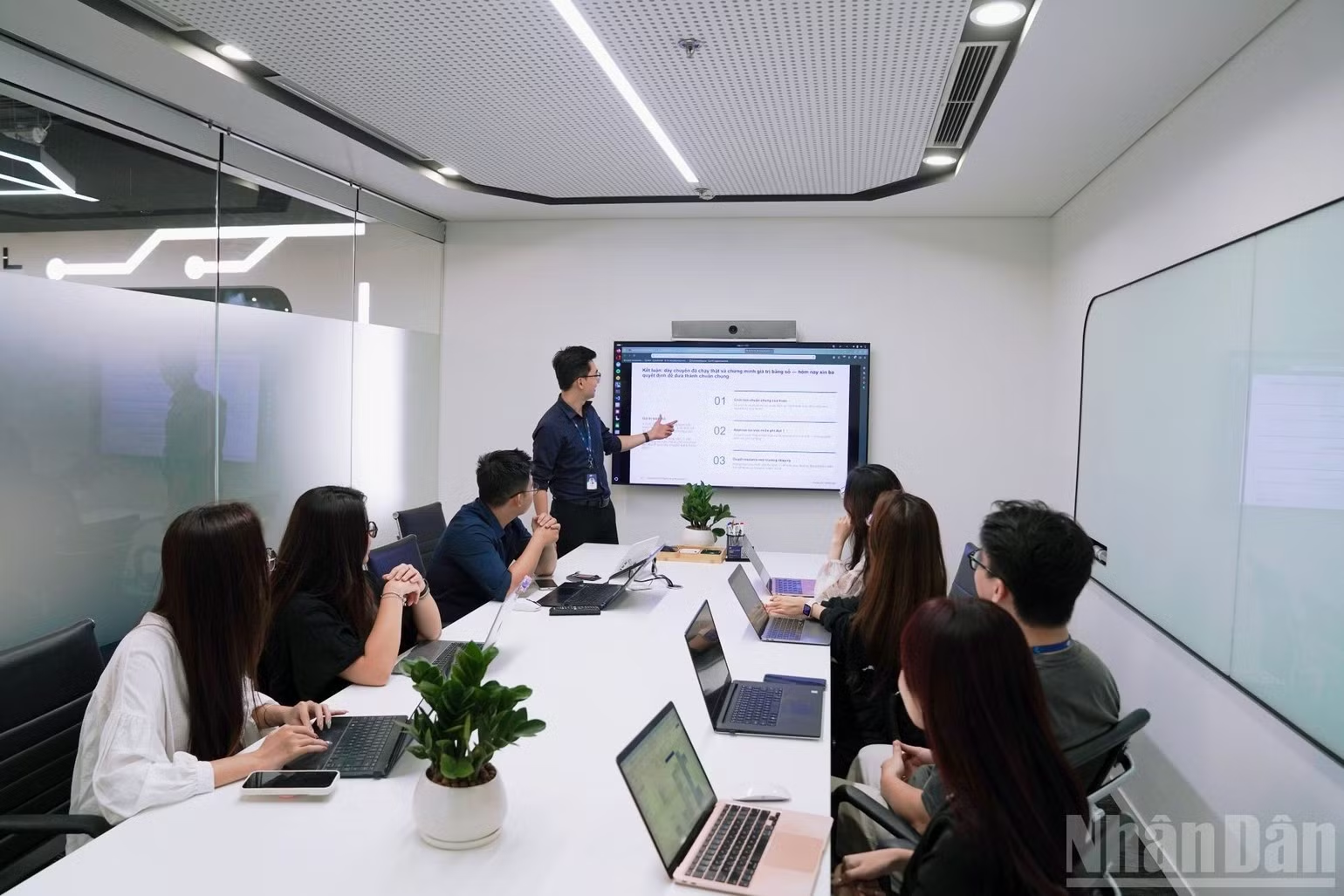
The second is organisational learning velocity.
Rapid technological change makes it increasingly difficult for businesses to develop long-term plans and execute them sequentially without adaptation.
Alongside strategic direction, enterprises must experiment regularly, measure results, gather insights, and pivot when necessary.
The third is the ability to redesign operations and business models. AI does more than accelerate routine tasks. It also prompts leaders to question whether work could be organised differently, whether products could be delivered through new channels, and whether previously unmet needs could transform into viable business opportunities.
Enterprises capable of synthesising data, rapid learning, and operational innovation will be primed to strengthen their long-term competitiveness.
Q: AI is poised to dirupt employment structures and the skills required of workers. How should businesses prepare for this transition?
A: In my view, the labour market is not a zero-sum equation where AI simply displaces human labour.
Rather than asking only which jobs AI will automate, businesses must examine individual roles to determine which tasks AI can perform more effectively, which tasks humans can enhance through technology, and what new jobs might emerge.
Workforce reskilling is necessary, but insufficient on its own. Businesses must also redesign jobs and workflows. AI can increasingly absorb repetitive tasks, information searches, data synthesis, and information processing, freeing humans to focus on judgement, creativity, problem-solving, understanding customers, and taking responsibility for final decisions.
In addition to their existing workforce, businesses also need to consider digital workers. These are AI-powered agents integrated into business processes that interact with human personnel through digital tools. The key challenge is how to organise work so that human employees and digital workers can collaborate seamlessly, amplifying both individual output and overall enterprise capability.
Building long-term competitiveness
Q: For small and medium-sized enterprises (SMEs), which often face constraints in finance, data, and technological expertise, what practical pathway can prevent them from falling behind?
A: This is a particularly critical issue in Viet Nam, where SMEs account for approximately 97% of all enterprises. Being small does not necessarily put businesses at a disadvantage in the AI wave, even if gaps in technological access and adoption persist.
According to OECD data released in January 2026, 52% of large enterprises in OECD countries surveyed used AI in 2025, compared with only 17.4% of small enterprises.
Generative AI is helping lower some barriers to technology adoption. Small businesses have advantages in their streamlined organisational structures, shorter decision-making cycles, and the ability to experiment quickly. Therefore, a targeted approach is far preferable to launching a large-scale AI strategy. Businesses can target specific pain points in customer support, sales, document processing, inventory management, or information retrieval, leverage off-the-shelf platforms, and set measurable milestones.

The key is to begin building capabilities early through iterative experimentation and refinement. Over time, implementation experience, organisational learning capacity, and effective data management will build decisive competitive moats, regardless of their size.
Q: On the occasion of Vietnamese Entrepreneurs' Day, what changes would you like to see among the next generation of Vietnamese entrepreneurs over the next five to ten years to strengthen their position in international markets?
A: I hope Vietnamese entrepreneurs will gradually move beyond passive adaptation towards wielding technology to solve core business problems and capture market opportunities. Vietnamese entrepreneurs have proven their resilience across successive stages of development, from economic opening and international integration to the rise of the Internet, e-commerce, and digital transformation.
With AI, access to knowledge, analytical capabilities, and technology is democratising, opening fresh avenues for businesses of all sizes.
In my view, three pivotal shifts are needed. First, businesses must move from mere tech adoption to mastering problem-solving.
Enterprises do not necessarily need to develop every underlying technology in-house. However, they must deeply understand domestic market needs and know how to integrate appropriate technologies to address them.
Second, businesses should move beyond optimising existing models towards pioneering new paradigms. AI can help enterprises boost efficiency across sales, production, and cost management, while opening pathways to launch novel products, services, and business models.
Third, Vietnamese enterprises must transition from passive market participation to proactive global competition. Business challenges originating in Viet Nam often resonate across regional and global markets. To seize these openings, enterprises need ambition, the ability to learn quickly, and the capacity to scale solutions internationally.
At FPT Digital, we partner with the business community to unlock new value drivers and bolster competitiveness.
I hope Vietnamese entrepreneurs will become more assertive in identifying opportunities, harnessing technology, and exporting tailored solutions to global markets.
Thank you very much!