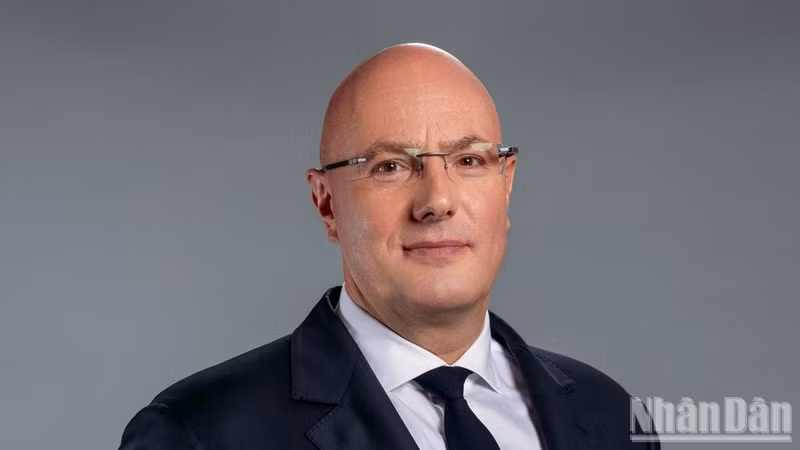
Ahead of the visit, Russian Deputy Prime Minister Dmitry Chernyshenko spoke to a correspondent of Nhan Dan Newspaper based in Russia about the significance and objectives of the visit.
Q: Deputy Prime Minister, the Comprehensive Strategic Partnership between Viet Nam and Russia has recently achieved many positive results, including contributions from regular contacts between the two countries’ senior leaders. In this context, how do you assess the upcoming State visit by General Secretary and President To Lam to Russia?
A: President of Russia Vladimir Putin has stressed that Viet Nam is our long-standing and reliable partner. Russia–Viet Nam relations are built on a foundation of traditional friendship and mutual assistance. Regular, trusted contacts at the highest level between the leaders of the two countries play an important role.
An important milestone was reached in June 2024, when Russia and Viet Nam adopted a Joint Statement on further deepening their Comprehensive Strategic Partnership — a document that set out new directions for cooperation in the years ahead. This momentum continued in 2025, when President of Russia Vladimir Putin held talks with General Secretary To Lam.
Subsequently, 2026 was declared the Year of Russia–Viet Nam Science and Education Cooperation, an area that has always brought the peoples of the two countries closer together and where we have gained unique cooperation experience.
Therefore, the upcoming State visit to Russia by General Secretary and President To Lam is an event of particular importance. It is not only a continuation of the tradition of regular high-level contacts, but also an opportunity to create new momentum for bilateral cooperation, from trade, the economy, and science and technology to people-to-people ties and education, which are being given top priority during the current Year of Science and Education Cooperation.
I am confident that the visit will be an important milestone in further strengthening the strategic relationship between Russia and Viet Nam.
Q: How do you assess the current state and potential of cooperation between Viet Nam and Russia in science, technology, and innovation? What steps can the two sides take to make this sector a new driving force for bilateral relations?
A: The level of interest and desire for cooperation between Russia and Viet Nam in science and education has always been high. The Russia–Viet Nam Committee for Educational, Scientific, and Technological Cooperation is operating effectively, while the Intergovernmental Committee on Trade, Economic, and Scientific and Technical Cooperation meets regularly.
The Viet Nam–Russia Tropical Centre is a leading platform for joint research. A development strategy through 2035 has been approved for the Centre. On the Russian side, around 60 scientific organisations participate in the Centre’s activities, including agencies under the Russian Ministry of Education and Science, the Federal Service for Surveillance on Consumer Rights Protection and Human Wellbeing (Rospotrebnadzor), and the Kurchatov Research Institute.
I would particularly emphasise the maritime sector. Since 2018, Russian and Vietnamese scientists have conducted joint expeditions aboard the research vessels Akademik Oparin and Akademik Lavrentyev. In December 2025, a Roadmap for Marine Scientific Research Cooperation for 2026–2035 was signed. Russia’s Professor Gagarinsky research vessel was transferred to the Tropical Centre. This year, the vessel conducted a research expedition to assess the ecological status of Viet Nam’s coastal waters.
Funding support for joint projects is also being actively developed. On the Russian side, the Ministry of Education and Science and the Russian Science Foundation organise annual competitions, selecting dozens of promising research projects in such fields as materials science, biotechnology, ecology, aquaculture, and renewable energy.
As for potential, I believe there is still enormous untapped room for cooperation. First, funding for joint research needs to be expanded, making competitive grant schemes a regular and planned mechanism for scientists from both countries.
Second, academic exchanges and human resources training should be stepped up, including the training of technical specialists through alliances of technical universities.
Third, high-tech and innovation fields such as artificial intelligence, cybersecurity, and renewable energy should be actively incorporated into cooperation. And, of course, we must continue to strengthen the institutional framework for cooperation between universities and research organisations of the two countries, which currently have more than 500 cooperation agreements in force.
Q: Could you identify the specific product groups and cooperation models with the greatest breakthrough potential, thereby bringing bilateral trade turnover to a level commensurate with the political relations between the two countries?
A: October this year marks the 10th anniversary of the entry into force of the Free Trade Agreement between the Eurasian Economic Union (EAEU) and Viet Nam. Customs duties on goods exported from EAEU countries to Viet Nam have fallen to 1%, from 9.5% in 2015, while those on imports have fallen to 2%, from 9.7% in 2015.
For some products, Russia continues to significantly increase exports to Viet Nam, partly due to tariff liberalisation under the Agreement. Last year saw record exports of fertilisers, up 87% from the previous year, and pork, up 30.9%. Energy and polymer exports have also grown steadily.
Meanwhile, the Agreement’s transition period has ended, and much of its potential for rapidly increasing trade has already been realised. Therefore, it is now important for the two countries to establish new foundations for developing trade and investment cooperation. This is reflected in the Russia–Viet Nam Comprehensive Cooperation Plan through 2030, signed in 2025, which sets a target of raising bilateral trade turnover to 15 billion USD.
We currently see a number of areas with potential to promote bilateral trade. However, in my view, it is important not only to look at the export of individual goods, but also to take into account the potential for expanding technological cooperation and production. This serves both Viet Nam’s interests in strengthening technological sovereignty and Russia’s need to increase exports.
The first area is energy and energy machinery manufacturing. This is a traditional area of cooperation between Russia and Viet Nam, with potential far beyond existing projects. Cooperation covers not only oil and gas, but also energy equipment, power grids, power generation, services, and localisation of production.
The second area is railways and metro systems. This area is particularly promising as Viet Nam plans to develop its urban transport and railway infrastructure. Russian enterprises have capabilities not only in manufacturing locomotives and rolling stock, but also in design, construction, electrification, signalling, automation, and railway system management. Therefore, the two countries can implement comprehensive projects, from supplying equipment and technology to participating in the construction of metro and railway systems, training personnel, and providing technical maintenance.
The third area is mineral extraction and processing. Viet Nam has significant mineral resources, but developing their extraction requires modern technologies, equipment, and expertise. Russia can provide technologies for geological exploration, mineral extraction and beneficiation, mining equipment, automation, and ore-processing solutions, including for metal ores. This would simultaneously increase Russian exports of engineering products and create a foundation for long-term investment cooperation.
The fourth area is agriculture and food. Russia has competitive advantages in grain, oils and fats, animal feed, meat, and certain agricultural raw materials. However, the greatest benefits can be achieved by developing longer value chains: domestic raw materials, processing in Viet Nam, and joint access to the ASEAN market. This would enable the two countries not only to limit themselves to supplying raw materials but also to create added value, while expanding the presence of Russian companies in the region.
The fifth area is pharmaceuticals and medical equipment. Viet Nam is interested in increasing the supply of medicines and developing its domestic pharmaceutical and healthcare industries. Russian enterprises can supply not only finished medicines but also pharmaceutical active ingredients, technologies, and equipment, as well as establish local production facilities, provide services, and train specialists.
The sixth area is digital technology. Russia has strong capabilities in cybersecurity, financial technology, artificial intelligence, digital identity, and enterprise software. Viet Nam is actively digitalising its economy, so business-to-business cooperation models, joint technology projects, and the application of Russian solutions in the Vietnamese market and eventually the ASEAN market are highly promising.
Of course, to realise all these potential opportunities, it is necessary to definitively address infrastructure-related issues — bilateral payment mechanisms, improving logistics, finding reliable partners, and adapting Russian products to meet the requirements of the Vietnamese market. These issues are being addressed.
As for new forms of cooperation, e-commerce has enormous potential. Russia is currently among the world’s leaders in e-commerce development, and e-commerce platforms have become one of the main channels for promoting goods for small and medium-sized enterprises. In Viet Nam, e-commerce is also developing at one of the fastest rates in Southeast Asia. Promoting cooperation between Russian and Vietnamese e-commerce platforms could significantly facilitate market access for Russian producers.
Q: With Viet Nam’s growing energy demand and Russia’s clear advantages in technology, resources, and experience in this field, what new areas of energy cooperation could be expanded between the two countries? What new investment projects in this sector could be implemented in the near future, Deputy Prime Minister?
A: One area that is emerging as a foundation for deeper cooperation is nuclear energy. Russian universities are also involved in training technical personnel for Viet Nam’s nuclear industry. In the current academic year, the Vietnamese Government has allocated 59 places out of the Russian Government scholarships for the training of nuclear industry specialists at Russian universities. Universities in Russia and Viet Nam are actively cooperating in many areas, including nuclear and hydrogen energy, renewable energy, power engineering, and electrical engineering, as well as the aviation industry and information technology.
Q: Deputy Prime Minister, relations between Viet Nam and Russia are built not only on political and economic cooperation but also on the solid foundation of special sentiments and ties between the peoples of the two countries. In your view, what needs to be done to further develop cooperation in culture and education, and particularly to attract the interest of the younger generation, thereby creating a solid social foundation for Viet Nam–Russia relations in this new stage of development?
A: Student exchanges, joint science and education projects, youth forums, and cultural programmes — all these enable young people from the two countries to understand each other better and establish direct contacts, which can subsequently serve as a foundation for cooperation in many areas. More than 3,000 Vietnamese students are currently studying at Russian universities. Language and educational cooperation is also highly developed. Russian has been taught in Viet Nam since the 1950s.
I would also like to highlight the Russian Language Olympiad, which has been held since 2023. More than 700 school and university students took part in the qualifying round last season, with the winners given the opportunity to attend a free summer language internship in Moscow. In my view, projects of this kind are the best way to attract young people, giving them practical study experience in Russia. Interest in the Vietnamese language is also growing in Russia.
Currently, around 350 students are studying Vietnamese under Asian studies, international relations, and linguistics programmes at 10 Russian universities. The twinning relationships between Ha Noi and Moscow, Ho Chi Minh City and St Petersburg, Ho Chi Minh City and Vladivostok, and Da Nang and Yaroslavl Province, among others, play an important role in strengthening people-to-people ties. This dialogue opens up more opportunities for joint projects in education, culture, and youth exchanges.
Reporter: Thank you very much, Deputy Prime Minister!
![[In Pictures] General Secretary and President To Lam delivers policy speech at University of Copenhagen](https://en-cdn.nhandan.vn/images/3NY4Z6Du1Md1PrS_s0ZZOrwc5xDfq4rRua69depr-TDIXqOrGxgyFlbehboeAXumVU-iNoVYeFFkfgs0TXTy7ge8IKcHwEv_rFSm_tMswqNwLSgl03nJ1NCr56FT-Opqn8pRcU13EW860CRC78OOSOp8BbIe0IoOZM7TLbbO3sAQkSBSgF9oHIV2PYQOszBk/vna-potal-tong-bi-thu-chu-tich-nuoc-to-lam-phat-bieu-chinh-sach-tai-dai-hoc-copenhagen-5885.jpg.avif)