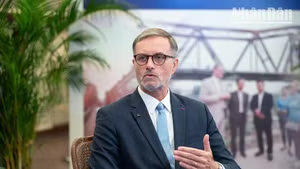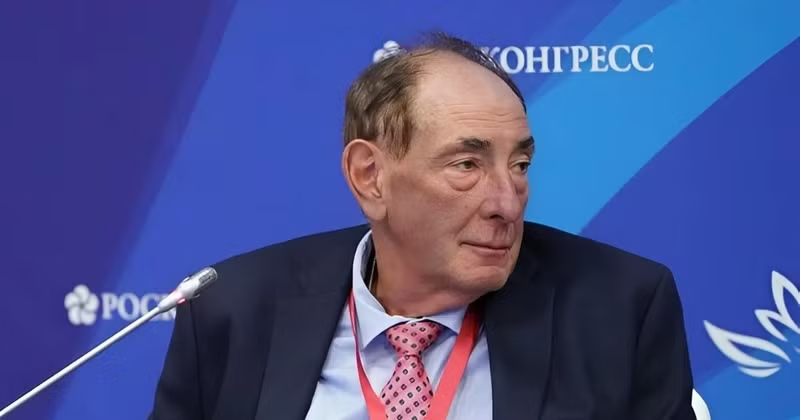
In an interview with the Russia-based correspondent of Nhan Dan Newspaper ahead of Party General Secretary and State President To Lam’s State visit to the Russian Federation, Georgy Toloraya noted that, based on its own historical experience, Viet Nam views peace not as an abstract political concept, but as an essential condition for development.
Over the past decades, Viet Nam has charted an impressive trajectory, transforming itself from a country that suffered immense devastation from conflict into one of the world’s most dynamic developing nations. The process of modernisation and economic development has not diminished its national identity, while Viet Nam has remained steadfast in pursuing an independent and self-reliant foreign policy.
According to Georgy Toloraya, in this development process, Party General Secretary and State President To Lam has played a particularly pivotal role in shaping Viet Nam’s foreign policy towards a more proactive, substantive, and flexible approach, harmonising national interests with the responsibility to contribute to regional peace and stability.
Under the leadership of Party General Secretary and State President To Lam, foreign affairs continue to be identified as a key and regular task of the State, with economic diplomacy playing an instrumental role in advancing the country’s development goals.
“What is decisive, in my view, is the harmonious combination of national development and a peaceful foreign policy. Viet Nam is demonstrating that economic development, international integration, the maintenance of independence and self-reliance, and the building of good relations with neighbouring countries can go hand in hand and, indeed, complement and reinforce one another,” Georgy Toloraya remarked.
During Party General Secretary and State President ToLam’s upcoming visit to Russia, the Leo Tolstoy International Peace Prize Foundation — named after the great Russian writer and advocate of peace, renowned for his deeply humanistic philosophy emphasising moral values and compassion — will present the Leo Tolstoy International Peace Prize to the Vietnamese leader.
Georgy Toloraya stressed that the Russian Academy of Sciences believes the presentation of the Leo Tolstoy International Peace Prize to Party General Secretary and State President To Lam represents not only an endorsementof the role of a particular leader, but also an affirmation of the broader development path Viet Nam has chosen — one oriented towards peace, development, dialogue, and responsible participation in shaping the regional order.
According to the expert, a defining feature of Viet Nam’s foreign policy is its promotion of an equitable, indivisible,and non-discriminatory regional security architecture, while advocating a fair world order based on international law.
Georgy Toloraya also noted that Party General Secretary and State President To Lam champions an approach to regional security based on dialogue, mutual respect, adherence to international law, stronger economic connectivity, and the establishment of mechanisms for conflict prevention and management.
He observed that Viet Nam’s commitment to peace represents a proactive policy in which the safeguarding of national interests goes hand in hand with efforts to resolve differences through dialogue and negotiations rather than the use of force.
According to the expert, the Russia–Viet Nam Comprehensive Strategic Partnership has entered a transformative phase in recent years. The two countries have achieved breakthroughs across numerous areas, including energy, cultural and educational cooperation, higher education, exchanges among scientific and expert communities, youth exchanges, and joint projects in literature and the arts.