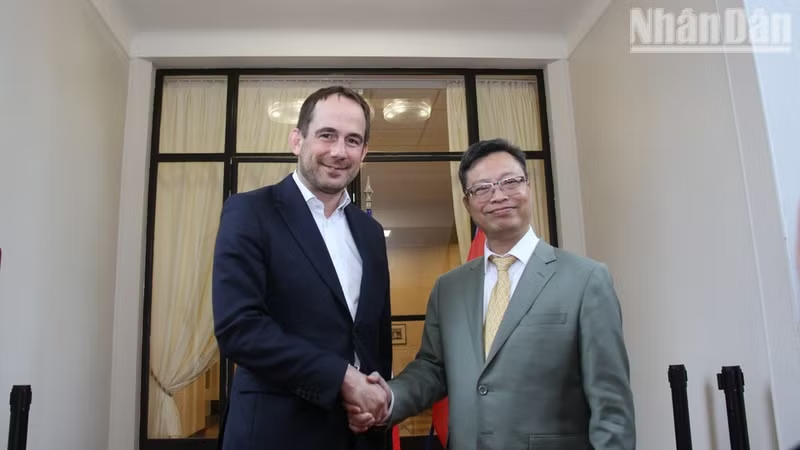
Held under the theme “Promoting the pioneering role and fulfilling the vital and regular tasks of Viet Nam’s foreign affairs in the new era”, the conference, set to take place from August 1 to 7, will provide an opportunity to comprehensively assess the global and regional situation, thoroughly grasp the foreign policy orientations set out by the 14th National Party Congress, and identify directions, tasks, and solutions for building a comprehensive, modern, and professional diplomacy that meets the country's development requirements in the new stage.
Q: The 33rd Diplomatic Conference is taking place as the country enters a new era — the era of the nation's rise. How do you assess the requirement to “promote the pioneering role” of the diplomatic sector in general, and of the Embassy of Viet Nam in France in particular, in order to realise this strategic vision?
A: As Viet Nam enters a new era — the era of the nation's rise — the diplomatic sector faces a historic mission. The “pioneering” role of foreign affairs goes beyond maintaining a peaceful and stable environment. It must proactively expand the country's development space, seize golden opportunities, and maximise external resources to support the nation's breakthrough development.
This requires the diplomatic sector to undergo a profound transformation by becoming more proactive in strategic forecasting, more flexible in handling complex international relations, and more effective in translating diplomatic frameworks into concrete projects and cooperation that generate high added value.
For the Embassy of Viet Nam in France, we have clearly identified our foremost mission as deepening and elevating the substance of the Viet Nam–France Comprehensive Strategic Partnership. France is not only a long-standing partner of Viet Nam, but also one of the world's leading centres for science and technology, education, clean energy, railways, and innovation.
The Embassy will continue to serve as a “proactive bridge”, effectively connecting ministries, sectors, localities, businesses, and research institutes of both countries. We believe that the pioneering role of a diplomatic mission today should be two-way in nature — not only “bringing resources, knowledge, and technology home”, but also serving as a “launchpad” to help Vietnamese enterprises enhance their competitiveness and gradually expand their presence in the French and European Union (EU) markets.
Q: Viet Nam and France upgraded their ties to a Comprehensive Strategic Partnership in 2024 during Party General Secretary and State President To Lam's official visit to France. This has provided an important impetus for the two countries to expand cooperation across a wide range of fields in the new phase. What measures and activities to advance bilateral relations have been undertaken by the Embassy of Viet Nam in France during the first six months of 2026? And what have been the most notable and substantive outcomes?
A: From the very beginning of 2026, building on the Comprehensive Strategic Partnership established in 2024, the Embassy has carried out coordinated and determined diplomatic activities to translate high-level political commitments into tangible drivers of development.
We have focused on strengthening political trust by maintaining exchanges of delegations at all levels and expanding engagement with the French Government, Parliament, political parties, local authorities, and business community. In economic diplomacy, the Embassy has concentrated on three strategic priorities.
First, promoting large-scale projects in sectors where France possesses outstanding strengths and Viet Nam has pressing needs.
Second, supporting Vietnamese localities, ministries, and sectors in gaining access to source technologies, high-quality capital, and modern governance models.
Third, positioning Viet Nam as a safe destination, a dynamic growth hub, and an indispensable link in global supply chains.
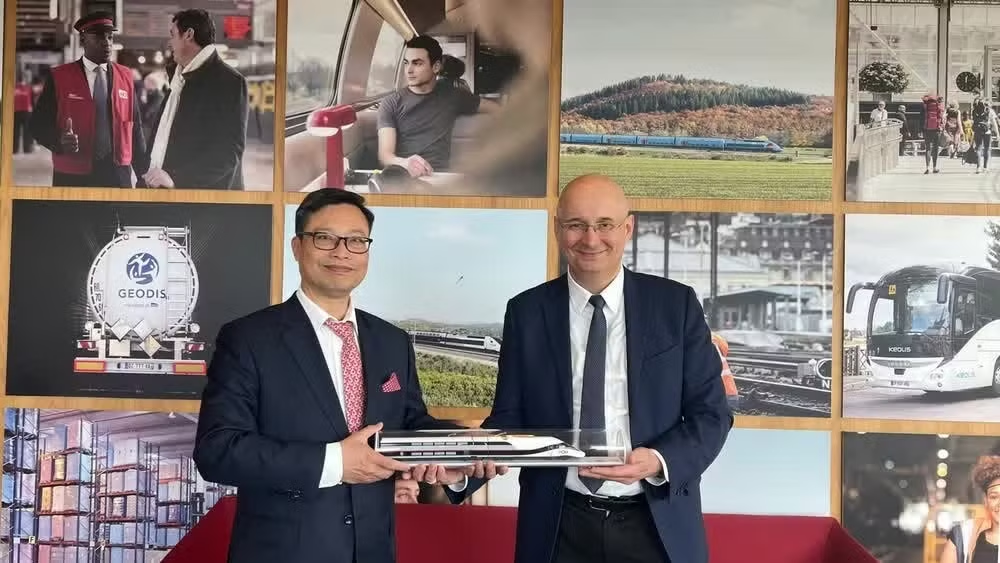
The most significant and substantive achievement over the past six months has been our transition, together with our French partners, from "exchanging orientations" to "developing concrete cooperation projects". The Embassy has established extensive connections with leading industrial groups such as Airbus (aerospace), Thales (high technology and defence), EDF (energy), and SNCF and Alstom (rail infrastructure), while also expanding its network to small and medium-sized enterprises (SMEs) with core technologies.
In addition, local cooperation has developed dynamically in areas including port development, logistics, green urban planning, and digital transformation. All current cooperation agreements are closely linked to technology transfer, high-quality human resource training, the development of supporting industries, and enhancing Viet Nam's economic self-reliance.
Q: At the inaugural meeting of the Central Steering Committee on Foreign Affairs and International Integration on June 30, Party General Secretary and State President To Lam emphasised that foreign affairs must serve the country's development more effectively, safeguard the nation, and elevate Viet Nam's international standing. Given France's strengths in technology and green energy, what breakthrough measures will the Embassy take to attract these high-quality resources?
A: To effectively implement the directions of Party General Secretary and State President To Lam, the Embassy of Viet Nam in France believes that foreign affairs must be proactive, forward-looking, and measurable by tangible results. We will carry out breakthrough initiatives in "technology diplomacy" and "economic diplomacy" under the guiding principle of "Right priorities – Right partners – Close monitoring of every project", giving priority to attracting French resources in strategic infrastructure, energy, and cutting-edge technology sectors such as artificial intelligence (AI), semiconductors, aerospace, digital healthcare, biotechnology, and the marine economy.
The most important breakthrough lies in our approach to cooperation: shifting from simply "attracting investment" or "purchasing equipment" to a strategic partnership model that encourages French partners to conduct joint research, co-invest, transfer technology, train human resources, and establish production chains in Viet Nam.
On that basis, the Embassy will actively encourage major French corporations to establish R&D centres, maintenance facilities, and engineering training centres in Viet Nam. At the same time, it will maximise its role as a "connector" by helping remove procedural and policy obstacles so that cooperation commitments can be swiftly translated into concrete projects on the ground.
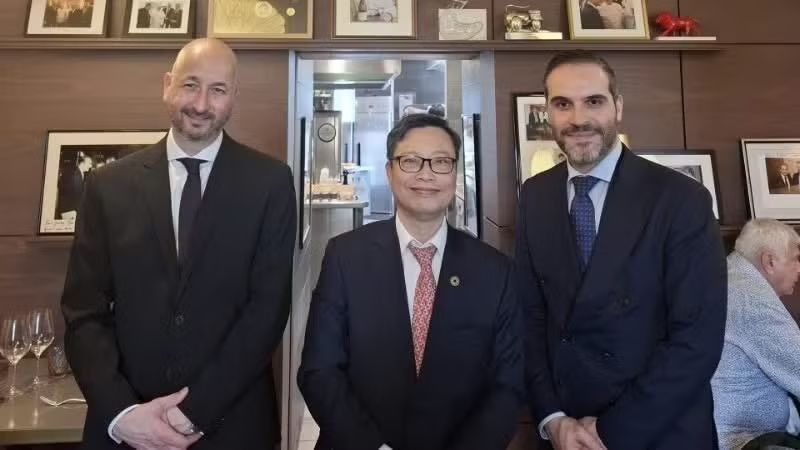
Q: France hosts the headquarters of many major international organisations, including the United Nations Educational, Scientific and Cultural Organisation (UNESCO), the Organisation for Economic Co-operation and Development (OECD), the International Energy Agency (IEA), the European Space Agency (ESA), and the Organisation Internationale de la Francophonie (OIF). Enhancing multilateral diplomacy therefore plays a particularly important role. Could you share the Embassy's major priorities for reinforcing Viet Nam's proactive and responsible role in these forums?
A: Paris is one of the world's principal centres of multilateral diplomacy. It is where many of the most important international rules, standards, and policies are shaped in such fields as culture, education, energy, sustainable development, and technology. Maintaining an active presence and making meaningful contributions here delivers dual benefits: enhancing Viet Nam's international standing while directly bringing international knowledge and standards to support domestic development.
The Embassy's key priorities in the coming period include two major directions.
First, shifting from simply "participating" to "proactively contributing and shaping" initiatives so as to enhance the quality of Viet Nam's initiatives at UNESCO, the OECD, the IEA, the ESA, and the OIF. Viet Nam will clearly demonstrate its image as a responsible member, ready to undertake shared responsibilities within the international community.
Second, mobilising multilateral resources for national priorities by making effective use of expert knowledge, financial resources, and policy support from these organisations to address Viet Nam's major development priorities, including improving the socialist-oriented market economy institutions, advancing the green transition and digital transformation, strengthening energy security, developing humanitarian artificial intelligence, and preserving cultural heritage in association with tourism development.
Q: Cultural diplomacy and work relating to overseas Vietnamese have always been regarded as "important and regular tasks". With Vietnamese culture becoming increasingly popular in France and a large community of highly qualified overseas Vietnamese, what plans does the Embassy have to turn these advantages into soft power and drivers of development?
A: Cultural diplomacy and the Vietnamese community in France are two invaluable pillars of soft power that reinforce each other in enhancing Viet Nam's standing in France.
In terms of cultural diplomacy, the Embassy of Viet Nam in France will comprehensively renew its approach to promoting Vietnamese culture by making it more modern, creative and multidimensional. While continuing to honour the country's cultural heritage, cuisine, and traditional arts, we will also promote Vietnamese culture in contemporary fields such as cinema, applied arts, design, fashion, cultural industries, and digital content. We will strengthen cooperation with major museums, art institutions, film festivals, and French media outlets so that the image of Viet Nam and its people appears more frequently, more vividly, and with greater prestige before the international public.
The community of more than 300,000 Vietnamese people in France, particularly intellectuals, experts, scientists, entrepreneurs, and the younger generation, represents a "goldmine of knowledge" for the country. The Embassy is developing specialised networking platforms in areas such as artificial intelligence, medicine, energy, finance, and international law.
We are not only encouraging overseas Vietnamese to return home to work but also creating flexible conditions for them to contribute their expertise, professional networks, and resources to the country while remaining in France.
The overseas Vietnamese community will serve as the country's most effective "cultural ambassadors" and its most trusted bridges for economic and technological cooperation. In doing so, we reaffirm that the Vietnamese community in France is an inseparable part of the nation and an important source of strength contributing to the country's overall development.
We will pursue breakthrough initiatives in “technology diplomacy” and “economic diplomacy” under the guiding principle of “Right priorities – Right partners – Close monitoring of every project”, giving priority to attracting French resources in strategic infrastructure, energy, and cutting-edge technology sectors such as artificial intelligence, semiconductors, aerospace, digital healthcare, biotechnology, and the marine economy.
Vietnamese Ambassador to France Trinh Duc Hai
Q: Politburo Resolution No. 59-NQ/TW identifies international integration as a strategic driver for Viet Nam to move confidently into the new era. To build a comprehensive, modern, and professional diplomacy, how will the Embassy of Viet Nam in France reform its working methods and strengthen the capacity of its staff?
A: Resolution No. 59-NQ/TW serves as the guiding compass for Viet Nam's foreign affairs in the new period. Thoroughly embracing the spirit of the resolution, the Embassy of Viet Nam in France has identified transformation in both mindset and staff capacity as the breakthrough that will drive all other breakthroughs.
We are focusing our efforts on three main areas.
First, reforming governance and working methods. We are making a decisive shift towards a more proactive and professional approach, with our contribution to the country's breakthrough development serving as the highest measure of effectiveness. We are accelerating digital transformation in diplomatic operations, building a shared database on France, and strengthening big data analytics to support research and strategic forecasting.
Second, enhancing comprehensiveness and connectivity. We aim to remove barriers between different areas of work. Political diplomats must have a sound understanding of economic affairs, while officers engaged in economic diplomacy must also be well versed in technology and culture. Political, economic, cultural, and science and technology diplomacy, together with work relating to overseas Vietnamese, must operate as a unified and well-coordinated whole.
Third, building a diplomatic corps that is both politically steadfast and professionally competent. This requires cultivating strong political resolve, strategic thinking, and proficiency in foreign languages and international negotiation skills. Specifically, diplomats serving in France must continuously update their knowledge of the green economy, emerging technologies, international law, and public communication.
Every diplomat at the Embassy must truly become a "national brand ambassador" — dedicated, resilient, innovative, proactive, well acquainted with the host country, and capable of inspiring others while effectively mobilising international resources for the homeland. This will provide a solid foundation for building a comprehensive, modern, and professional Vietnamese diplomacy that is ready to accompany the country as it enters its new era of national advancement.
Reporter: Thank you very much!
![[Infographic] Comprehensive strategic partnership between Viet Nam and Denmark](https://en-cdn.nhandan.vn/images/SCsTDAWshkugd_CR7euN3dJE8R5tBjXTeI_Ei3N1rqlMQ51GV2YGcjvxpQFD7-NjQniu1tgyhNBVDsDJmLSxVpkf6BzifI5ne9fyVawgZKkw1QSqvshBTU8QQcE1uc2tD2kFaBWIxM59QGKFzthJwQ/comprehensive-strategic-partnership-between-viet-nam-and-denmark-8462.png.avif)