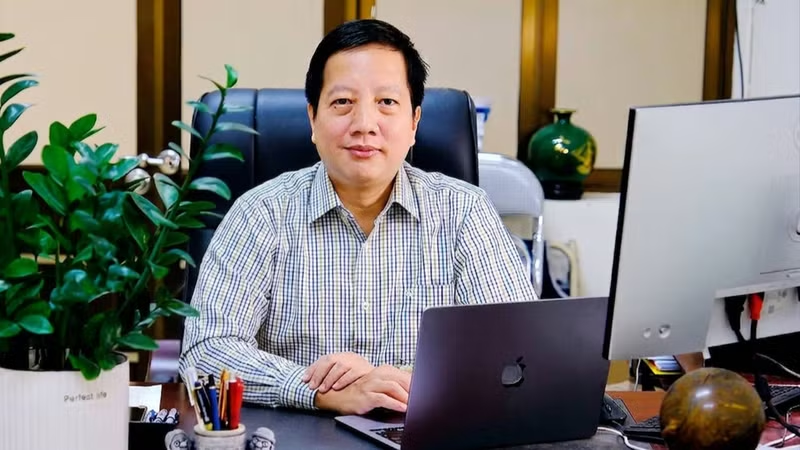
Nhan Dan spoke with Associate Professor Nguyen Trung Nam, Deputy Director of the Institute of Biology under the Viet Nam Academy of Science and Technology (VAST), to gain a deeper understanding of the DNA identification work carried out by scientists, researchers and technicians at the Centre for DNA Identification.
Q: The VAST has mastered next-generation sequencing (NGS-SNP) technology for the DNA identification of fallen soldiers’ remains. How has this technology overcome the limitations of traditional DNA identification methods? What are the greatest challenges faced by the centre’s scientists and technicians when analysing the remains of soldiers who were buried decades ago?
A: Traditional DNA identification methods rely mainly on short tandem repeat (STR) markers or mitochondrial DNA (mtDNA). These techniques have produced many important results, but their effectiveness declines significantly when analysing remains that have been buried for decades, as the DNA is often severely fragmented, degraded or present only in extremely small quantities.
NGS-SNP technology represents a major advance because it can simultaneously analyse thousands of single nucleotide polymorphism (SNP) markers across the entire genome using only minute quantities of highly degraded DNA.
By using far more genetic information, the technology greatly improves the ability to establish biological relationships, even where only more distant relatives remain alive.
It also offers high accuracy and a high degree of automation, and is well suited to the development of a national-scale DNA database, providing a solid foundation for future efforts to identify fallen soldiers.
The greatest challenge is that DNA in skeletal remains is often severely degraded due to the effects of time, soil conditions, temperature, humidity and microorganisms. Many samples contain only very short DNA fragments or are contaminated with substances that inhibit analysis.
In addition, each set of remains has been preserved to a different extent, meaning that a single processing procedure cannot be applied to every sample.
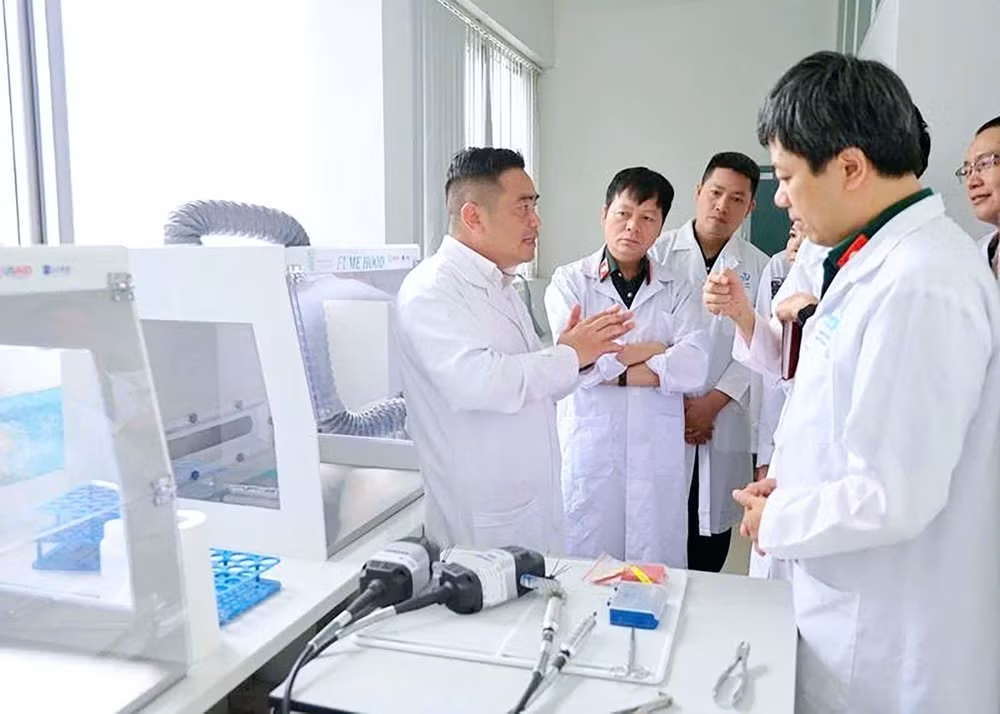
As a result, staff at the Centre for DNA Identification must assess the quality of each sample individually before selecting the most appropriate extraction method, DNA enrichment process and analytical strategy. This requires highly specialised expertise, state-of-the-art laboratories and rigorous quality control procedures to ensure accurate results.
Another challenge is collecting suitable reference samples from relatives, as the passage of time means that close family members of many fallen soldiers are becoming increasingly rare.
Q: What obstacles are currently affecting the collection, preservation and transportation of samples, and what measures are needed to improve the identification of fallen soldiers? What are the main difficulties in collecting DNA samples from relatives, and what should be done to build a more comprehensive and integrated database?
A: Sample quality depends heavily on the collection process at the recovery site. If a sample is not taken from the correct location, or is improperly preserved or transported, the DNA may continue to degrade, reducing the likelihood of successful analysis.
At present, the main difficulty is that sample collection in many localities is still being carried out on a relatively small scale. As this is a new process, more time is needed before we can fully assess the quality of the samples currently being collected.
Another major challenge is that many soldiers fell in battle a very long time ago, meaning that the number of surviving close relatives continues to decline. In many cases, only more distant relatives remain, making kinship analysis considerably more complex.
To address this challenge, DNA sample collection from relatives should continue to be expanded nationwide, while databases should be regularly updated, family history information standardised, and data managed in a unified manner. Combining DNA data with information from military records, recovery locations and other relevant sources will significantly improve the effectiveness of search and identification efforts.
Q: The establishment of a genetic database of fallen soldiers’ relatives is expected to be a breakthrough in identification work. What technical, data and resource challenges does the project currently face?
A: A genetic database is only effective if it contains sufficient high-quality data that is continuously updated. Building such a database therefore requires not only technological solutions, but also financial resources, technical infrastructure, skilled personnel and effective coordination among ministries, government agencies and local authorities.
Alongside investment in modern analytical systems, it is essential to establish unified standards for collecting, storing, protecting and using DNA data. At the same time, the application of artificial intelligence and big data analytics will help reduce comparison times and improve identification accuracy in the future.
In addition, because random genetic similarities are relatively common within the population, large-scale matching cannot rely solely on mitochondrial DNA as the primary basis for identification. It must be combined with NGS-SNP technology or supported by sufficiently strong corroborating evidence.
Q: DNA testing does not always produce a successful result on the first attempt. In your view, what are the main reasons why some remains cannot yet be identified, and what measures is the centre taking to improve its success rate?
A: There are several reasons why identification may not be successful at the first attempt. The most common are that the DNA in the remains has deteriorated beyond a usable level, the quantity of DNA is insufficient for analysis, or no suitable reference sample from relatives is available.
To improve the success rate, the centre is combining multiple identification methods, particularly the use of NGS-SNP technology for difficult samples. We are also continually refining DNA extraction procedures, strengthening laboratory capacity, expanding the collection of family reference samples and updating the DNA database.
Q: The VAST has worked with the US government and the International Commission on Missing Persons (ICMP) on research and technology transfer. Which international experiences could be effectively applied in Viet Nam? And what motivates scientists and researchers engaged in DNA identification to persevere with such demanding work?
A: Through our cooperation with the US government and the ICMP, the Centre for DNA Identification has been able to access, gradually master and optimise many advanced DNA identification technologies suited to the characteristics of fallen soldiers’ remains in Viet Nam. These include technologies for analysing long-degraded remains, next-generation sequencing, the establishment and management of large-scale DNA databases, and laboratory quality management systems that meet international standards.
International experience demonstrates that highly effective identification requires the integrated application of modern technology, well-trained personnel, standardised technical procedures, comprehensive DNA databases and close coordination among relevant agencies. These lessons are extremely valuable for Viet Nam in identifying the remains of fallen soldiers.
However, it is not enough simply to adopt foreign technologies. We must master, optimise and adapt them to Viet Nam’s specific conditions. The remains of fallen soldiers in our country are often extremely degraded because of the tropical climate, long burial periods and preservation conditions that differ significantly from those in many other countries. Technical procedures must therefore be researched, evaluated and refined on the basis of Vietnamese data.
In the coming years, the Centre for DNA Identification will continue expanding international cooperation to keep pace with scientific advances, while strengthening domestic research capacity to build a modern DNA identification system.
We also plan to provide training and transfer new technologies to the four DNA identification facilities designated by the government to carry out this work. Our long-term goal is to identify as many of the remaining unidentified fallen soldiers as possible.
Above all, however, for those of us engaged in DNA research and identification, every successful identification is more than a scientific achievement. It is a mission from the heart and a tribute to those who sacrificed their lives for the nation. Behind every set of remains is a family that has waited for decades to know where their loved one is finally laid to rest.
It is this profound humanitarian significance that motivates our scientists, technicians and researchers at the Institute of Biology, together with colleagues at other institutions involved in identifying fallen soldiers’ remains, to persevere day after day in advancing our research, improving our technologies and overcoming professional challenges in order to fulfil the important responsibility entrusted to us by the Party, the State and the people.
We firmly believe that every successful identification not only helps clarify history but also brings long-awaited closure to the families of our fallen heroes, while upholding the Vietnamese tradition of honouring those who have made sacrifices for the nation.
Thank you very much.