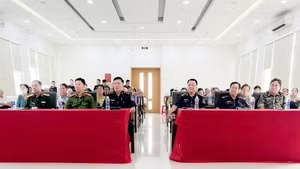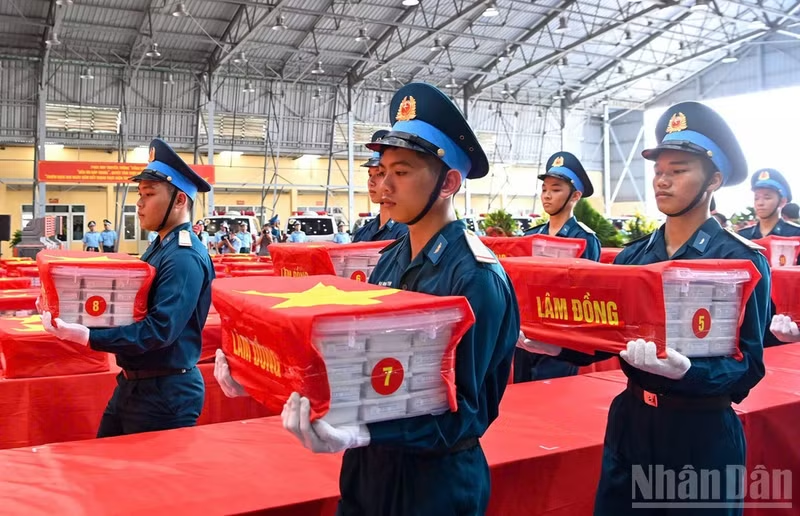
Bringing great comfort to families of fallen soldiers
Sharing information on the current situation and results of efforts to identify martyrs’ remains through DNA testing, Ngo Kieu Lien, Head of the Data and Information Division for People with Meritorious Services under the Department of People with Meritorious Services, Ministry of Home Affairs, said that searching for, collecting and identifying martyrs’ remains is an important and sacred political task that has consistently received attention and direction from the Party and State.
Under current regulations, the identification of martyrs’ remains is carried out using two methods: identification based on factual evidence and DNA testing. DNA testing has been implemented since 2013 under Project 150, approved by the Prime Minister through Decision No. 150/QD-TTg dated January 14, 2013, on identifying martyrs’ remains with missing information. In practice, this has proved to be a highly reliable scientific method, making an important contribution to restoring the identities of fallen soldiers.
As the 500-day-and-night campaign to accelerate the search for, collection and identification of martyrs’ remains is being implemented, ministries, sectors, localities and DNA testing units have worked closely together and made considerable efforts.
Specifically, during the first seven months of the campaign, from March 15 to October 15, 2026, relevant units completed DNA testing and returned results for nearly 800 samples of martyrs’ remains, successfully identifying dozens of fallen soldiers. The results have been respectfully delivered to their relatives.
Each result reflects the dedication and sense of responsibility of the participating forces, while bringing great comfort to the families of fallen soldiers.
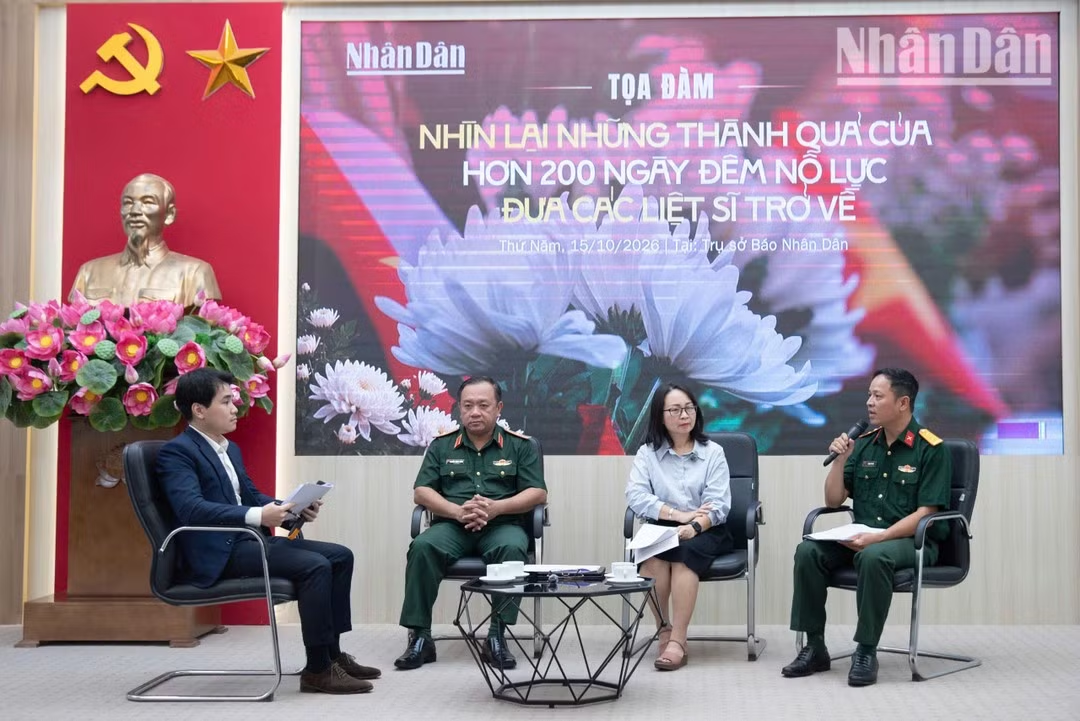
Lien shared this information during an online discussion entitled “Looking back at the achievements of more than 200 days and nights of efforts to bring fallen soldiers home”, organised by Nhan Dan Newspaper.
However, according to the head of the Data and Information Division for People with Meritorious Services, these results remain modest compared with the number of unidentified martyrs’ remains and the expectations of their relatives.This is mainly due to various objective difficulties, which relevant authorities are working together to address.
Under the assignment of the National Steering Committee for the Search, Collection and Identification of Martyrs’ Remains (National Steering Committee 515), the Ministry of Home Affairs will organise inspection teams at designated DNA testing units during the final months of 2026.
These include the Military Institute of Forensic Medicine under the Ministry of National Defence, the National Institute of Forensic Medicine under the Ministry of Health, the Institute of Biology under the Viet Nam Academy of Science and Technology, the Institute of Criminal Science under the Ministry of Public Security, and the Hanoi Steering Committee 515.
The inspections will focus on progress in receiving, analysing and returning results for samples of martyrs’ remains, as well as difficulties, obstacles and solutions to promptly resolve problems or recommend action by competent authorities, ensuring the effective implementation of tasks in the coming period.
At the Ha Noi Steering Committee 515, the inspection team will specifically examine the results of collecting samples of martyrs’ remains at martyrs’ cemeteries, as well as sample preservation and handover procedures.
Towards improving DNA testing capacity for martyrs’ remains
Ngo Kieu Lien said that, according to reports from the relevant units, DNA testing of martyrs’ remains still relies primarily on mitochondrial DNA analysis.
The Institute of Biology under the Viet Nam Academy of Science and Technology is piloting next-generation sequencing technology. Testing units have also applied methods for processing severely degraded bone and tooth samples. The expertise of specialists has gradually improved, while efforts to establish a genetic database for comparison are being accelerated.

In particular, under the 500-day-and-night campaign, testing units are expected to receive new technology-based DNA testing systems from mid-October 2026, helping increase testing capacity.
Regarding difficulties and obstacles, practical experience and reports from relevant units show that DNA identification of martyrs’ remains is an exceptionally challenging field, even for countries with advanced scientific capabilities. Results depend on numerous factors, some of which are beyond human control.
First, sample quality remains a major challenge. Most remains have been buried for more than 50 years in acidic, humid soil under tropical climatic conditions, causing severe DNA degradation and fragmentation. Many samples contain only tiny amounts of bone or are contaminated. Some have undergone repeated analysis without yielding results.
Second, information about fallen soldiers on many graves has been lost or is inaccurate, making it extremely complicated to narrow down potential identities and conduct comparisons.
Third, the number of samples requiring analysis is enormous. Under the 500-day-and-night campaign, sample collection has been completed for nearly 150,000 samples of martyrs’ remains. Together with approximately 17,000 samples collected previously, the total has reached around 167,000, while the current capacity of testing units remains limited.
“We therefore hope that the families of fallen soldiers will understand and share these difficulties. Some cases require more time, while in others, identification may not yet be possible with current scientific capabilities. Nevertheless, we affirm that the relevant authorities will not give up. Samples and data will be preserved over the long term for further comparison when additional information becomes available or advances in technology make identification possible,” Ngo Kieu Lien said.
Key tasks of the 500-day-and-night campaign
1. Search for and collect approximately 7,000 sets of martyrs’ remains.
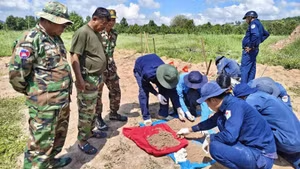
2. Complete the collection of samples from unidentified martyrs’ graves in martyrs’ cemeteries and from newly discovered and recovered remains.
3. Conduct DNA testing on approximately 18,000 samples of martyrs’ remains.
4. Develop, complete and put into operation a genetic database of relatives of unidentified fallen soldiers to facilitate DNA matching and identification of martyrs’ remains.
5. Accelerate and complete the clearance of landmines and unexploded ordnance to support the search for and collection of martyrs’ remains, focusing on priority areas and key locations such as Tuyen Quang Province, Lao Cai Province, Lang Son Province and other areas where information about martyrs’ graves is available.
Source: Decision No. 27/QD-BCDQG dated March 22, 2026, promulgating the plan to launch the “500-day-and-night campaign to accelerate the search for, collection and identification of martyrs’ remains”.