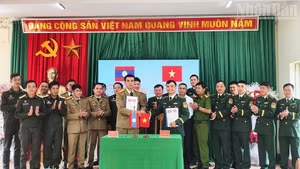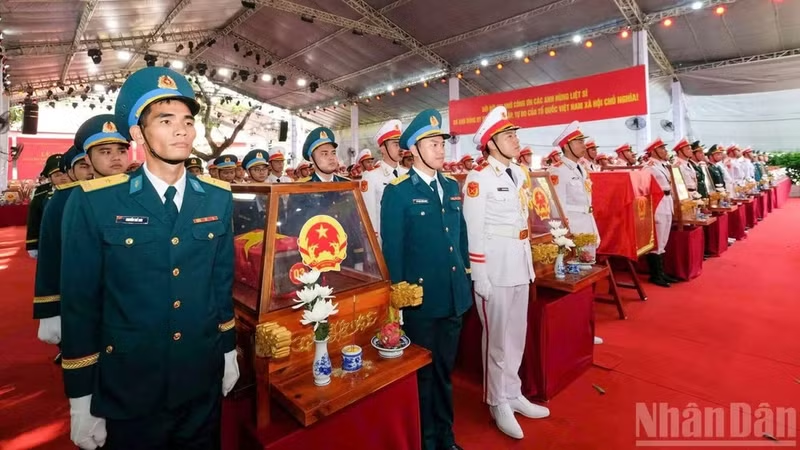
In recent days, many provinces and cities across the country have held solemn memorial and burial ceremonies for the remains of fallen soldiers recovered during the campaign.
On October 14, Ho Chi Minh City held a ceremony to commemorate and bury the remains of 731 fallen soldiers discovered at Le Thi Rieng Park, a day of particular significance not only for the city but also for millions of Vietnamese people.
On October 15, a deeply moving memorial and burial ceremony was held at the Vi Xuyen National Martyrs’ Cemetery in Tuyen Quang Province for the remains of 93 soldiers who gave their lives defending the country’s northern border.
Similar ceremonies have taken place in many other localities nationwide, where fallen soldiers’ remains have been recovered and laid to rest with full honours.
Search and recovery reach more than half of campaign target
According to a report by the Office of the National Steering Committee for the Search and Recovery of Fallen Soldiers’ Remains, the campaign has produced notable results in the more than 200 days since March 15.
On search and recovery, the Ministry of National Defence has assigned specific targets to military regions, set up 11 temporary recovery teams and reinforced eight existing teams, bringing the total to 32. Of these, eight teams are operating in Laos, 11 in Cambodia and 14 in Viet Nam.
The ministry has also directed a review of information and records provided by domestic and foreign organisations and individuals on fallen soldiers and their graves, particularly collective burial sites.
Workshops have been held to verify information. Map coordinates have been cross-checked against the terrain and historical witness accounts, using modern equipment such as ground-penetrating radar, to improve accuracy, shorten search times and reduce the need for excavation and demolition.
According to figures updated as of October 15, search teams had recovered 3,686 sets of fallen soldiers’ remains, equivalent to 52.66% of the campaign’s target. These included 2,416 sets in Viet Nam, 224 in Laos and 1,020 in Cambodia.
Notable discoveries included five collective burial sites of fallen soldiers in Tuyen Quang Province and the remains of 731 fallen soldiers at Le Thi Rieng Park in Ho Chi Minh City.
All 34 provinces and cities complete sample collection
Regarding the collection of samples from unidentified fallen soldiers’ remains at martyrs’ cemeteries and of biological samples from their relatives, the Ministry of National Defence has issued guidelines on collecting and digitising samples from the remains, together with technical procedures for collecting, transporting, handing over, preserving and storing them.
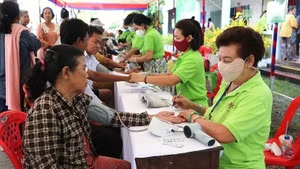
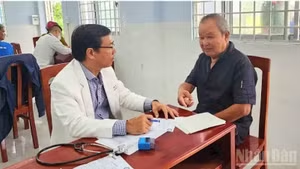
Military regions and local authorities have set up 297 sampling teams with about 3,500 personnel. Meanwhile, the Ministry of Public Security has carried out two intensive drives to collect DNA samples from relatives of unidentified fallen soldiers.
To date, all 34 provinces and cities across the seven military regions have completed collecting samples from fallen soldiers’ remains at martyrs’ cemeteries, covering 230,000 graves and meeting 100% of the campaign’s target.
Local authorities have also collected and stored 276,853 biological samples from fallen soldiers’ relatives, of which 100,701 have been analysed and 95,797 entered into the database.
Efforts to identify fallen soldiers’ remains have also been intensified. The National Steering Committee has issued coordination procedures and assigned responsibilities by area for receiving samples and conducting DNA testing to identify remains with incomplete information.
The Ministry of National Defence is carrying out a 2026-2030 project to strengthen the military’s DNA testing capacity for identifying fallen soldiers’ remains.
It has also renovated and put into operation the K4 facility at the Military Institute of Forensic Medicine, which receives, preserves and stores samples from fallen soldiers’ remains and can hold 110,000 samples. Construction has begun on the institute’s K3 facility, designed to accommodate 300,000 samples.
Meanwhile, the Ministry of Public Security has developed technical standards for collecting, transporting, handing over, preserving and storing biological samples from fallen soldiers’ relatives for DNA testing and identification.
The Viet Nam Academy of Science and Technology has launched a course providing training and technology transfer in next-generation DNA analysis.
To date, 122,121 samples from fallen soldiers’ remains submitted by local authorities have been received and stored. DNA analysis has been conducted on 786 samples, of which 203 have yielded gene sequencing results.

Mine and explosive ordnance clearance completed in Vi Xuyen’s core area
Alongside the search, recovery and identification of fallen soldiers’ remains, mine and explosive ordnance clearance has been stepped up to protect personnel and ease access to areas believed to contain graves.
The Ministry of National Defence has ordered the deployment of personnel and equipment for mine and explosive ordnance clearance in priority areas, including Vi Xuyen in Tuyen Quang Province, and Lao Cai and Lang Son provinces.
Altogether, 360 clearance teams, with 5,183 personnel, have been set up and equipped with 1,311 detectors and other devices.
By October 15, clearance operations had covered 18,042.07 hectares of the planned 22,100 hectares, or 81.64% of the target.
Public communication on the campaign has also received considerable attention.
Next-generation DNA technology requires additional samples from fallen soldiers’ relatives
To improve DNA-based identification of fallen soldiers, Deputy Prime Minister Pham Thi Thanh Tra has urged local authorities to collect additional biological samples from paternal relatives, in line with guidance from the Ministry of Public Security.
The Deputy Prime Minister said that although collection of biological samples from relatives has largely reached its target, next-generation DNA identification technology requires additional samples to provide sufficient data for comparison and identification of fallen soldiers’ remains.
The Deputy Prime Minister also identified reviewing and completing records on individual graves and collective burial sites of fallen soldiers as another priority.
There are currently about 250 such dossiers, of which 39 have largely been completed by collecting and cross-checking information from records handed over by US organisations and individuals.
The 500-day campaign is scheduled to conclude in nine months. However, considerable challenges remain, and much work is still needed to achieve its objectives: recovering the remains of about 7,000 fallen soldiers, completing sample collection from around 230,000 graves of unidentified fallen soldiers and conducting DNA analysis on about 18,000 samples from fallen soldiers’ remains.