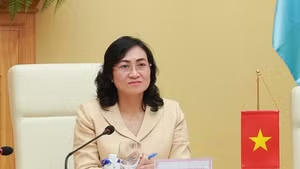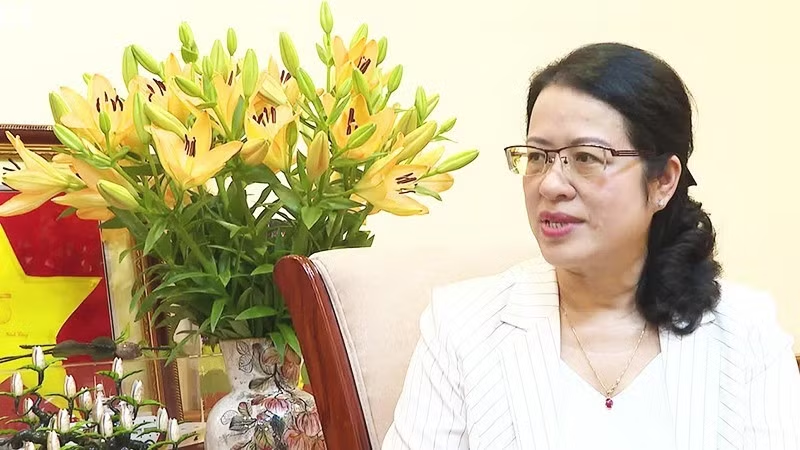
Nguyen Thi Phuong, former Deputy General Director of the Viet Nam Bank for Agriculture and Rural Development (Agribank), spoke to Thoi Nay reporter about the leading role of credit flow in the development of agriculture, farmers, and rural areas.
Q: Looking back at history, what important turning points in Viet Nam’s agricultural economy were associated with the establishment of Agribank?
A: The establishment of Agribank was closely associated with the Khoan 10 mechanism (Resolution No. 10-NQ/TW, issued in 1988, on renewing the management of the agricultural economy). At the same time, the Council of Ministers decided to establish the Agricultural Development Bank (the predecessor of Agribank), separating it from the State Bank system to shift to a commercial banking model. From merely allocating funds according to plans, we had to mobilise our own capital for lending and began offering loans to production households.
Q: When it was newly established, what challenges did the bank face in terms of resources and personnel?
A: At that time, Agribank was a very small bank, with only around 1.5 trillion VND in capital, but it had to serve the entire country. The biggest challenge was the personnel structure. When the bank was separated, we inherited a very large number of staff, around 30,000 people, most of whom had only elementary-level qualifications or were demobilised soldiers.
In 1990, Agribank made a historic decision when it submitted a proposal to the government to allow 10,000 staff members to leave under Decision 176, in order to reduce the payroll and rejuvenate the workforce. I was among the first cohort of full-time university graduates recruited during that period. The leaders at the time, including General Director Pham Van Thuc, were very determined to train staff with professional qualifications and foreign-language skills so that we could “reach out overseas” and approach international financial institutions such as the Asian Development Bank (ADB), the World Bank, and the UN Food and Agriculture Organisation (FAO).
Q: Could you share the story of “breaking new ground” in new areas of banking operations when Viet Nam began exporting food?
A: In the 1990s, Viet Nam transformed from a country facing food shortages into a food exporter. At that time, when it came to import and export activities, people thought only of the Bank for Foreign Trade. However, Agribank’s leaders believed that the younger generation could break new ground in this area.
Although I had specialised in credit, I was assigned to foreign exchange operations. We had to learn while working, attending evening classes at the Foreign Trade University, learning from experts at partner banks, and taking training courses overseas. At the age of just 25, I was one of the first people to write training materials for branch staff. We developed payment services for food and seafood exports and established an international correspondent banking network. From the first operations developed in Ha Noi and Ho Chi Minh City, these activities spread nationwide. Agribank gradually became a “midwife” for both agricultural production and agricultural exports.
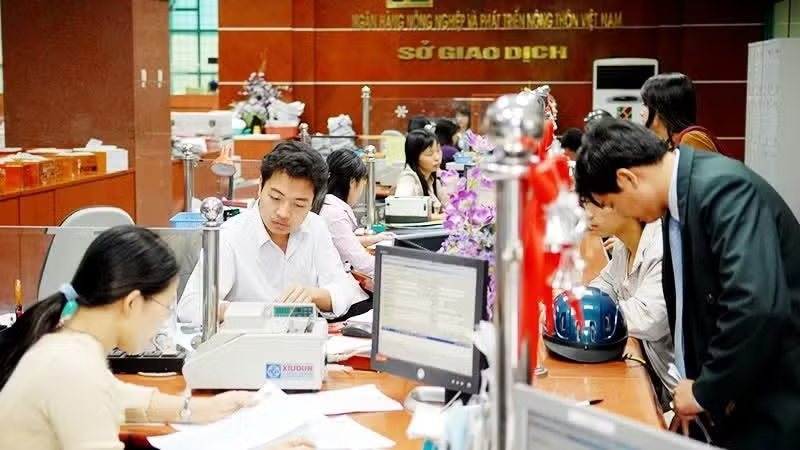
Q: You once shared a story about how, in the early days, bank staff had to “persuade” farmers to borrow money?
A: That is right. In the early period, people were very afraid of borrowing money. They worried that they would not be able to repay their debts. Some people borrowed money and then tightly wrapped it up and put it away. When the repayment date came, they brought exactly the same amount of money back to the bank.
To address this, Agribank coordinated with local authorities and mass organisations such as the Women’s Union and Veterans’ Association to establish loan groups. In these groups, farmers learned from one another about methods of doing business, while bank staff provided guidance on procedures and advised them on how to use loans effectively. This model has been extremely successful, and there are now around 50,000 loan groups nationwide. Credit is not just money; it is also advice. Credit officers come into contact with many different models, learn about which projects face difficulties and which have succeeded, and then share that knowledge with farmers.
Q: Now that we are entering the digital era, what difficulties does Agribank face in deploying modern services such as QR codes and digital banking in rural areas?
A: The biggest difficulties in remote and isolated areas are telecommunications infrastructure and costs. In many places, it is difficult enough to install power lines, let alone Wi-Fi for each household. The distances between houses in mountainous areas are very far, and oftentimes people must go to the commune People’s Committee office, a school site, or a market to get a signal.
Although there are now mobile applications with comprehensive features, local people still have a strong habit of using cash. Agribank has more than 3,000 ATMs to maintain, with very high operating and cash replenishment costs. Previously, we also operated mobile banking services using specially equipped vehicles, with funding support from the World Bank and ADB. These vehicles were like mobile bank branches, offering full services including cash withdrawals, deposits, and account opening, reaching even the most remote villages.
Q: Agribank is often referred to as the “midwife” for agriculture, farmers, and rural areas, and is also known for its role in social welfare as part of its business operations. Could you talk more clearly about this?
A: Given our scale, if we simply pursued profits like joint-stock commercial banks, Agribank could achieve much higher figures. But we must shoulder responsibility for social welfare.
Our customers are farmers who take out very small loans, sometimes only tens of millions of VND, so operating costs are therefore very high. We provide hundreds of billions of VND each year to support healthcare, education, and the construction of schools and medical stations. In particular, our humanity is reflected in the way we deal with debts. In rural areas, a farmer may have only one house, which is also a place of worship passed down through generations. We very rarely seize assets to recover debts. Instead, the bank seeks to restructure debts, extend repayment periods, and create conditions for them to take out new loans to revive production and gradually repay their debts.
Q: Against the backdrop of rapid urbanisation, how is Agribank’s role shifting?
A: As rural areas transform, we are also shifting from lending to households to lending to farm-based economies, agricultural enterprises and even large economic groups specialising in agriculture.
We have also taken the lead in programmes for clean agricultural production that meets quality standards for export to demanding markets. Agribank accepts lower profits and reduces interest rates to encourage farmers to adopt VietGAP models and practise responsible production. Today, “accompanying agriculture, farmers, and rural areas” is not merely a slogan but a culture deeply ingrained in every member of our staff. Even as the economy urbanises, Agribank will remain the “steering wheel” guiding capital flow and ensuring that agriculture continues to serve as a pillar of the national economy.
Reporter: Thank you very much!