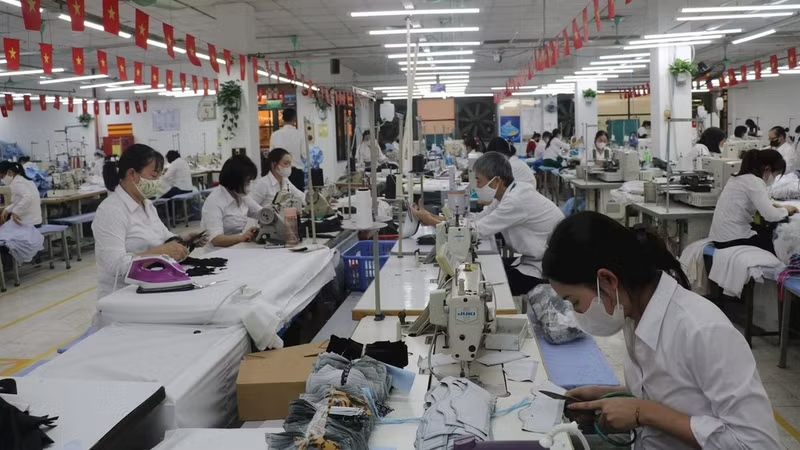
Cao Huu Hieu, General Director of the Viet Nam National Textile and Garment Group (Vinatex), said the group's consolidated revenue in the first eight months of the year rose 8.3%, while pre-tax profit increased 39.3% year on year. Notably, the company's pre-tax profit margin improved from 7.4% to 9.5%. The results were driven in part by the yarn sector, in which revenue rose 18.8% and profit nearly tripled year on year, while towel revenue increased 19.4% and the profit rose 37.3%. In the garment sector, although revenue still increased by 3.9%, the business faced considerable pressure on its profit margin as price competition intensified, orders became smaller, and delivery times became shorter.
“Currently, the garment sector has orders through the fourth quarter, with some units already having orders for the first months of 2027. In the yarn sector, orders are sufficient through September, but coverage from October onwards is uneven. We expect to maintain our growth momentum in the first nine months, with consolidated revenue rising by about 7.3% and pre-tax profit increasing by 37.8% year on year, exceeding our annual profit target,” Cao Huu Hieu emphasised.
Nguyen Ngoc Lan, General Director of Nha Be Garment Corporation (NBC), added that the company is currently producing eight highly specialised groups of key products, including men's suits, men's trousers, women's suits, women's trousers, shirts, two-layer jackets, knitwear, and mid- to high-end fashion. The company has secured orders through the end of 2026, while orders for products made from ottoman fabric have already “exceeded” its production capacity.
Because many products cannot be subcontracted to satellite factories, the company has had to further specialise production and allocate orders among factories within its system. Each factory serves multiple customers to balance and adjust production capacity, improve operational efficiency, and meet delivery deadlines.
“Orders for 2026 have been secured, but the market outlook for 2027 remains unclear as many traditional customers have not announced their ordering plans. In the coming period, we will continue implementing solutions to improve efficiency, increase profit margins, and expand our markets and customers, with a view to achieving our targets as soon as possible,” Nguyen Ngoc Lan affirmed.
Import trends in the major consumer markets for Viet Nam's textile and garment products over the past seven months show clear differentiation. Textile and garment imports by the US fell 7.7%, while those by the EU declined by about 8%. In contrast, textile and garment imports by Japan increased 6.6%, while those by the Republic of Korea and China rose by 1% and 24%, respectively, compared with the same period in 2025. Nevertheless, Viet Nam continued to lead textile and garment exporting countries in terms of export turnover growth.
In August alone, export turnover reached 4.8 billion USD, up 8.1% year on year, with textiles and yarns increasing by 40% and garments by 3.2%. In the first eight months, textile and garment exports reached 33.02 billion USD, up 6.7%; textiles and yarns rose sharply by 37.4%, while garments increased by 1.6%.
Assessing market signals for the final months of the year, Cao Huu Hieu said the market still carries many potential risks, with sharp fluctuations in cotton and fibre prices; exchange-rate risks that could adversely affect exports, with the VND/USD exchange rate tending to rise; narrowing demand in the US and EU; and rising logistics and raw material and auxiliary-material costs putting continued pressure on profit margins. Requirements concerning rules of origin and trade remedies are also becoming increasingly stringent, while competition from Bangladesh, China, and other textile and garment-producing countries continues to increase.
Therefore, enterprises must closely control cash flow, receivables, inventories, and capital efficiency, while focusing on improving productivity, cutting costs, enhancing efficiency, and protecting profit margins. They must also closely monitor the market and US tariff policies, proactively update management scenarios, and develop plans for 2027.
In light of unpredictable market developments, enterprises need to review their production models, customer structures, product portfolios, and business methods.
Le Tien Truong - Vinatex Chairman
Vinatex Chairman Le Tien Truong added that, in the context of unpredictable market developments, enterprises need to review their production models, customer structures, product portfolios, and business methods. Building KPI systems should be expanded to include indicators reflecting efficiency and profit margins, rather than focusing solely on revenue, profit, and dividends. At the same time, enterprises need to step up the application of technology, diversify currencies used for import and export payments, gradually reduce their dependence on bank loans, and increase mobilisation of capital from shareholders, partners, and major customers.