The selection of a new UN Secretary-General, who is expected to take office on January 1, 2027, is attracting considerable attention in the final months of 2026. A representative of Greece, which holds the rotating presidency of the UN Security Council in October 2026, said October was the time for member states to “make progress and reach consensus” on a new secretary-general.
Under the selection procedure, the UN Security Council must agree on a candidate to recommend to the UN General Assembly. Seven candidates are currently in the race, including Rebeca Grynspan, Secretary-General of the UN Conference on Trade and Development (UNCTAD), and Rafael Grossi, Director General of the International Atomic Energy Agency (IAEA).
The race to find a successor to UN Secretary-General Antonio Guterres is more than just a routine leadership transition. It also marks the beginning of a new chapter for the UN, calling for bold, profound, and comprehensive reforms to enable the organisation to adapt effectively to a rapidly changing world.
The new secretary-general will be tasked with guiding the organisation through a turbulent period marked by simultaneous challenges, including geopolitical tensions, financial shortfalls, and weakening confidence in multilateralism. Whoever emerges victorious will also need sufficient credibility, experience, and resolve to build consensus among countries with sharply differing strategic interests or positions on major issues.
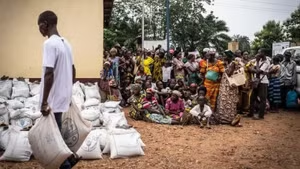
The United Nations is facing a period of severe financial difficulties and a crisis of confidence. On the budgetary front, limited resources have forced the organisation to adopt austerity measures. As funding shortages hamper core missions, such as peacekeeping and humanitarian assistance, many people in need are at risk of being excluded from aid and relief programmes. The UN High Commissioner for Refugees (UNHCR) recently reported that the agency had received only 3 billion USD of the 8.5 billion USD required for 2026.
Strengthening the UN's standing and influence is another difficult task. Questions have been raised about its ability to unite and lead collective efforts amid strategic competition and deep divisions among member states. One example was the Security Council's failure to adopt a draft resolution aimed at strengthening security in the Strait of Hormuz, despite the conflict in the region disrupting global trade flows.
Reforming the United Nations is also an urgent priority requiring consultation and consensus among many countries, with Security Council reform standing out as a central issue. Matters concerning security, peace, and development in Africa frequently feature on the Security Council's agenda, yet the continent still has no permanent representation on the body.
Against this backdrop, some observers have pointed to shortcomings in the Security Council's representativeness. Last weekend, the 14th Ministerial Meeting of the African Committee of Ten on United Nations on the reform of the Security Council was held in Libya.
Today's global geopolitical landscape differs significantly from that of 81 years ago, when the United Nations was established. This places an important responsibility on the next Secretary-General to advance reform. Another major task will be to restore the international community's confidence in multilateralism, ensuring that the United Nations continues to be regarded as a "beacon" guiding the world towards a future of peace and cooperation.