Against the backdrop of intensifying strategic competition and changing transatlantic relations, the EU and Canada are seeking to establish an additional pillar of cooperation to enhance their resilience to “shocks” and strengthen the strategic autonomy of both sides.
A signal of efforts to strengthen EU-Canada strategic relations emerged after European Commission (EC) President Ursula von der Leyen declared that the EU wanted to build an “alliance for the future” with Canada, going beyond the framework of the Comprehensive Economic and Trade Agreement (CETA). The EC leader also gave the green light for Canada to become the EU’s first “associate member”.
In response to the signal from the EU, Canadian Prime Minister Mark Carney said he was promoting an upgrade of relations with the EU towards building a unique alliance that goes beyond the framework of trade relations, as Ottawa seeks to strengthen its links with Europe. Ottawa affirmed that it had no intention of becoming a full member of the EU but was considering a new cooperation framework under which Canada could become the EU’s first associate member.
The foundation of EU-Canada relations was laid long ago. CETA, provisionally applied since 2017, has contributed to strongly promoting bilateral trade. However, amid major changes in the global situation, as economies race to secure supplies of strategic minerals and maintain production capacity during crises, relations between the two sides have undergone major adjustments.
One of the most important drivers behind the development of the new partnership is the complementarity of resources. Canada possesses abundant natural resources, including many minerals that are important to the defence industry, energy transition, and high technology. The EU, meanwhile, needs to diversify its sources of supply, and the two sides are moving towards increasingly close cooperation to respond to mounting pressure and increasingly fierce competition.
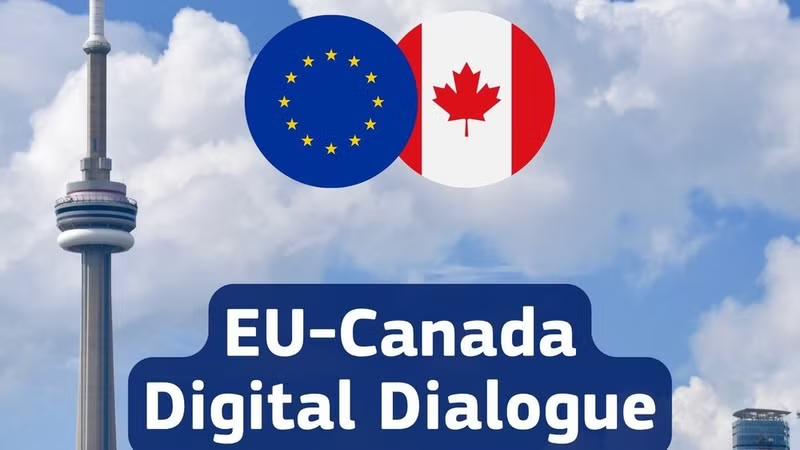
If minerals are the material inputs, technology could become the glue binding EU-Canada relations in the long term. The two sides signed a digital partnership in 2023, covering areas of cooperation such as artificial intelligence (AI), semiconductors, quantum technology, cybersecurity, data governance, and research.
The EU-Canada Digital Partnership Council has identified AI, digital wallets, secure international connectivity, and online safety as priority areas for cooperation. This further underscores that technological cooperation is not only aimed at promoting trade but is also related to technological sovereignty. The EU wants to reduce dependence on technologies that could become security risks, while Canada also stands to benefit from expanding its technology and research networks.
Canada and the EU are preparing for talks in Montreal in late October, with the expectation that they can translate the EC President’s proposal to elevate bilateral relations to the “highest possible level” into concrete measures. According to the plan, the two sides will announce a series of agreements to deepen cooperation in digital trade, critical minerals, energy, technology, and wildfire response.
The two sides are expected to sign a digital trade agreement, increase cooperation between competition authorities, and allow the European Investment Bank (EIB) to invest in Canada’s critical minerals projects. The EU and Canada have identified potential cooperation on diversified and reliable energy supply chains, including liquefied natural gas (LNG), renewable energy, low-carbon hydrogen, and clean technologies.
With advantages that can complement each other, effective coordination will help EU-Canada relations move beyond the framework of a free trade agreement and become one of the notable cooperation structures in the transatlantic space.