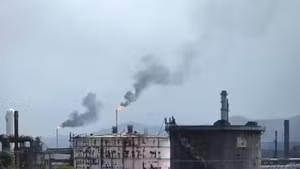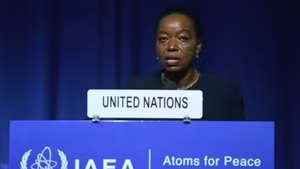
Electrification is one of the key mechanisms highlighted by the UN chief. It is increasingly seen as an indispensable pathway for economies to overcome energy crises, stay competitive, reduce reliance on fossil fuels, and move closer to carbon neutrality.
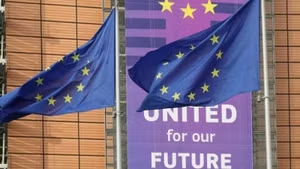
Aware of this, many countries have stepped up the global electrification drive. The European Commission (EC) has unveiled an Electrification Action Plan aimed at making Europe the world’s first continent to run entirely on clean energy.
The plan aims to accelerate the shift from fossil fuels to clean electricity in key sectors such as industry, transport, and construction, thereby raising the share of electricity in the European Union’s total final energy consumption to 46% by 2040.
According to EC estimates, meeting this targe could save the bloc hundreds of billions of euros in fossil fuel import costs each year, while bolstering strategic autonomy and economic competitiveness. Beyond the bloc, nations worldwide have joined the race.
According to Australian media, since March 2026, about 25 countries have introduced policies to promote electrification. There are many reasons why the world is pushing ahead with the new electrification process.
Professor of Energy and Climate Policy at the University of Oxford Jan Rosenow said the clean energy transition is an urgent requirement to ensure long-term energy security.
Relying on imported fossil fuels leaves economies exposed to external shocks and vulnerable to supply disruptions.
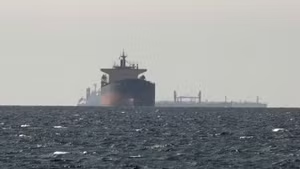
Recent disruptions to oil supplies from the Middle East highlight the inherent vulnerabilities of fossil-fuel-dependent economies.
In this context, increasing the use of domestically produced electricity will help countries become more energy self-reliant and strengthen their resilience to geopolitical volatility and global market shocks.
Economically, electrification brings undeniable benefits. The International Energy Agency (IEA) estimates that accelerating the clean power rollout could help countries save more than 400 billion USD in fossil fuel import costs by 2035 compared with 2025 levels. Yet the transition faces formidable headwinds.
The foremost challenge is expanding and upgrading power grids. Wind and solar farms are being deployed faster than the development of the infrastructure needed to connect and transmit electricity. More than 2,500 GW of electricity from renewable energy projects is currently “queuing” to be connected to power grids.
According to the IEA, until 2040, the world needs to add or upgrade more than 80 million kilometres of power grids, equivalent to the total length of the global grid system today.
This is a significant challenge, especially for economies where transmission infrastructure development is not keeping pace with the expansion of renewable energy. In addition, ensuring a stable electricity supply at reasonable prices remains critical.
In some regions of the world, electricity prices are currently three times higher than gas prices. Without measures to reduce electricity prices, the global power transition will struggle to achieve its goals.
The global energy system stands at a historic crossroads, opening up an opportunity to end decades of dependence on fossil fuels and enter a “new electrification era” with the transition to clean energy.
As countries continue to face unpredictable fluctuations in the global geopolitical environment, electrification is no longer merely a technical solution, but a vital pillar of national economic resilience.