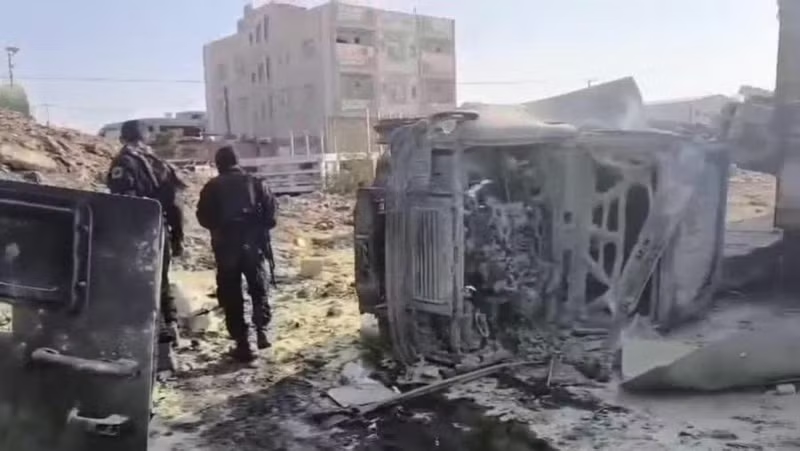
The Houthis have accused Saudi Arabia of carrying out a series of heavy airstrikes against their facilities. According to the Houthis, they have come under more than 100 Saudi Arabia’s airstrikes since September 8, including 58 strikes on September 13 alone. Saudi Arabia has also continued to conduct airstrikes on Saada Province, a Houthi stronghold, while heavily shelling the border district of Monabbih.
In retaliation, the Houthis used missiles and unmanned aerial vehicles (UAVs) to attack the Sharurah military base in southern Saudi Arabia, targeting weapons depots and command centres. Saudi Arabia's Civil Defence Authority also accused the Houthis of launching an unidentified object into the Jizan area, near the Yemen border, injuring two people. The incident also damaged a mosque, several buildings, and a number of vehicles.
Saudi Arabia strongly condemned the attack, stressing that targeting civilian facilities constitutes a serious violation of international humanitarian law. Saudi Crown Prince Mohammed bin Salman even asked US President Donald Trump to launch airstrikes against the Houthis. However, the White House chief firmly refused.
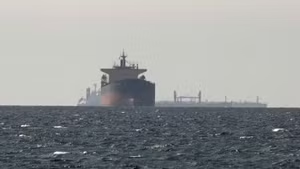
The outbreak of tit-for-tat attacks has once again pushed security in the oil-rich Middle East into a high-tension situation. Earlier, Saudi Arabia had to temporarily shut down the East-West oil pipeline after it was attacked by UAVs. Countries including Algeria, Libya, and Egypt immediately condemned the attack. They accused the reckless action of increasing regional instability and threatening the security of energy facilities and the international oil supply.
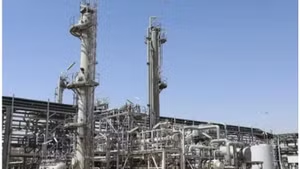
The East-West pipeline is approximately 1,200km long, transporting oil from fields in eastern Saudi Arabia to export facilities on the Red Sea coast. The pipeline has a transport capacity of around 4-5 million barrels of oil per day, equivalent to nearly 5% of the global oil supply. It currently plays an important role amid the disruption of the Strait of Hormuz.
In addition to the conflict with Saudi Arabia, the civil war between the Houthis and the Yemeni Government forces has also seen complicated and dangerous developments. Mocha, a strategic city on the Red Sea coast, was recently hit by six missiles. Although there have been no reports of casualties or the extent of the damage, the large-scale attack on the city has left local residents confused and fearful.
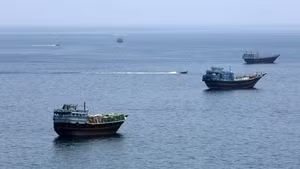
The Houthis have also continued their attacks and seized control of a strategic island located in the Bab al-Mandab Strait — an important shipping route connecting the Red Sea and the Gulf of Aden. The Houthis' continued use of force to expand their control of the area has heightened concerns over the security of one of the world's busiest maritime transport routes. Bab al-Mandab lies at the southern entrance to the Red Sea and serves as a vital link for the transport of goods and energy between Asia, the Middle East, and Europe.
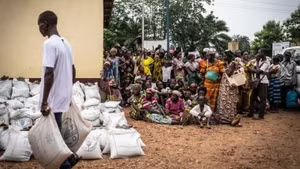
In these conflicts, the people suffering the most are Yemeni civilians. They have already been living under a barrage of bombs and gunfire since the Middle Eastern country descended into civil war in 2014. The prolonged conflict has claimed hundreds of thousands of lives. Deaths have resulted not only from bombs and gunfire but also from a severe humanitarian crisis, including shortages of food, clean water, and healthcare services.
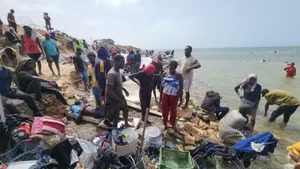
According to the International Organisation for Migration (IOM), recent fighting in Yemen has forced at least 86,000 people to flee their homes. Of whom, more than 2,000 have even been unable to find safe shelter in Yemen and have had to risk fleeing to neighbouring countries. The IOM has expressed concern that many villages in Taiz City have been left "deserted". The Mocha-Taiz road, a vital supply route, has been completely cut off, making it difficult to deliver humanitarian aid to affected areas.
The Yemeni people are urgently calling on the United Nations and international organisations to take stronger and more decisive action to intervene and help end the civil war in Yemen, as well as the fighting currently raging between the Houthis and Saudi Arabia. If measures are not taken soon to silence the guns, the humanitarian crisis in the Middle Eastern country could become one of the world's worst crises.