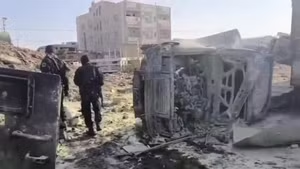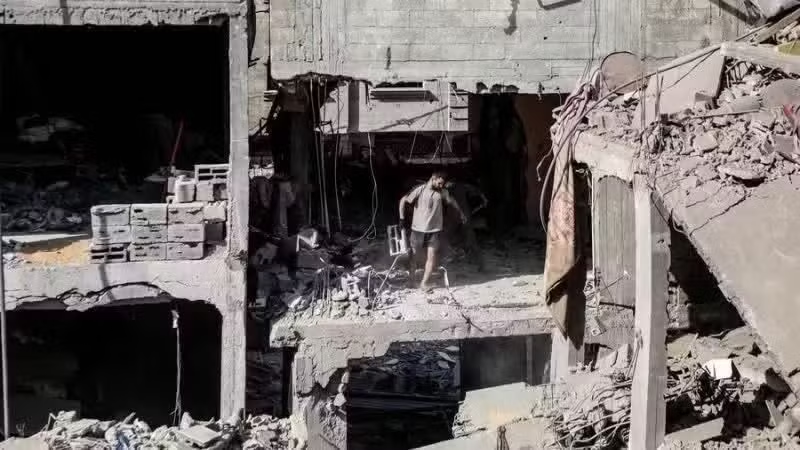
Three years of fighting in the Gaza Strip have profoundly altered the political and security landscape across the Middle East, with more than 74,000 Palestinians killed and new fronts of military confrontation emerging throughout the region, most notably the fighting between the Israeli military and the Hezbollah movement in Lebanon.
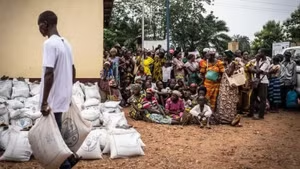
Figures released by the United Nations Conference on Trade and Development (UNCTAD) in late September 2026 have laid bare the dire living conditions and uncertain future facing people amid the rubble and destruction of war: 92% of economic establishments in Gaza have been damaged or destroyed; Gaza’s daily per capita GDP stands at 0.58 USD; and more than 90% of the working-age population is unemployed.
The longer the conflict continues, the greater the pressure on the parties involved to bring it to an end. Protests calling for an early cessation of fighting in Gaza have emerged in Israel, partly reflecting public fatigue after prolonged tensions. The fighting in Gaza, together with the protracted US-Iran confrontation and other military flashpoints, has placed the entire Middle East in an especially sensitive state, where even a single incident could reignite intense fighting and trigger a chain reaction, spreading instability across the globe.
Against this backdrop, the US-backed peace plan for Gaza has brought hope to the territory. A key element of the roadmap is for the Hamas movement and Palestinian armed groups to disarm in stages under international supervision, while the Israeli military gradually withdraws from Gaza in line with the progress of disarmament and the transfer of control.
However, challenges emerged immediately, with the most contentious issue concerning the sequence of implementation. Neither Israel nor Hamas wants to accept the risk of having to act first. Israel has refused to withdraw its troops until Hamas forces have been completely disarmed, while Hamas has proposed gradual disarmament rather than immediately and unilaterally laying down its weapons. This also highlights the lack of trust between the two sides after years of conflict.
Israel’s general election, scheduled for late October 2026, is also putting some pressure on Israeli Prime Minister Benjamin Netanyahu, as decisions seen as concessions on the Gaza issue could spark controversy in the political arena. This has partly contributed to a stalemate in the peace roadmap. Nevertheless, Hamas’s agreement in principle to the peace plan, including disarmament, is also regarded as a favourable factor, as the movement has repeatedly rejected calls for disarmament in the past.
The reconstruction of the Gaza Strip is also fraught with difficulties. Estimates suggest that addressing the physical damage across Gaza alone will require approximately 35.2 billion USD in the medium term, followed by an additional 71.4 billion USD over the next 10 years. If funding from the international community is not disbursed on schedule, the peace process could lose momentum.
According to a report by international aid organisation Oxfam, in addition to the physical destruction, the conflict has also inflicted serious damage on Gaza’s social foundations. Libraries, archives and cultural organisations have suffered losses, affecting the preservation of Palestinian history and identity. An even more difficult question is: how can the Gaza Strip truly be rebuilt when its security and political foundations remain fragile?
To find a sustainable solution for stability in the Gaza Strip, the core factor is for the parties involved to overcome their differences and calculations of political interests, demonstrate genuine goodwill and persevere in efforts to bring a peaceful life not only to the people of Gaza, but also to the wider region.