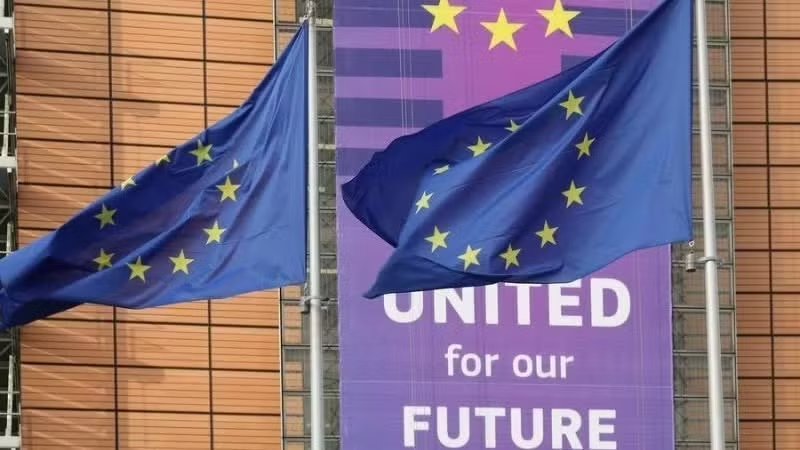
Efforts to expand the European Union have gained considerable momentum in recent years. Brussels has described enlargement as an urgent geopolitical imperative for the 27-member bloc.
However, the path towards enlargement remains fraught with challenges. In practice, the more members the EU has, the harder it becomes to reach common positions and take collective action, given the differences in national interests and perspectives.
Without stringent criteria for selecting new members, enlargement could also increase the number of economically vulnerable members within the bloc, potentially placing considerable pressure on the EU budget and deepening disagreements among member states.
To ensure the EU can function effectively following enlargement, the European Commission (EC) has recently proposed a series of measures concerning financial controls, agricultural policies and compliance with the rule of law among new members.
One issue attracting particular attention is the potential impact of admitting countries with large agricultural sectors on the EU budget and single market.
The EC has proposed special mechanisms to limit financial assistance to new members, while allowing restrictions on exports of certain products where necessary. Brussels also wants new members to commit to not obstructing the accession of other candidate countries.
The Commission has further suggested that existing members move away from unanimity towards majority voting in certain areas to prevent decision-making deadlocks.
Many experts warn that the EU risks being sidelined in geopolitical affairs unless it improves its decision-making capacity.
Indeed, difficulties in reaching consensus have repeatedly hampered decisions on major EU issues, including budget allocations and foreign policy, as opposition from a single member state can bring an entire process to a standstill.
However, shifting to majority voting is unlikely to gain universal support. Many member states are reluctant to relinquish their veto powers, which they regard as an important means of safeguarding national interests and preventing their positions from being overridden.
Throughout its history, the EU has undergone several rounds of enlargement. One of the most significant took place on May 1, 2004, when 10 countries joined the bloc in what the media described as a “Big Bang” enlargement, increasing its membership from 15 to 25.
Today, amid mounting regional and global security challenges, EU enlargement has once again become a major focus of attention.
European Council President Antonio Costa has described the admission of new members as “the most important geostrategic investment in peace, stability, security and prosperity”.
The EC has announced plans to develop concrete accession roadmaps for candidate countries while promoting their gradual integration into the single market before they formally join the bloc.
Although admitting new members would expand the EU’s geographical reach, it would also introduce complex institutional and structural challenges within the Union.
The proposed enlargement-related measures are expected to be discussed in greater depth at the EU summit scheduled for mid-October 2026.
Despite the likelihood of differing opinions, these proposals reflect the EU’s efforts to pursue internal reforms, proactively address risks and prepare for a new phase of development as the number of countries under its common roof continues to grow.