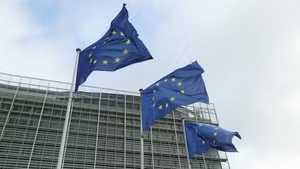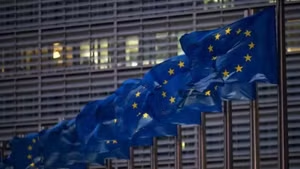
Building a strong and self-reliant EU was emphasised in the 2025 State of the Union Address delivered by President of the European Commission (EC) Ursula von der Leyen in September 2025. One factor that has made the union more acutely aware of the risks of dependence is the less-than-smooth developments in the US–EU alliance. Over the past year, allies on both sides of the Atlantic have maintained divergent views on a wide range of issues, from trade, tariffs, defence budgets, and military assistance to Ukraine to migration and climate change. This has strained bilateral relations to some extent and placed the EU in a strategic dilemma.
With regard to the conflict in Ukraine, US President Donald Trump has repeatedly conveyed the message that Europe will have to play a long-term leading role in resolving the conflict. While European leaders have consistently sought to strengthen Ukraine’s combat capabilities, President Donald Trump has frequently shifted his stance, at times expressing support for Kyiv, and at other times leaning towards Moscow with peace proposals widely seen as favourable to Russia.
This reality has compelled the EU to make greater efforts to assume a more proactive role in the regional security architecture, rather than relying on the US “security umbrella”. At the EU’s final summit of 2025, leaders of the Blue Flag Union agreed to provide 90 billion EUR in support for Ukraine over the next two years.
There is no shortage of sceptical voices suggesting that Europe may find itself “caught between a rock and a hard place” as it seeks to increase support for Ukraine while facing limited financial capacity and deep internal divisions. Higher military spending would mean that countries may have to cut social support programmes. This is unlikely to gain broad public support within the bloc, especially given Europe’s high proportion of elderly population. The EU economy struggled overall in 2025, largely due to the shock from US tariff policies. The European Commission forecasts that the Eurozone economy will grow by only 1.3% in 2025. Germany, the bloc’s largest economy, is projected to grow by just 0.1% this year, far below the previously expected rate of 0.8%.
To date, the EU and its member states have provided a total of 187.3 billion EUR in support to Kyiv. The deeper the EU moves along the prolonged path of the Ukraine conflict, the more clearly its problems come to the forefront, including internal divisions. Disagreements among member states over the use of frozen Russian assets are a concrete example.
Also related to defence spending, European countries within the North Atlantic Treaty Organization (NATO) have agreed to the request of President Donald Trump to raise defence expenditure to 5% of GDP. However, whether countries can achieve this target by 2035 remains an open question, given that many European states have struggled to meet the previous commitment of 2% of GDP. In the economic sphere, the EU has outlined a strategy to strengthen economic security with a focus on improving foreign direct investment screening mechanisms, trade defence measures, and establishing funds to support industrial development.
In a world marked by increasingly complex and unpredictable changes, Europe’s prioritisation of strategic autonomy across multiple fields is seen as an inevitable choice. It is a long road, requiring strong political will as well as consensus and unity among member states. Overcoming internal divisions is a fundamental prerequisite for the EU to seize opportunities and position itself effectively in the new context.