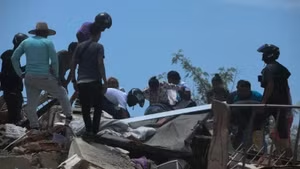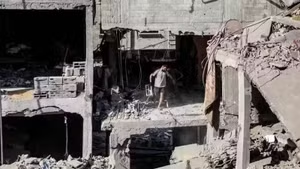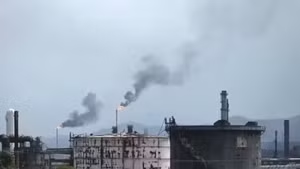
Alarmingly, many flashpoints have erupted simultaneously across the global security map. The “powder keg” in the Middle East exploded after the US–Israel coalition officially launched a military campaign against Iran. Iran responded forcefully, firing dozens of missiles at Israel and US military bases in the region. The death of Iran’s Supreme Leader Ali Khamenei has marked a new dangerous escalation. These tit-for-tat actions are pushing the parties into a large-scale conflict, which risks being prolonged and extended beyond bilateral conflict, severely impacting energy security and the global geopolitical environment.
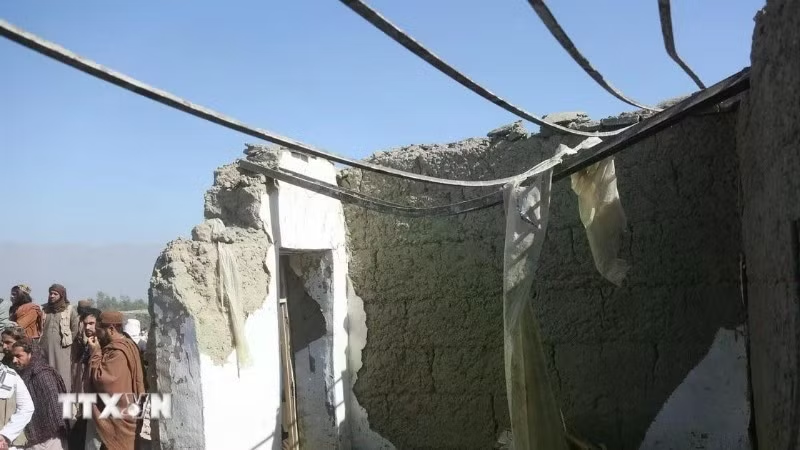
At the same time, another conflict erupted fiercely in South Asia, stemming from long-simmering tensions. In late February 2026, Pakistan’s military carried out large-scale airstrikes against Afghanistan, leading to one of the most serious confrontations between the two neighbouring countries since the Taliban returned to power in Afghanistan in 2021. Relations between the two countries have remained strained in recent time. Pakistan has repeatedly accused the Taliban authorities of failing to prevent militant groups from using Afghan territory to launch attacks and destabilise Pakistan, while Afghanistan has rejected the allegations.
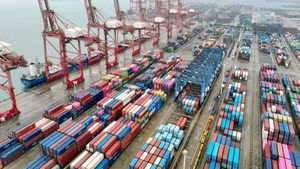
These crises are deeply interconnected. A conflict between two nations can trigger ripple effects, causing fluctuations in energy markets, trade, and leading to economic and social crises in many other countries. The successive retaliatory strikes between the US–Israel coalition and Iran, along with their significant impact on global energy markets, are a clear example.
According to Daniel Montamat, former Director of Argentina’s national oil company YPF, the current conflict could set off a chain reaction, causing energy markets to operate less according to supply and demand fundamentals and more under the influence of geopolitical factors. He noted that 83% of liquefied natural gas (LNG) production in the Gulf region passes through the Strait of Hormuz, meaning any disruption caused by conflict in this area could have ripple effects across Asia. With the possibility of such a chain reaction, the world is in a sensitive state where a miscalculation or incident could ignite and spread instability worldwide.
In this context, diplomacy is regarded as the only path to prevent a worst-case scenario for global security. Its importance lies not only in silencing the guns, but also in sustaining long-term peace, supporting reconstruction and healing the wounds of war. Behind the confrontations between the US and Iran, Afghanistan and Pakistan, and Russia and Ukraine, channels for dialogue remain ajar.
However, diplomatic processes often encounter obstacles, mainly due to the lack of strategic trust and deep divergences in political interests. Without sufficiently substantive dialogue, negotiations ultimately serve only as “shock absorbers” for conflict. Diplomatic efforts by other countries, especially major powers, are essential for de-escalation but are frequently shaped by their own strategic calculations. Ultimately, the conflicting parties demonstrate a proactive and constructive spirit in resolving their disagreements.
After these dangerous turning points, the world hopes that security flashpoints will be brought under control in time, rather than descending into broader and more complex confrontation with far-reaching consequences. In any conflict, no side can achieve genuine victory through force. Diplomacy remains the guiding lighthouse, leading the world through turbulence towards the aspiration for peace.