As the 2030 deadline for the United Nations’ Sustainable Development Goals (SDGs) approaches, Africa must adopt bold and transformative measures capable of reversing the current situation, as the continent continues to grapple with a host of pressing challenges.
In 2015, the UN General Assembly adopted the 2030 Agenda, comprising 17 SDGs aimed at comprehensively addressing global challenges, from poverty eradication and climate change to gender equality and quality education.
With sustained efforts in recent years, Africa has made progress in areas such as infrastructure, energy, regional integration and digital transformation. However, the path towards achieving sustainable development remains distant.
At the 12th session of the Africa Regional Forum on Sustainable Development, held in Ethiopia, regional leaders expressed concern that Africa has regressed on five of the 17 goals and is making only slow progress on the remaining 12.
The SDG landscape across Africa remains overshadowed by persistent challenges. Around 600 million people—nearly 43% of the population—lack access to electricity, while millions more are without clean water and essential services.
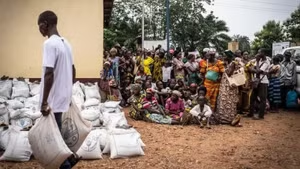
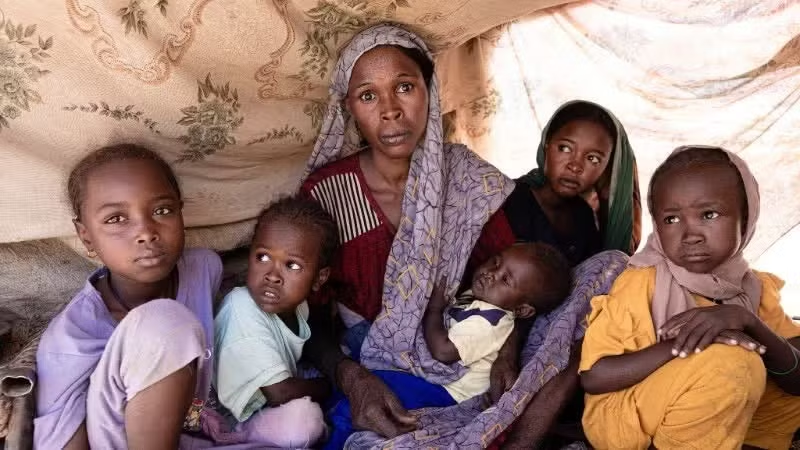
According to the United Nations, approximately 300 million Africans face food insecurity due to conflict and climate change. Hunger levels in countries such as Burundi, Somalia and South Sudan are at alarming levels, posing major obstacles to inclusive and sustainable development.
These entrenched issues continue to hinder progress. Although Africa holds a significant demographic advantage, with over 70% of its population under 30, it remains disadvantaged in global labour markets and education systems due to high unemployment and a workforce that does not yet meet development demands.
UNESCO reports that sub-Saharan Africa has the highest illiteracy rates worldwide, with many young people lacking access to basic education and essential skills.
While its young population remains Africa’s greatest asset, this advantage can only be realised through sustained investment in education and employment. Otherwise, cycles of poverty and lack of education risk becoming major barriers to development.
According to analysts, Africa’s progress towards achieving the SDGs has been hindered by the cumulative impact of ongoing crises in recent years. Among these, security instability remains the foremost challenge. Many countries in the region have been caught in persistent cycles of conflict with no clear resolution, resulting in serious consequences for economic development, social stability and the well-being of their populations.
In addition, financial constraints present a major obstacle. Public debt has long weighed heavily on growth, with high borrowing costs limiting investment in critical sectors such as healthcare, education and infrastructure.
The United Nations estimates that developing countries require around 4 trillion USD annually to meet the SDGs by 2030. For many African nations burdened by heavy debt, this target may remain out of reach.
Despite facing numerous challenges, Africa possesses significant advantages that could be leveraged to turn the current situation around. These include favourable conditions for developing renewable energy, an abundant labour force, vast land resources and rich natural endowments, particularly strategic minerals essential for the energy transition and high-tech industries.
Selma Malika Haddadi, Vice-President of the African Union Commission, emphasised that to fully harness these advantages and achieve a breakthrough in advancing the Sustainable Development Goals, Africa needs to adopt coherent policies across the region and step up investment in key sectors such as clean water, energy, infrastructure and industry.
With less than five years remaining to meet the SDGs, this is a critical moment for Africa and the international community to accelerate efforts, turn commitments into concrete action and work together towards building a sustainable future for present and future generations.