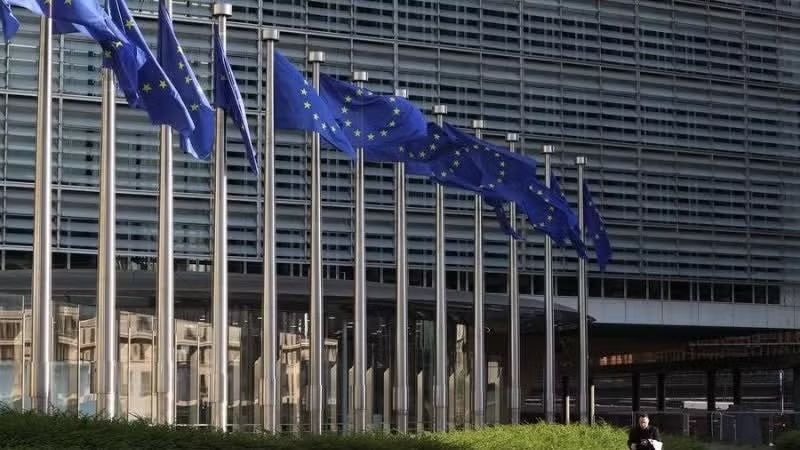
The EU is facing a difficult task: simultaneously trying to ease tensions with the US — an ally that provides essential guarantees for the continent's security environment — and demonstrating its ability to be self-reliant in defence.
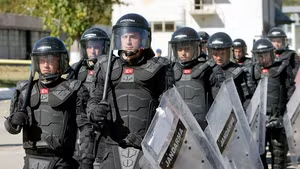
The strained relationship between the US and European NATO countries over the past few months has escalated to a new level of tension following Washington’s decisive move to withdraw troops from Europe. The US reduced its combat brigades deployed in Europe from four to three, bringing the size of its military presence in the region back to 2021 levels.
Previously, the administration of US President Donald Trump announced the withdrawal of at least 5,000 troops from Germany and left open the possibility of reducing forces in Italy and Spain. These steps clearly reflect a strategic shift in the US’ relationship with Europe, where self-interest and strategic calculations increasingly overshadow long-term commitments.
Not simply a technical adjustment of US priorities, Washington’s troop withdrawal is seen by analysts as a measure to pressure NATO partners to adjust their positions on many issues, especially regarding the conflict in the Middle East. The cautious attitude of NATO countries towards the conflict in the Middle East — a war with many repercussions for Europe, from security instability to energy supply disruptions — is completely contrary to US wishes.
NATO is also facing new challenges as the US shifts its strategic priorities. With the US deploying a large-scale military operation in Iran, NATO feared that sophisticated military equipment, a core component of the alliance’s deterrence capabilities, will not be replenished in a timely manner to keep pace with the US military’s consumption of its reserves. This was also discussed at the recent NATO foreign ministers’ meeting in Sweden.
NATO Secretary General Mark Rutte stated that the issue is not whether NATO needs to increase arms production, but rather the speed at which member states translate political commitments into actual military capabilities. NATO remains heavily reliant on US weapons to support Ukraine.
To de-escalate the situation, several European allies have deployed warships to the Strait of Hormuz to participate in maritime security operations. Some observers believe that President Donald Trump is increasingly frustrated with the progress of negotiations with Iran, and that the American leader is shifting from prioritising diplomacy to the possibility of ordering an attack.
A rare bright spot in relations between the US and European countries is President Trump’s recent announcement that Washington will deploy an additional 5,000 troops to Poland, a country playing a crucial logistical role in supporting Ukraine. The frequent changes in US decisions have made many countries cautious, and this new development also reflects the ambiguity and uncertainty surrounding the Trump administration's approach to NATO.
At the recent NATO summit, Swedish Foreign Minister Maria Malmer Stenergard stated that it is not always easy to grasp Washington’s message and that Europe’s top priority is to continue investing in its defence and capabilities.
The 2026 NATO summit, to be held in Türkiye this July, is considered by the US to be one of the most important summits in NATO’s history. The US’ troop adjustments have raised concerns about the future security of the military alliance.
European allies are also grappling with the dilemma of maintaining relationships with their key security partner while enhancing their autonomy as NATO’s security structure enters a period of profound adjustment.