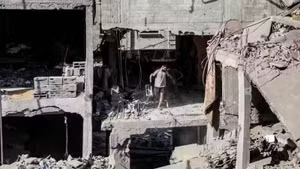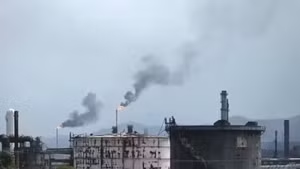
The Middle East has recently witnessed the worst escalation in tensions between Israel and Iran since the ceasefire agreement took effect in April. The Israel Defence Forces (IDF) carried out air strikes against multiple military targets in western and central Iran. In response, Iran’s Islamic Revolutionary Guard Corps (IRGC) targeted key Israeli air bases.
Although both Israel and Iran subsequently announced a halt to attacks, the conditions set by each side make it difficult to implement their commitments. Iran stated that it would cease offensive operations against Israel only if Israel halted military actions against Iran and in southern Lebanon, while sources in Israel said the country's military would concentrate its full force on operations in southern Lebanon in the coming days.
The US has sought to distance itself from Israeli military operations against Iran while declaring diplomacy its preferred approach. However, in reality, tensions between the US and Iran continue. Iran accused the US of violating the ceasefire agreement and condemned the US strike on coastal radar facilities in the Persian Gulf region as an infringement of Iran’s sovereignty and territorial integrity. Tehran called on countries in the region not to provide territory or infrastructure for US actions against Iran and urged the United Nations and international organisations to take timely measures to prevent further escalation.
Retaliatory moves by both the US and Iran in their struggle for control of the Strait of Hormuz remain a major threat to commercial shipping through this strategic maritime route.
Significant differences persist between the US and Iran on a range of issues, particularly US sanctions against Iran, further complicating negotiations. Iran is pressing for the release of more than 100 billion USD in frozen overseas assets and has insisted that this is a prerequisite for any agreement with the US. The US, meanwhile, maintains that it will neither release frozen assets nor lift sanctions before a peace agreement is reached.
In addition, the US continues to pursue its maximum-pressure strategy against Iran by expanding the “Economic Fury” campaign with new sanctions targeting networks involved in the trade of liquefied petroleum gas (LPG) and underground financial channels allegedly used to help Iran circumvent sanctions. The new measures target numerous individuals, companies, and vessels linked to LPG exports worth hundreds of millions of USD.
Washington has accused the network of disguising Iranian LPG as goods originating from Oman before shipping them to markets in South Asia and East Asia. The sanctions are intended to cut off Iran’s energy revenues, disrupt covert shipping networks, and restrict Tehran’s access to the global financial system.
The US Treasury Department argues that Iran’s financial system relies heavily on brokerage firms and intermediary businesses operating through offshore shell-company networks to conceal international transactions and maintain access to foreign currency sources.
Although the US, Israel, and Iran all claim to prioritise diplomacy as a means of ending the conflict, the reality is that the parties continue to use fire power to exert pressure on one another, allowing confrontation to overshadow dialogue. Military actions by the US and Israel, coupled with tighter economic sanctions, have prompted firm responses from Iran, creating major obstacles to efforts to find a peaceful solution for the Middle East.