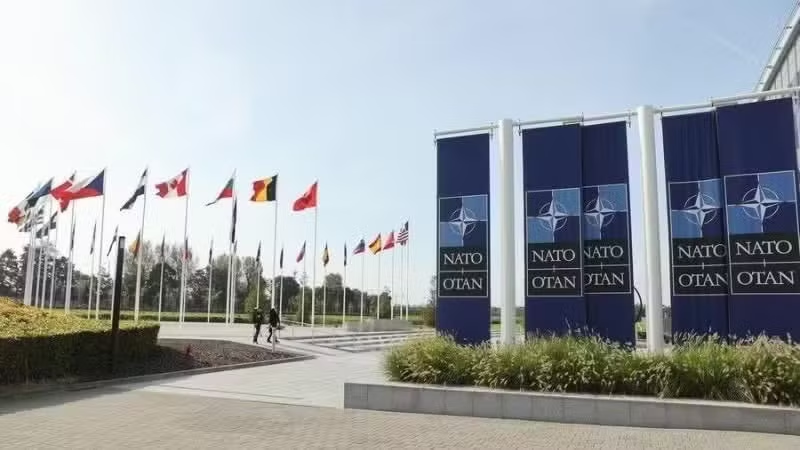
The "NATO 3.0" model that the military alliance is pursuing marks a new stage in its development. However, it is also a demanding test of Europe's capacity for strategic autonomy as its transatlantic ally, the US, realigns its strategic priorities.
In recent years, the US has repeatedly articulated the vision of a "NATO 3.0", seeking to reshape the military alliance through a far-reaching restructuring. Under this model, pragmatic calculations of strategic interest would gradually supersede traditional security commitments.
Specifically, the model envisions a Europe capable of achieving greater self-reliance in security matters, transitioning from a dependant posture to one of shared responsibility with the US within NATO.
US President Donald Trump has consistently asserted that European allies have benefited significantly from Washington's "security umbrella" but have failed to shoulder financial and military burdens proportionally.
Aware of the risks of security dependence, European allies have also agreed to shoulder a greater share of responsibility within NATO. NATO Secretary General Mark Rutte voiced optimism regarding the new model, envisioning "a stronger Europe in a stronger NATO."
At present, Washington is realigning its strategic priorities to the Indo-Pacific region and scaling back its footprint in Europe, as evidenced by the gradual withdrawal of troops from the continent.
The NATO Summit held in Türkiye in early July 2026 was widely viewed as a new milestone in NATO's adaptation to a rapidly changing security environment.
Recently, Polish and German troops agreed to strengthen coordination within the framework of the Eastern Shield programme, aimed at reinforcing NATO's eastern flank.
The military alliance also endorsed an investment plan valued at approximately 27 billion EUR to modernise its military fuel transport and storage systems.
According to NATO, defence spending by European members and Canada has expanded substantially, projected to rise by 11% in 2026 compared to 2025.
However, higher defence spending does not imply that Europe can rapidly bridge existing gaps or supplant the role of the US within NATO.
According to the website europeanrelations.com, Europe still lacks several vital operational capabilities, including intelligence, surveillance, reconnaissance, and space-based data collection.
The website also highlights statistics revealing that, as of 2023, the US alone operated 246 military satellites, while the combined number of military satellites owned by all European NATO members amounted to merely one-fifth of that figure.
Increasing defence expenditure also confronts Europe with difficult decision, compelling it to divert resources from the economic and social welfare sectors.
Spain has rejected NATO's proposal to increase defence spending to 5% of GDP, arguing that enforcing a uniform target of 5% of GDP is incompatible with maintaining the country's social welfare system and ensuring sustainable public finances.
Instead, Madrid contends that NATO should bolster its security capabilities while maintaining a balance with economic priorities and social welfare.
The challenges are intensifying as the security environment in Europe and across the world grows increasingly complex. NATO currently confronts the imminent risk of strategic overstretch as it is compelled to respond to multiple hotspots simultaneously.
In particular, significant disagreements remain among related states over the resistance war in Ukraine, a conflict that is closely linked to and has direct implications for European security. Slovakia and Czech have previously declined to provide financial assistance aimed at bolstering Ukraine's military capabilities.
Growing strains in transatlantic relations, coupled with pressure from Washington, have rendered greater defence and security autonomy both a strategic objective and an imperative task for Europe.
To achieve this goal, simply making budgetary commitments is insufficient. Reducing dependence on the US requires resolute political will and consensus on common European security issues, thereby ensuring a more equitable distribution of strategic autonomy among member states.