This development is not only deepening disagreements between allies on both sides of the Atlantic, but it is also putting NATO to a crucial test of its ability to preserve unity and reconcile interests at a time of increasingly intense strategic competition.
Tensions within NATO have continued to escalate after the US Treasury recently warned EU member states against retaliatory tariffs, following Washington’s threat to impose duties on countries that do not support its plan to gain control of Greenland, the vast Arctic island belonging to Denmark.
The US Treasury Secretary also stressed that any EU retaliation would be an unwise move. Earlier, US President Donald Trump warned of progressively higher tariffs on goods from European allies until the US is allowed to “buy back” Greenland.
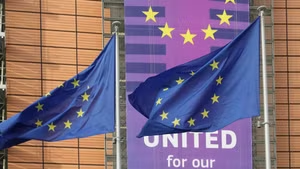
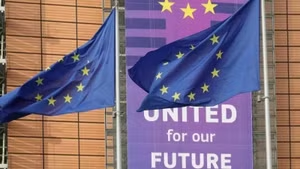
The US statement came as German and French finance ministers, on January 19, affirmed that European countries would not yield and would respond clearly and in a unified manner to US threats to escalate tariffs in order to exert pressure over Greenland.
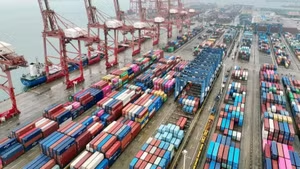
One option under consideration is a 93-billion-euro tariff package on US goods. The EU has also signalled that it is ready to respond by weighing the activation of its “anti-coercion instrument” — a mechanism never before used — which could restrict a partner’s access to public procurement, investment, banking activities, or trade and services, areas where the US runs a surplus with the EU.
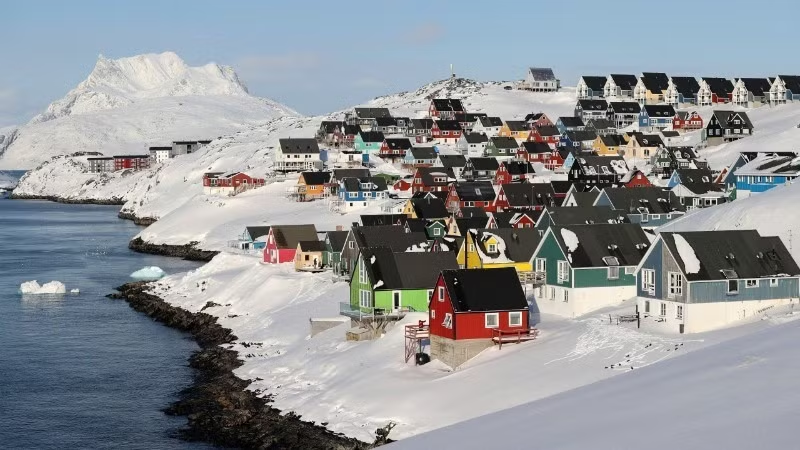
Greenland, a self-governing territory of Denmark — a NATO member — is more than just a vast expanse of the Arctic. This “icy jewel” is increasingly viewed as strategically significant amid intensifying geopolitical competition in the region.
Situated as a “strategic key” between North America and Europe, Greenland plays an important role in early-warning systems, missile defence, and the monitoring of major new sea routes emerging as ice melts.
For these reasons, Washington’s overt desire to increase its control over Greenland — whether through purchase or annexation — has triggered divergent reactions within NATO.
For Denmark and EU countries, the issue is not only about strategic interests, but it is also related to principles of respect for sovereignty, territorial integrity, and consensus among transatlantic allies.
Even as European countries have voiced support for Denmark, the US growing determination to obtain Greenland has pushed the world’s largest military alliance into an unusually sensitive predicament.
Divisions within the alliance are deepening as Washington and EU capitals continue to spar — each warning of tariff countermeasures — prompting a wider debate about how NATO’s security cooperation intersects with its members’ economic relations.
Over more than 70 years of existence and development, NATO has been built on the foundation of collective security, while trade disputes among members have generally been handled through separate mechanisms.
This time, however, the resort to tough economic measures to assert political and security positions has fuelled growing anxiety within NATO itself.
For EU countries, pressure from Washington is forcing the bloc to weigh carefully the balance between economic interests, alliance obligations, and the need to uphold an independent policy stance within the framework of international law.
The declaration of readiness to defend itself against pressure from Washington, therefore, is not merely an immediate response; it also clearly reflects a growing emphasis on strategic autonomy, while asserting Europe’s voice and responsibility in the alliance’s collective decision-making.
With Greenland’s future still a major question mark, NATO faces an important test: can the alliance show the mettle to preserve harmony and manage differences arising from within?
As challenges both internal and external persist — prolonged conflicts, great-power rivalry, and pressure on defence budgets — any sign of internal division could weaken the bloc’s overall capability.
How NATO handles the Greenland issue will not only shape US–Denmark relations, but it will also send a broader message about the role, resilience, and future of the transatlantic military alliance itself.