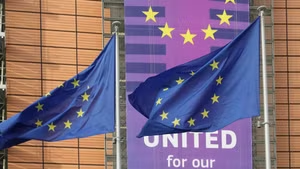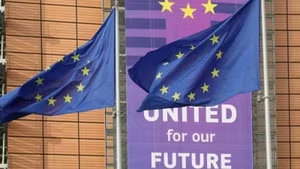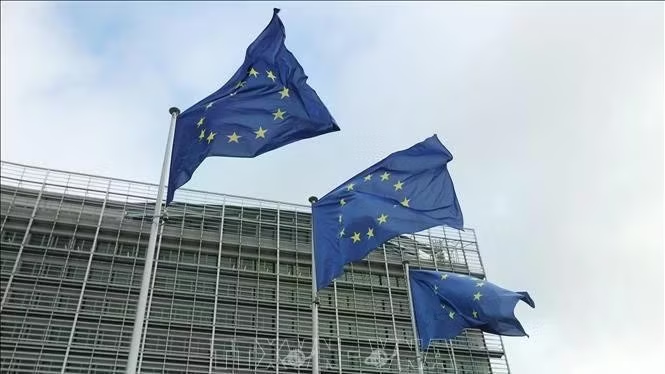
The leaders of the 27 EU member states endorsed the economic restructuring plan with a strict timetable, identifying 2026 as the moment to shift decisively into substantive implementation, placing competitiveness at the heart of policymaking. The programme represents a determined course of action designed to dismantle barriers and transform the EU into what has been described as “an economic giant”.
An informal EU summit held at Alden Biesen Castle in Belgium’s Limburg province focused on assessing the current economic landscape and setting strategic priorities, while charting a roadmap to drive growth, create high-quality jobs, and ensure affordable living costs for citizens amid intensifying global competition.
President of the European Commission Ursula von der Leyen stressed that the pressure and the sense of urgency are enormous — that in itself can help us turn the tide.
Meanwhile, President of the European Council Antonio Costa said discussions at Alden Biesen had generated renewed momentum and a clear consensus on the urgency of enhancing competitiveness.
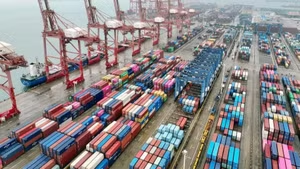
Reviving the EU economy has become more pressing than ever in the wake of recent geopolitical shocks, including the significant impact of US tariff policies on global trade.
The restructuring plan centres on upgrading and coordinating an integrated energy network, deepening financial integration, and relaxing merger rules to allow European companies to scale up and compete more effectively.
One of the most widely supported priorities is the continuation of an ambitious agenda to simplify administrative procedures. This is regarded as essential to creating a more favourable environment for production, business, and investment, thereby boosting productivity and competitiveness while reducing administrative burdens on investors.
EU leaders also agreed to move from what remains a fragmented single market towards “a unified market for a united Europe”, identifying this as an urgent task to be completed during the 2026–2027 period.
With the current system still highly fragmented and European firms facing greater difficulty in accessing capital to expand compared with their US counterparts, leaders underscored the need to unlock financing for businesses as early as this year.
The EU is grappling with a shortage of capital, while competitiveness cannot be improved without additional investment. To address this, the President of the European Commission proposed that if all 27 member states cannot reach a common agreement, the bloc should consider enhanced cooperation mechanisms among groups of like-minded countries.
Regarding market structure, EU leaders concurred that in certain sectors — particularly telecommunications — a degree of consolidation should be permitted to achieve the necessary scale for investment and innovation. Such consolidation would be tied to commitments on investment and innovation, safeguarding the broader interests of consumers and the economy.
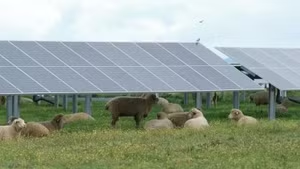
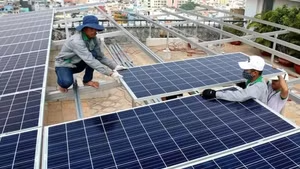
Energy transition has been identified as the most effective long-term strategy for achieving greater autonomy and reducing costs.
To bolster energy security, promote renewable energy integration, and enhance the EU’s competitiveness amid volatility in global energy markets, the European Commission has allocated nearly 650 million EUR in grants from the Connecting Europe Facility to support 14 cross-border energy infrastructure projects. The selected projects are considered pivotal to completing the EU’s single energy market.
In strategic industries, EU leaders reached a consensus on the importance of strengthening defence, space, clean technology, quantum computing, artificial intelligence, and payment systems.
The bloc will review areas of dependency and pursue diversification strategies, while applying targeted “European preference” mechanisms in strategic sectors.
The Alden Biesen meeting has laid the groundwork for EU leaders to agree on concrete actions at the forthcoming European Council summit scheduled for March.
The outcomes of the discussions at Alden Biesen will be translated into specific commitments and implementation roadmaps. All efforts are aimed at reinforcing internal cohesion within the EU, promoting economic growth, and enhancing the autonomy and competitiveness of the European economy.