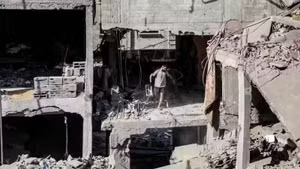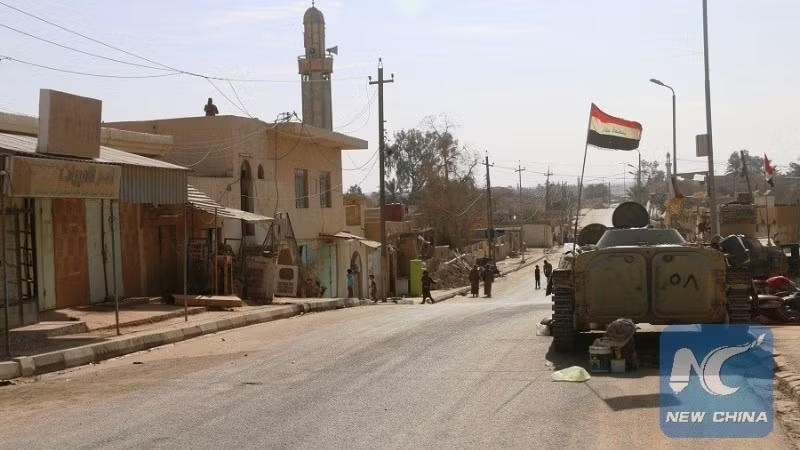
Although the fight against IS has passed its most brutal peak, the “shadow” of terrorism still looms, posing a security threat to Iraq, Syria, and the wider region.
The US-led international coalition has been present in Iraq since 2014 to help roll back IS after the group seized large areas in the region. Although Iraq declared victory over IS in 2017, remnants of the terrorist organisation have continued to hide in desert areas and remote regions, forcing the Iraqi military to carry out sustained sweep operations. According to the International Centre for Counter-Terrorism, IS’s on-the-ground presence in Iraq and Syria in 2025 fell sharply after 21 years of activity.
At its peak, IS reportedly had around 80,000 fighters, including more than 42,000 foreign terrorists from over 120 countries. By mid-2025, the number had dropped to an estimated 1,500–3,000 fighters operating in Syria and Iraq. Even so, the threat has not ended, as the group’s networks and extremist ideology continue to exist in many parts of the world. In Syria, following the collapse of former President Bashar al-Assad’s Government at the end of 2024, political and security instability has created conditions for IS to attempt a resurgence, becoming a major challenge to regional security.
Recently, the US has stepped up anti-IS operations in Syria, launching large-scale strikes aimed at eliminating remaining terrorist elements. The US Central Command (CENTCOM) has carried out an air strike in north-western Syria, killing Bilal Hasan al-Jasim, described as a “notorious terrorist leader”. The strike was intended to fulfil US President Donald Trump’s commitment and deliver a heavy punitive blow to insurgent groups behind an attack last December in Syria’s Palmyra City that killed two US soldiers and a civilian interpreter.
According to CENTCOM, the individual killed was a key planner behind a number of attacks and had direct links to IS gunmen responsible for a deadly assault on US troops. Since the ambush on December 13, 2025, the US military has carried out a series of large-scale air operations across Syria, striking more than 100 IS infrastructure and weapons-storage targets. Over the past year, the US military and partner forces have detained more than 300 suspects and killed more than 20 IS fighters in Syria.
However, rapid developments in Syria in recent times — particularly interim Syrian President Ahmed al-Sharaa pushing to reassert control over the north-east, an area previously under the control of the US-backed Syrian Democratic Forces (SDF) — have prompted the Pentagon to adjust its counter-terrorism posture. The Syrian Government’s recapture of several areas in the north-east from the SDF has led the White House to consider withdrawing all US forces from Syria. The Pentagon has also begun a process to transfer up to 7,000 IS detainees from north-eastern Syria to security detention facilities in Iraq.
The Iraqi Government, however, is concerned that a US withdrawal from Syria would leave a security vacuum and increase the risk of IS elements infiltrating Iraq from across the border. Iraqi security forces are maintaining a high operational tempo to safeguard domestic security while addressing concerns from the other side of the border. The Iraqi military has stressed that the country’s security is a “red line”, and Baghdad will not allow remaining IS elements in Syria to create instability.
IS has been weakened in both Syria and Iraq, but its “tentacles” remain present in many places. Although Iraq–US relations have shifted from counter-terrorism operations towards activating memoranda of understanding on military cooperation, in practice neither the US nor Iraq can afford to rest easy, as IS remnants remain a latent threat to regional and global security.